


Stay Ahead With Linux Security HOWTOs
How to Secure My Network network security Linux administration
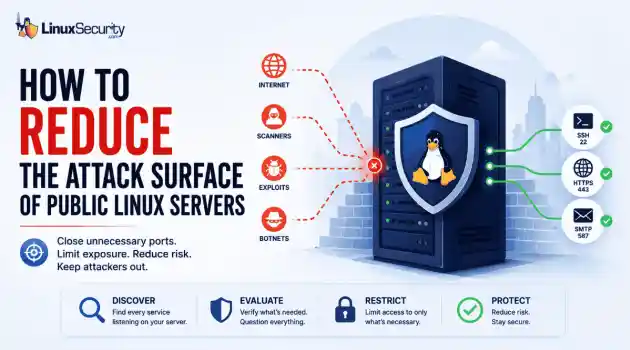
network security Linux administration Open ports have a way of accumulating over time. A test environment gets deployed and never removed. An administrative interface is exposed for troubleshooting and left in place. A database that was supposed to listen internally ends up reachable from the internet. . Attackers look for these mistakes constantly. Redis, Elasticsearch, MongoDB, Jenkins, and similar services still show up on internet-facing systems where they were never meant to be exposed. Sometimes it's a temporary change that...
 Jun 10, 2026
How to Secure My Networksecurity advisory intrusion detection
security advisory intrusion detection A compromised Linux server can continue running malware long after the initial intrusion. One of the most common persistence techniques is a malicious cron job that silently downloads payloads, restarts malware, or re-establishes attacker access every few minutes. This guide shows how to identify suspicious cron entries, preserve forensic evidence, remove unauthorized scheduled tasks, and verify that no additional persistence mechanisms remain. . What Should You Save Before Removing Cron Jobs...
Jun 09, 2026 
How to Secure My Networkaccess control Linux administration
access control Linux administration Most SSH hardening advice ends at the same recommendation: Disable password authentication and use SSH keys. . That's good advice. It removes entire classes of attacks, including password spraying, credential stuffing, and brute-force attempts against exposed servers. The problem is what happens next. Many administrators treat SSH keys as the finish line when they are really the beginning of the hardening process. Attackers rarely care whether they obtained access with a password or a private...
Jun 05, 2026 
How to Secure My Networksecurity advisory remote access
security advisory remote access Most of the time, nobody notices. SSH authentication succeeds, no alerts are generated, and the connection looks exactly the way it did the day the key was installed. That's part of the problem. . When security teams investigate unauthorized access on Linux systems, they often focus on passwords, exposed services, or vulnerable software. Trusted access receives less attention. Yet a single forgotten or unauthorized SSH key can provide the same access as a legitimate user while attracting very...
Jun 03, 2026 
How to Secure My Networkintrusion detection application security
intrusion detection application security The wrong IPS rule can look like a security fix right up until it becomes an outage. . On Linux systems, detection and prevention are often discussed together, but they do not carry the same operational risk. One tells admins that something suspicious happened. The other can decide whether traffic is allowed to continue. That is why IDS vs IPS is not just a definition to memorize. It is a deployment decision about where to monitor, where to block, and how much confidence a team needs before...
Jun 01, 2026  Refine HOWTOs
X Clear Filters Get the latest News and Insights
Get the latest Linux and open source security news straight to your inbox.
Community Poll
What got you started with Linux?
Loading...
Explore Latest Linux Security HOWTOs
We found 820 articles for you...
167
 unauthorized accesssecurity techniquesSSH
How To Understand Failed Authentication Patterns in Linux Logs
Exposed SSH servers are continuously hammered by brute-force attacks, password spraying, credential stuffing, and recycled passwords from infostealer dumps. Attackers rotate usernames, test weak credentials, and probe for anything that gives them initial access. The logs usually look messy long before the compromise happens. . The difficult part is separating harmless failures from actual intrusion activity. One failed login from an internal workstation rarely matters. Repeated failures against privileged accounts from cloud VPS ranges usually do. Especially when sudo activity or successful authentication starts appearing afterward. This guide walks through how failed authentication activity appears in Linux SSH and PAM logs, how brute-force attacks differ from password-spraying operations, and how administrators surface suspicious login patterns before attackers establish persistence or reach root access. Raw auth logs get noisy fast. Understand Where Linux Authentication Logs Are Stored Linux distributions store authentication events in different locations depending on the platform. Debian and Ubuntu systems typically write authentication logs to: /var/log/auth.log RHEL, CentOS, AlmaLinux, and Rocky Linux systems usually use: /var/log/secure Modern Linux systems running systemd may also expose authentication activity directly through the system journal: journalctl -u ssh Authentication logs usually contain entries generated by both the SSH daemon ( sshd ) and PAM, which stands for Pluggable Authentication Modules. They appear together because SSH relies on PAM during the authentication process itself. SSH handles the network connection. PAM handles authentication checks, account validation, session management, and policy enforcement. That’s why one SSH login attempt can generate multiple related log entries within seconds. New administrators often think the logs are duplicated at first. They aren’t. Authentication logs generally contain four types of events: Failed login attempts Successful logins Session openings and closures Privilege escalation activity through sudo or su One of the most common ways administrators monitor authentication activity is by tailing logs in real time. sudo tail -f /var/log/auth.log Or on RHEL-based systems: sudo tail -f /var/log/secure “Tailing” logs simply means watching new log entries appear live as the file updates. Authentication events are chronological, so the newest events appear at the bottom. This helps administrators observe SSH activity while reproducing login attempts or investigating suspicious behavior. You can also review SSH-specific events through the journal: journalctl -u ssh That becomes useful on systems where older logs rotate quickly or where journald stores events centrally instead of relying entirely on flat files. Learn What Normal Failed Login Activity Looks Like Most failed authentication events are harmless. Linux systems generate routine login failures constantly during normal operations. Users mistype passwords. Somebody tries the wrong SSH username. A scheduled task continues using an old password after credentials change. Service accounts fail periodically when applications restart with outdated secrets. It happens everywhere. A normal failed SSH login often looks like this: Failed password for john from 192.168.1.25 port 51122 ssh2 You’ll usually see a related PAM entry nearby: pam_unix(sshd:auth): authentication failure; user=john These entries typically belong to the same authentication attempt. SSH records the failed password event while PAM records the internal authentication failure generated during credential validation. A single failed password attempt is common and usually harmless. Administrators should focus more on frequency, repetition, timing, and source behavior instead of isolated events. One failed login from an internal workstation rarely matters. Repeated failures against multiple accounts fromunfamiliar external IP addresses matter a lot more. Authentication logs also help administrators monitor long-term patterns. Repeated failures tied to the same system, user account, or subnet often reveal configuration problems before they become security issues. Sometimes broken automation looks almost identical to credential abuse at first glance. How to Detect Brute Force Attempts in SSH Logs Brute force attacks are usually easy to recognize once the pattern becomes repetitive. Attackers repeatedly attempt passwords against the same account until something works or the target blocks further access. Internet-facing Linux servers see this constantly. Especially SSH services exposed directly to the public internet. Administrative accounts like root get targeted heavily because attackers already know the username exists on many Linux systems. They only need to guess the password. Brute force activity often looks like this: Failed password for root from 185.220.101.4 port 55872 ssh2 Failed password for root from 185.220.101.4 port 55881 ssh2 Failed password for root from 185.220.101.4 port 55903 ssh2 The source IP remains consistent while the connection port changes with each new SSH attempt. That’s normal behavior because every SSH connection opens a separate session. Administrators usually start by searching for failed password events directly: grep "Failed password" /var/log/auth.log To focus specifically on root targeting: grep "Failed password for root" /var/log/auth.log This becomes more useful when combined with IP aggregation: awk '/Failed password/ {print $(NF-3)}' /var/log/auth.log | sort | uniq -c That command extracts source IP addresses from failed authentication entries, sorts them, and counts how often each address appears. Repeated login attempts from the same external IP usually stand out quickly. What matters operationally is repetition. One failed SSH login is normal. Hundreds of failures targeting the same administrativeaccount from the same host usually indicate automation. The MITRE ATT&CK framework tracks brute force authentication abuse under T1110 Brute Force . MITRE documents how attackers automate password guessing against exposed services, administrative accounts, and remote access infrastructure. The behavior described there closely matches what administrators see inside Linux authentication logs during active SSH attacks. Attackers automate these attempts because eventually, weak passwords work. Especially on systems that were not hardened properly after deployment. How to Identify Password Spraying in Linux Authentication Logs Password spraying looks different from traditional brute force activity. Instead of attacking one account repeatedly with many passwords, attackers try a small number of passwords across many usernames. Slower. Quieter too. The goal is to avoid account lockouts while testing reused credentials at scale. Many lockout policies trigger after repeated failures against a single account. Password spraying sidesteps that problem by rotating usernames instead. A spraying attempt may look like this: Failed password for admin from 203.0.113.44 Failed password for backup from 203.0.113.44 Failed password for finance from 203.0.113.44 One source IP rotates through multiple usernames carefully over time. Attackers often target predictable accounts first: admin backup finance support deploy test Administrators can start reviewing spraying behavior with simple searches: grep "Failed password" /var/log/auth.log | awk '{print $11}' Or broader sorting: grep "Failed password" /var/log/auth.log | sort Timestamps matter heavily during spraying investigations. Attackers intentionally spread attempts across longer periods to remain below alert thresholds and avoid triggering lockout policies. Ten failures over an hour often attract less attention than ten failures in thirty seconds, even though the intent is the same. This is why authentication logs should always be reviewed as sequences instead of isolated events. Password spraying tends to look subtle until someone lines up the timestamps properly. How to Investigate Stolen Credential Abuse Failed authentication attempts become much more serious once attackers successfully log in. At that point, the investigation shifts from attempted access to potential compromise. A successful SSH login following repeated failures deserves immediate review. Example: Accepted password for backupadmin from 203.0.113.44 port 60211 ssh2 Then shortly afterward: sudo: session opened for user root That sequence matters because attackers frequently escalate privileges immediately after gaining initial access. Especially if compromised accounts already have sudo access or weak privilege restrictions. Administrators investigating suspicious authentication activity usually begin with successful login searches: grep "Accepted password" /var/log/auth.log Then review privilege escalation events: grep "session opened" /var/log/auth.log A practical investigation workflow usually looks like this: Review failed logins leading up to successful authentication Identify the originating IP address Compare timestamps between failures and successful access Review sudo activity and privilege escalation Determine whether the behavior matches normal operational patterns Suspicious login timing often becomes a strong indicator. Administrative accounts authenticating at unusual hours from unfamiliar IP addresses deserve attention, even if the credentials themselves were valid. Research from Elastic Security Labs and Splunk Security Research consistently emphasizes correlating failed and successful authentication activity together instead of reviewing them independently. Rapid privilege escalation, abnormal login velocity, and suspicious authentication sequencing frequently appear during SSH compromise investigations. This iswhere authentication logs stop being troubleshooting data and start becoming incident response evidence. Understand PAM Authentication Failure Messages PAM messages confuse many administrators because the entries look verbose and disconnected from normal SSH logging. They actually provide useful context once you understand how PAM works during authentication. PAM, or Pluggable Authentication Modules, handles authentication processing for many Linux services, including SSH. During login attempts, PAM modules validate credentials, apply account restrictions, enforce authentication policies, and create sessions. That’s why PAM entries appear beside SSH daemon logs constantly. A typical PAM authentication failure looks like this: pam_unix(sshd:auth): authentication failure; logname= uid=0 euid=0 tty=ssh A successful session creation may appear like this: pam_unix(sshd:session): session opened for user john Administrators commonly search PAM-specific activity using: grep "pam_unix" /var/log/auth.log Or through the system journal: journalctl | grep pam PAM logs supplement SSH logs by showing different stages of authentication processing. One SSH login attempt may generate multiple PAM events, including: authentication failure user validation session opened session closed This is normal behavior. PAM modules log actions separately as the authentication process moves through different stages internally. Beginners often assume multiple PAM entries indicate multiple login attempts. Usually, they belong to the same session sequence instead. The Red Hat PAM documentation explains how PAM modules generate authentication and session events during login processing. Understanding those stages helps administrators interpret Linux authentication logs more accurately during both troubleshooting and security investigations. PAM fills gaps that SSH logging alone doesn’t always explain clearly. How to Respond to Suspicious Authentication Activity Once suspicious authentication behavior appears, response speed matters. Attackers rarely stop after gaining initial access. Start by identifying exposed or compromised accounts. Disable accounts showing suspicious activity until the investigation finishes. sudo passwd -l username Review whether Fail2Ban or equivalent rate-limiting protections are active: sudo systemctl status fail2ban Then inspect the SSH daemon configuration d irectly: sudo nano /etc/ssh/sshd_config Several SSH settings reduce exposure significantly: PermitRootLogin no PasswordAuthentication no Disabling password authentication forces SSH key usage instead of credential-based logins. Restricting direct root login removes one of the most heavily targeted accounts from external authentication attempts entirely. Administrators should also review: sudo rules firewall restrictions privileged accounts dormant users MFA coverage SSH key management IP-based access restrictions help reduce the attack surface further on systems that only require administrative access from trusted locations. Continuous log monitoring matters too. Authentication abuse usually escalates gradually. Attackers test footholds quietly first, then move toward privilege escalation once they understand the environment. Most compromises leave warning signs in the logs long before defenders notice the breach itself. Conclusion Failed authentication attempts happen on every Linux system. Most is harmless operational noise. The patterns behind those failures often reveal much more. Brute-force attacks, password-spraying campaigns, and stolen-credential abuse all leave traces in SSH and PAM logs before attackers establish persistence or gain root access. Administrators who understand those patterns can investigate suspicious activity more quickly and reduce the chances of unauthorized access going unnoticed. Authentication logs become far more useful once you stop reading individual entries andstart tracking behavior over time. Repetition matters. Timing matters. Successful logins after repeated failures matter even more. Linux logs look chaotic initially. Eventually, the attack patterns start standing out on their own. Want more Linux security guidance, threat analysis, and hardening tutorials delivered directly to your inbox? Subscribe to the LinuxSecurity.com newsletter for practical updates, emerging threat coverage, and operational Linux administration tips. Related Reading Fail2ban Linux Security Brute Force Protection and Monitoring PAM: Important Risks in Linux Authentication Trust Chain Essential Log Management Tools for Effective Linux Security Detecting Lateral Movement on Linux Systems Without EDR Securing Remote Access to Linux Servers: Best Practices for 2026 . Learn to identify and respond to failed authentication patterns in Linux logs to enhance your security posture effectively.. Linux Security, Authentication Logs, Access Monitoring. . MaK Ulac
 May 28, 2026 •
 How to Secure My Network
 167
 security advisoryincident responsemalware detection
How to Respond After Detecting a Compromised Linux Server
The first 30 minutes after discovering a compromised Linux server usually decide how much evidence remains available. One rushed reboot or cleanup attempt can wipe logs, terminate malicious processes, or remove network activity that investigators still need to review. Attackers also do not usually stay on one system for long once access is established. Early response is mostly about preserving visibility. Collect process information. Save network connections. Limit access carefully before making major changes to the system. . Step 1: Verify the Server Is Actually Compromised Start by confirming the server is actually compromised. Broken applications, failed deployments, and unstable services can create symptoms that look malicious at first. Early triage is mostly about identifying unauthorized access, suspicious processes, and unexpected network activity before making changes to the system. who w last -a Look closely at: Unknown usernames Source IP addresses you do not recognize Logins at unusual hours Simultaneous sessions from different locations Sessions that remain active longer than expected An SSH login from another country at 3 AM does not automatically confirm compromise, but it should immediately raise questions. The same goes for service accounts logging in interactively when they normally do not. Once login activity looks suspicious, move directly into process inspection. Attackers often leave behind running malware, reverse shells, persistence scripts, or crypto miners. ps auxf top pstree -p This stage is less about memorizing process names and more about spotting behavior that feels wrong for the system. Things worth investigating include: Suspicious Behavior Why It Matters Processes running from /tmp Malware often hides in temporary directories Randomized process names Attackers rename malware to avoid detection Unexpected parent-child relationships A web server spawning shells is a bad sign High CPU usage with no explanation Common with crypto mining malware Shells started by application users May indicate command execution abuse A compromised web server spawning /bin/bash underneath an Apache or Nginx process deserves immediate attention. After checking processes, inspect network activity. A server talking to unfamiliar systems or listening on unexpected ports may already be under remote control . ss -plant lsof -i -P -n Pay attention to: Unknown listening ports Outbound connections to unfamiliar IPs Established sessions with cloud VPS providers Reverse shell behavior Services binding to unusual interfaces A reverse shell often appears as a process maintaining an outbound connection to a remote host over a strange high-numbered port. If the server normally only handles web traffic but suddenly maintains persistent outbound sessions to external infrastructure, that is not normal operational behavior. Step 2: Do Not Reboot the Server Yet In most cases, rebooting a compromised Linux server too early destroys valuable evidence . Memory-resident malware disappears. Active network connections vanish. Temporary files get deleted. Shell history stored only in memory may never be recoverable again. A reboot can also terminate the exact malicious process you were trying to investigate. That sounds helpful until you realize it removes the ability to understand what the attacker was doing, how they got in, and whether they still have access somewhere else. The following artifacts may disappear after a reboot: RAM-based malware Active reverse shells Running attacker processes Unsaved shell history Temporary files under /tmp Active network sessions Evidence tied to process memory Avoid rebooting the server unless the situation is actively getting worse. Preserve logsfirst. Save process information. Capture active network connections before changing services or killing processes. In ransomware or destructive attacks, emergency shutdowns may still become necessary. Outside of those situations, immediate reboots usually create more problems for the investigation. Step 3: Isolate the Server Carefully Most compromised servers should be isolated quickly, but investigators still need access to the system. The goal is to limit attacker movement without cutting off visibility completely. Good containment limits external access while keeping the server reachable for evidence collection and review. Good Containment Methods Action Why It Helps Remove the server from the load balancer Prevents users from reaching a compromised application Restrict inbound traffic with firewall rules Limits new attacker access Isolate the system in a dedicated VLAN Reduces lateral movement risk Block internet egress traffic Stops outbound command-and-control communication Preserve secure SSH access Allows investigators to continue evidence collection A cloud workload might be isolated by changing security groups. An on-premises server might move into a quarantine VLAN. The exact method changes between environments, but the objective stays the same. Bad Containment Methods Some responses create more problems than the attackers themselves. Pulling the power cable Wiping the virtual machine immediately Deleting suspicious files before analysis Restarting services blindly Running cleanup scripts without evidence collection Deleting malware immediately feels productive, but it often destroys indicators investigators need later. The same malicious file may reveal persistence methods, attacker tooling, or lateral movement paths across the environment. Containment should slow the attacker downwithout destroying the evidence trail. Step 4: Capture Volatile Evidence Immediately Volatile evidence disappears fast. Running processes terminate. Network connections close. Logs rotate. This is the stage where responders start preserving everything they may need later for investigation, reporting, or legal review. Begin with process information. Save Process Information These commands create snapshots of currently running processes. ps auxf > /root/processes.txt pstree -p > /root/pstree.txt The redirected output preserves the process tree exactly as it existed during the investigation. That matters because attackers often terminate malware once they realize they have been detected. Move next into network evidence. Save Network Connections ss -plant > /root/network_connections.txt lsof -i -P -n > /root/open_sockets.txt This helps identify: Remote command-and-control infrastructure Reverse shells Internal lateral movement Suspicious listening services Unexpected outbound sessions A single established connection to an unfamiliar VPS provider can become the clue that ties the compromise together later. Then, preserve user activity. Save Logged-In User Activity who > /root/logged_in_users.txt last -a > /root/login_history.txt Historical login records often reveal how long the compromise existed before detection. Attackers regularly use valid credentials after initial access, especially when moving laterally. Logs should also be preserved before rotation occurs. Preserve Logs Before Rotation cp -r /var/log /root/log-backup journalctl > /root/journalctl.txt Linux systems rotate logs automatically. A busy server may overwrite critical authentication or application records quickly , especially during active attacks. Useful logs commonly include: Log Source What It Reveals /var/log/auth.log SSH logins and failed authentication /var/log/secure Security-related events on RHEL-based systems journalctl Systemd event history Web server logs Exploitation attempts and suspicious requests Cron logs Unauthorized scheduled tasks At this stage, documentation matters almost as much as evidence collection. Record timestamps. Save commands used during the investigation. Keep notes on every change made to the server. Step 5: Check for Persistence Mechanisms Attackers rarely compromise a server and leave voluntarily. Persistence mechanisms help them regain access after reboots, password resets, or partial cleanup efforts. This is why compromised systems often appear clean at first and then become compromised again days later. Cron jobs are one of the most common persistence methods on Linux systems. Inspect Cron Jobs crontab -l ls -la /etc/cron* Look for: Scripts executing from /tmp Obfuscated shell commands Base64-encoded payloads Unknown scheduled jobs Tasks running as root unexpectedly Attackers like cron because it survives reboots and blends into normal system administration. SSH keys are another common persistence method, especially after credential theft. Review SSH Keys cat ~/.ssh/authorized_keys Unauthorized SSH keys allow attackers to reconnect without passwords. Compare keys against known administrators and remove anything unexplained only after preserving copies for investigation. Persistence also appears inside systemd services. Inspect Systemd Services systemctl list-units --type=service systemctl list-unit-files Suspicious services often: Use vague names Restart automatically Execute scripts from unusual directories Launch hidden shells or networking tools A fake service named system-update.service launching a binary from /tmp/.cache should not be ignored. Startup scripts deserve inspection too. Check StartupScripts Common locations include: /etc/profile /etc/rc.local /etc/init.d/ /etc/bash.bashrc Attackers sometimes inject commands directly into startup scripts so malware launches every time a user logs in or the server boots. Kernel-level persistence is harder to detect and far more dangerous. If root access was obtained, trust in the operating system itself becomes questionable. Step 6: Determine How the Attackers Got In Understanding the initial entry point matters because cleanup without fixing the original weakness usually leads to reinfection. Attackers rarely use complicated techniques when simple exposure works. The most common Linux compromise paths include: Exposed SSH services Weak or reused passwords Vulnerable web applications Public-facing admin panels Credential theft through phishing Unpatched software packages Default credentials left unchanged Authentication logs provide a good starting point. lastb grep "Failed password" /var/log/auth.log Large numbers of failed SSH logins may indicate brute-force activity. A successful login immediately after repeated failures deserves investigation. Web servers should also be reviewed carefully. Exploited applications often leave traces in access logs. Things to look for include: Indicator Possible Meaning Requests containing long encoded strings Command injection attempts Requests to unknown PHP or JSP files Web shell activity POST requests to admin endpoints Credential abuse Repeated exploit attempts Automated scanning Outdated packages create another common entry point. Attackers routinely target publicly known vulnerabilities within days of disclosure. The longer internet-facing systems remain unpatched, the higher the risk becomes. The investigation may eventually show that the compromise began outside the server itself. Stol FinalThoughts A compromised Linux server can turn into a larger incident quickly if the response is rushed. Reboots, cleanup attempts, and configuration changes made too early often remove the evidence investigators still need. Early response work is mostly about preserving visibility long enough to understand the scope of the compromise. Save process data. Preserve logs. Identify active connections. Check whether the attacker established persistence or moved into other systems. A server may also appear stable after basic remediation while the original access path still exists. Unpatched applications, exposed admin services, stolen SSH keys, and reused credentials commonly lead to repeated compromise. In higher-severity incidents, rebuilding from a trusted image is often safer than attempting partial cleanup on a compromised host. Especially after root-level access or suspected persistence inside the operating system. FAQ Should I disconnect a compromised Linux server from the network immediately? Usually, yes, but isolation should be controlled. The goal is to limit attacker movement while preserving evidence and maintaining investigator access. Instead of powering the server off immediately, restrict inbound and outbound traffic carefully. Remove the system from production traffic if possible while preserving secure access for forensic review. Should I reboot a hacked Linux server? Usually no. Rebooting destroys volatile evidence, including memory artifacts, active attacker sessions, temporary malware files, and live network connections. Exceptions exist during destructive ransomware events or situations where active compromise threatens other systems immediately. What logs should I check after a Linux server compromise? Start with authentication and system logs. Common sources include: /var/log/auth.log /var/log/secure journalctl Apache or Nginx access logs Cron logs Audit logs Application logs These logs help identify loginactivity, exploitation attempts, persistence, and lateral movement. How do attackers maintain persistence on Linux servers? Attackers commonly maintain persistence through: SSH authorized keys Cron jobs Systemd services Startup scripts Web shells Kernel modules Hidden user accounts Persistence mechanisms are designed to survive reboots and partial cleanup. Can a compromised Linux server ever be trusted again? Sometimes, but root-level compromise changes the situation significantly. If attackers gained administrative access, complete trust in the operating system may be impossible to restore confidently. Many organizations rebuild compromised systems entirely instead of attempting a deep cleanup. What is the first thing to collect during incident response? Volatile evidence should be collected first. That usually includes: Running processes Active network connections Logged-in users Memory artifacts Open sockets Authentication logs This information disappears quickly once systems reboot or attackers detect investigation activity. Related Reading What Is SELinux? A Practical Take for Linux Admins Understanding Log Management and Analysis Tools for Linux Systems Top Linux Vulnerability Scanners in 2026: A Guide to Open-Source Security Tools Why CI/CD Pipelines Became Targets in Software Supply Chain Attacks RubyGems Attack Highlights Open Source Supply Chain Risks for Linux Teams . Learn critical steps to respond effectively after detecting a compromised Linux server to preserve evidence and contain threats.. Linux Security Incident Response, Server Compromise Analysis, Malware Detection Tactics, Evidence Preservation Strategies. . Dave Wreski
May 28, 2026 • How to Secure My Network 
167
 network monitoringLinux serversecurity investigation
How to Diagnose Suspicious Outbound Connections on Linux Servers
When a Linux server initiates an unauthorized outbound connection to an unknown IP address, it rarely triggers an immediate system failure. Instead, the server continues running normally, and the connection is usually only discovered during a routine firewall log review, a DNS audit, or a post-incident investigation. Because there are no obvious system crashes or performance drops, these quiet outbound sessions can easily be overlooked. . However, treating these anomalies lightly is a significant security risk. While an unexpected connection might simply be a misconfigured monitoring agent, a new package repository, or a developer's temporary test script, it can also be the first warning sign of a compromised host. Once attackers gain access to a server, they rely on outbound connections to download malicious tools, receive commands from a command-and-control server, or exfiltrate sensitive data. To secure your environment, you cannot rely on guesswork. When a server communicates in a way that contradicts its defined role, you must systematically investigate the traffic, isolate the specific local process responsible, and determine whether the connection is legitimate or malicious. Why Does Outbound Traffic Matter on a Linux Server? Most Linux hardening discussions focus on what can reach the server. SSH exposure, open ports, web application attacks, firewall rules, and failed logins. That is still important, but it only covers one side of the problem. Once a server is compromised, the attacker often needs the server to call out. That outbound connection may be used to: Download a tool Receive commands Resolve attacker-controlled infrastructure Send stolen data Keep a quiet foothold alive It may look like normal HTTPS or DNS because those protocols are already common in most environments. The practical question is not “Is outbound traffic bad?” Linux servers need outbound access for real work. The question is whether this specific server, running this specificprocess under this specific account, should connect to that destination at that time. NOTE : A web server connecting to an internal API may be expected. The same web server connecting to an unknown VPS provider from a PHP child process is different. A CI runner talking to registries and cloud APIs may be normal. A database host making repeated HTTPS requests to random domains should get attention fast. What Should You Check First? 1. Start with the server’s purpose This sounds basic, but it prevents wasted time. Before chasing an IP reputation score, ask what the host is supposed to do. A DNS resolver, mail relay, Kubernetes node, Git runner, web server, database server, and backup appliance all have different normal traffic. You cannot judge the connection without that context. 2. Identify the local process This is where the investigation becomes concrete. An unknown IP address is vague. A process name, user account, parent process, and binary path give you something to work with. A quick live check may start with: Bash ss -tunap lsof -i -n -P Use those as snapshots, not proof. Short-lived connections may be gone before you run the command. On busy hosts, the output can also be noisy. Still, when the connection is active, these commands often tell you whether you are looking at a normal daemon, an admin session, a script, or something that should not be there. The useful details are simple: Process name and PID Local user Remote address and port Whether the connection is established or only briefly appears Write them down. Do not trust memory during an incident. How Do You Decide Whether the Process Makes Sense? The process should fit the server’s job. That is the main test. What makes sense: A package manager reaching a known repository during a patch window, a backup agent connecting to its configured backup target, or a monitoring daemon sending data to the monitoring platform. Those still need validation, but they are atleast plausible. What raises suspicion: When the process does not belong in the network path. Shells, interpreters, and temporary binaries should not usually be opening unexplained outbound connections from production servers. There are exceptions, but exceptions should have owners. Look closely at processes like bash, sh, python , perl, php, node, curl, wget, and unknown binaries in writable paths. A script in /opt/company/scripts/ may be part of operations. A binary in /tmp or /dev/shm with an ordinary-looking name is a different conversation. Parent process matters: curl launched by a known deployment job is one thing. curl launched by a web server worker is another. python running from an application virtual environment may be normal. python running from an upload directory after a suspicious web request is not normal at all. Do not stop at the process name. Attackers rename files. A process called systemd-update is not trustworthy just because the name looks familiar. Check the path, ownership, command line, start time, and parent. What Does Beaconing Look Like in Practice? Beaconing is repeated outbound contact. A compromised host checks in with an external system, often with small amounts of data. Sometimes it happens every minute. Sometimes every hour. Sometimes the timing shifts slightly to avoid looking too mechanical. In practice, beaconing often looks boring. That is the trick. You may see the same server contacting the same destination again and again. The traffic may be small. The connection may close quickly. DNS may happen right before the connection. The process may sleep, wake up, connect, then disappear or go quiet. This is where older logs help. A live command only shows what is happening right now. Firewall logs, proxy logs, DNS logs, and process logs show whether this is a pattern. One strange connection may be a test or a failed update. A repeated pattern from the same odd process needs more care. Do not assume slow meanssafe. A server that checks in every six hours can still be under control. Some attackers prefer slow traffic because it blends into normal background noise. On Linux servers that run for months without rebooting, a quiet callback can live a long time. The practical move is to line up timestamps. When did the outbound traffic start? Did it begin after a: Package install or deployment? New container image? Admin login or failed SSH burst? Web exploit attempt? File modification? Timing often gives the first real lead. How Should You Investigate Suspicious DNS Activity? DNS is one of the best places to look because many command channels need name resolution, and some abuse DNS directly. It is also noisy. That means you need patterns, not one-off panic. Check the Resolver Path In many environments, Linux servers should send DNS to internal resolvers, not random public DNS servers. If a production host is querying outside resolvers directly, find out why. It might be a container setting, a hardcoded application resolver, a VPN tool, or a misconfiguration. It might also be deliberate bypassing. Analyze the Queries Look at the names being queried. Very long subdomains, random-looking strings, repeated failed lookups, unusual TXT lookups , and many queries from one host can all matter. Long subdomains are especially worth checking because data can be packed into DNS labels. TXT records deserve a second look. They are legitimate, but they can also carry flexible data. If a server starts making repeated TXT lookups to a domain nobody owns internally, do not hand-wave it. Watch for DNS over HTTPS (DoH) DNS over HTTPS adds another wrinkle. It hides DNS queries inside HTTPS traffic. That may be common on some desktops, but most Linux servers do not need it unless the environment intentionally uses it. If a server is running a DoH client and nobody can explain it, treat that as a finding even before proving malware. The goal is not to block every strange domain onsight. First, connect the DNS activity back to a process or workload. DNS from the system resolver during a package update is different from DNS generated by a script in a writable directory. Why Is HTTPS Still Useful to Investigate? HTTPS hides content, but it does not hide everything. You can still learn from the process, destination, timing, amount of data, and whether the traffic fits the server. Most attacker-controlled traffic today can look like web traffic. That does not make investigation impossible. It just means admins need to stop expecting payload visibility to answer every question. For suspicious HTTPS, focus on what you can prove: Which process opened the connection? Which user ran it? Was there a DNS query first? Did the connection repeat? Was more data sent than received? Did it start after a new file appeared? Does the destination match anything in the application configuration? A small HTTPS request from a strange process can be more important than a large transfer from a known backup job. Size alone does not decide severity. Context does. Be careful with cloud destinations. An IP owned by a major cloud provider does not make the traffic safe. Attackers use the same platforms everyone else uses. Object storage, paste services, temporary hosting, and developer platforms are common places to stage tools or receive data. This is also where outbound allow rules can become too loose. “Allow HTTPS anywhere” is operationally convenient. It also gives compromised systems a clean way out. Some servers need broad egress. Many do not. How Do You Tell Normal Admin Work From Something Bad? This is where Linux experience matters. Real environments are messy. A cron job may call a script with curl. A monitoring plugin may run under a service account. A backup agent may connect to a vendor endpoint. A container may resolve domains the host owner does not recognize. Ugly does not always mean hostile. The difference is whether the behaviorcan be explained and owned. Normal admin work usually has a trail: a ticket, a package, a systemd unit, a cron entry, a deployment, a known script path, or a person who says, “Yes, that is ours.” Compromise often has gaps. Nobody owns it. The path is odd. The parent process is strange. The timing lines up with suspicious activity. Do not accept weak explanations too quickly. “It is probably monitoring” is not enough. Which agent? Which config? Which destination? Which account? When was it installed? Why did it start now? A practical classification helps: Expected and documented Expected but poorly documented Unwanted misconfiguration Unexplained and under review Suspicious enough to contain Most incidents do not start with certainty. They start with a pile of details that either begin to make sense or get worse the longer you look at them. What Local Persistence Should You Check? On Linux, persistence does not need to be advanced. Cron still works. Systemd services and timers work. User-level systemd units work. Shell profile files, init scripts, application hooks, and modified service files also show up often enough to check. Look at the obvious places first. It is not glamorous, but it catches real issues. System Tasks: Review cron entries for root and relevant service accounts. Check systemd units and timers created or modified around the time the traffic began. File Paths: Look for scripts in writable directories. Review recently changed files in application paths. Check whether a web process wrote files it should not have written. Web Servers: Inspect upload directories, plugin directories, cache directories, temporary paths, and application-specific writable folders. A small web shell may be enough to start outbound connections. The network symptom may be the second thing you notice, not the first. CI and Automation Servers: Be more aggressive. These systems often hold secrets and have broad outbound access by design. Asuspicious connection from a build runner may indicate token theft or pipeline abuse, not just a compromised host. What Should You Do Before Killing the Process? Do not erase the evidence too early; it’s a common mistake. If the connection looks active and risky, containment may be urgent. But before killing processes or deleting files, capture enough detail to understand what happened. Even a quick note is better than nothing. At a minimum, collect: Process name, PID, and command line User and parent process Binary path and open network connection Destination, start time, and related DNS names Save relevant logs. Hash suspicious files before removing them if practical. Blocking outbound traffic is often safer than immediately destroying the process. A firewall rule, proxy block, security group change, or network policy can stop the callout while leaving the host available for review. That is not always possible, but it is worth considering. If the server is high value, assume credentials may be exposed. Rotate keys and tokens that lived on the host. Review SSH keys, cloud credentials, database passwords, deployment tokens, and application secrets. Attackers often use the first compromised server as a way to reach better systems. Rebuilding may be the right answer after the investigation. But rebuild from known-good sources, not from the same compromised state. Otherwise, you are just reinstalling the problem. How Can You Make This Easier Next Time? The best time to define normal outbound traffic is before an alert. The second-best time is after the first painful investigation. Start with server roles: A database server should have a short list of expected outbound needs. A web server may need APIs, DNS, logging, monitoring, and package repositories. A CI runner may need much more. That difference should be documented somewhere that admins actually use. Log Retention: Keep DNS logs long enough to investigate. Keep firewall or proxy logs longenough to see patterns. Where possible, collect process start information so a network connection can be tied back to a local process. Without that link, every investigation takes longer. Egress Controls: Egress controls help when they are realistic. Blocking all outbound traffic sounds clean until patching, logging, backups, and cloud integrations break. A better approach is role-based egress. Servers get the outbound access they need, not a default path to the whole internet. Review Exceptions: Old allow rules are where risk collects. A temporary “allow HTTPS anywhere” rule for troubleshooting often becomes permanent because nobody removes it. Attackers like permanent temporary rules. What Linux Admins Should Keep in Mind Suspicious outbound traffic is a reasoning problem, not just a command problem. The commands help, but the answer comes from context. Start with the server’s job. Find the process. Check the user account, parent process, path, timing, destination, and DNS behavior. Then decide whether the traffic fits what the server is supposed to be doing. DNS and HTTPS deserve special attention because they are normal enough to hide inside. Long DNS queries, direct external resolver use, odd TXT lookups, repeated small HTTPS sessions, and outbound traffic from shells or interpreters are all worth slowing down for. Do not dismiss strange traffic because the server still works. Many compromised Linux systems keep doing their normal job while quietly doing something else. That is why outbound investigation matters. The working rule is plain enough: unknown outbound traffic is not proof of compromise, but every unexplained connection should eventually become explained, contained, or removed. Stay Ahead of Linux Security & Infrastructure Trends Interested in more in-depth coverage of Linux server monitoring, outbound traffic analysis, firewall behavior, persistence detection, and enterprise hardening strategies? Subscribe to the LinuxSecurity newsletter for weeklythreat analysis, infrastructure security insights, and practical guidance covering the Linux and open-source ecosystem. Related Reading Egress Filtering Primer for Monitoring Outbound Traffic Linux Server Monitoring Essential for Modern Security Operations Linux Attackers Abuse Admin Tools For Stealthy Intrusions Strengthening Linux SSH Configurations to Prevent Proxy Attacks Understanding Linux Persistence Mechanisms and Detection Tools . Learn how to identify and investigate suspicious outbound connections on Linux servers to enhance your security posture.. Linux Outbound Traffic Analysis, Network Security Monitoring, Malicious Connection Detection, Process Behavior on Linux. . MaK Ulac
May 27, 2026 • How to Secure My Network 160
 file integritysystem administrationsecurity best practices
Effective File Integrity Monitoring Techniques for Linux Systems
A Linux system can be changed without immediately looking broken. A service still starts. Users still log in. The application still responds. Then an administrator finds that an SSH setting was changed, a firewall rule file has different permissions, or a systemd unit appeared in a directory where nothing new was expected. . That is the point where file integrity monitoring becomes useful. This HOWTO explains how to think about file integrity changes on Linux systems, what to monitor, what changes matter, and how to investigate alerts without treating every file change as a compromise. What File Integrity Monitoring Does File integrity monitoring checks whether selected files and directories still match a known baseline. The baseline is usually created when the system is in an approved state. Later checks compare the current filesystem against that baseline. The comparison is not limited to file contents. A file integrity tool may track: File type Permissions Inode number User and group Size Timestamps Link count and link name ACLs and extended attributes SELinux labels Cryptographic hashes AIDE, for example, builds a database from files listed in its configuration and stores many of these attributes for later comparison. That matters because attackers do not always need to replace a binary. A permission change can be enough. An ownership change can be enough. A new file in a startup path can be enough. A modified configuration file can change how the system authenticates users or exposes services. The purpose is not to record every possible change. The purpose is to notice changes that affect trust. Start With Files That Control System Behavior A common mistake is trying to monitor the whole filesystem at the same level. That creates long reports and weak attention. Start with files that define how the system behaves . Useful first targets include: /etc/ssh/sshd_config /etc/passwd /etc/shadow /etc/group /etc/sudoers /etc/sudoers.d/ PAM configuration systemd unit files cron directories firewall rule files kernel module configuration package manager configuration privileged scripts system binaries shared libraries application configuration files that control authentication or execution These are not the only paths that matter, but they are good examples of security-relevant files. A change to one of them can alter access, privilege, persistence, or network exposure. A web server may also need integrity checks on selected application paths. A bastion host may need stricter checks on SSH, sudo , shell profile, and audit configuration. A database server may need close monitoring on service units, authentication configuration, and backup scripts. The right scope depends on the host. The question to ask is simple: if this file changes without approval, does the system trust the change? Build the Baseline Carefully The baseline is the reference point. If the baseline is wrong, the monitoring will be wrong. Create the baseline from a clean and approved system state. Ideally, this is after installation, hardening, package updates, and application deployment, but before the host is exposed to production traffic. On existing systems, the first baseline can still be useful, but treat it as the current observed state, not proof that the system is clean. With AIDE, the basic model is to initialize the database, then use later checks to compare the system against it. Red Hat’s documentation describes this workflow as installing AIDE, generating an initial database, running integrity checks, and updating the database after verified system changes. It also recommends keeping the database, configuration, and AIDE binary in a secure location such as read-only media for stronger protection. That last part is important. If an attacker can modify the database, the configuration, or the integrity-checking binary, the result is less trustworthy. Local fileintegrity monitoring is still useful, but it is not tamper-proof when all of its components are stored on the same compromised host. Do not automatically approve every change into the baseline. A baseline update should follow a known event: a package update, a configuration management run, an application deployment, or an approved manual change. Automatic baseline replacement can turn a security control into a record of whatever happened last. Choose Attributes Based on the File Not every file needs the same checks. For system binaries: Content hashes matter. Ownership and permissions also matter because a binary that becomes writable by the wrong user is a problem even before it is modified. For configuration files: Content changes are important, but so are permissions, ownership, SELinux labels, and extended attributes. A configuration file may contain the same text but become writable by an account that should not control it. For directories: Added and removed files may be more important than content. A new file under /etc/cron.d/ , /etc/systemd/system/ , or a privileged script path may indicate persistence. A removed file may indicate cleanup or tampering. For logs and spools: Content changes are expected. Monitoring the full contents of every log file usually creates noise. But permissions, ownership, unexpected deletion, or suspicious truncation may still matter. AIDE allows rules to define which attributes are checked for different files and directories. The documentation also warns that configuration takes tuning and that broad ignores can hide files that an attacker may want to place somewhere unmonitored. The goal is not maximum coverage on paper. The goal is useful coverage in operation. Exclude Noisy Paths Without Creating Hiding Places Some paths change constantly. Logs grow. Caches update. Temporary files appear and disappear. Package managers write state. Applications create runtime data. Ignoring those paths completely may make reportsreadable, but it can also create blind spots. Avoid rules that exclude broad areas without thinking through attacker behavior. For example, ignoring all of /var may hide too much. A better approach is to exclude specific volatile file patterns while continuing to watch security-relevant paths under /var , application directories, and service-specific locations. Be careful with pattern matching. A loose exclusion may ignore more than intended. The AIDE documentation gives examples where a rule meant to ignore rotated log files can also ignore a current file or create room for an attacker to place files under a similar name. It recommends precise matching, including anchoring patterns when a single file is intended. Readable reports are important. So are safe exclusions. A report that nobody reads is not useful. A quiet policy that ignores attacker-controlled paths is also not useful. The work is in the middle. Use Audit Data to Find the Actor File integrity monitoring usually tells you what changed. It may not tell you who changed it. Linux auditing helps fill that gap. The audit daemon is the userspace component of the Linux Audit system. It writes audit records to disk. Rules are loaded into the kernel, and records can be reviewed with tools such as ausearch and aureport . For sensitive files, add audit rules that watch writes and attribute changes. For example: auditctl -w /etc/ssh/sshd_config -p wa -k sshd_config_change That kind of rule can help connect a file change to a user, process, and event. It is especially useful when the integrity alert only says that the file no longer matches the baseline. The auditd documentation also notes that rules can be loaded at startup and that adding the audit=1 boot parameter helps ensure early processes are marked as auditable by the kernel. Without that, some early activity may not be properly audited. Use file integrity monitoring for state. Use audit data for attribution. One tells you the file changed. The otherhelps explain how it changed. Use Real-Time Events Where Delay Matters Scheduled checks are useful, but some paths need faster visibility. Linux provides inotify for monitoring filesystem events. It can monitor files or directories and report events such as access, metadata changes, write-close events, file creation, deletion, modification, and rename activity. This can be useful for narrow, high-value monitoring . Examples include: SSH configuration sudoers files firewall rule paths cron directories systemd unit directories privileged application configuration Do not treat inotify as a complete integrity system. It has important caveats. Directory monitoring is not recursive by default. Event queues can overflow. Rename handling has race conditions. Events may be missed if activity happens outside the watched path. The API does not directly identify the user or process that triggered an event. It also does not report all activity on network filesystems or pseudo-filesystems in the way administrators may expect. Real-time monitoring is an early warning. It is not proof of the complete filesystem state. For important systems, use it alongside scheduled integrity checks and audit records. Investigate Alerts by Building a Timeline When a file integrity alert appears, do not start by assuming compromise. Start by placing the change in time. First, identify what exactly changed : Was the content modified? Were permissions changed? Was ownership changed? Was a file added? Was a file removed? Was a file renamed? Did the SELinux context or extended attributes change? Did the baseline change? Then, compare the alert against normal system activity . Check package manager history, configuration management logs, deployment records, sudo logs, audit records, user sessions, systemd journal entries, and nearby files or directory timestamps. A changed SSH configuration during a documented hardening update is differentfrom the same change made by an interactive shell at 03:00. A new file under a systemd directory from a package install is different from a manually written service unit that launches a binary from /tmp . Look for clusters. Attackers often change more than one thing. A new service file, a modified script, and a log gap around the same time are more concerning than any single event alone. MITRE describes adversaries selectively deleting or modifying artifacts such as logs, command histories, and file metadata to reduce indications of activity while keeping enough normal data in place to avoid immediate suspicion. That is why missing data matters . A cleared shell history, a truncated log, a changed timestamp, or an unexpected log rotation near an integrity alert should not be ignored. Watch for Changes That Look Administrative Many suspicious changes do not look dramatic. An attacker may enable password authentication in SSH for a short period. They may add an authorized key. They may place a script under a name that resembles a legitimate maintenance task. They may add a cron job that calls a script from an ordinary-looking path. They may change permissions so a low-privilege user can later modify a file. They may replace a binary and restore timestamps. Those changes can look like administration if viewed one at a time. This is why file integrity monitoring should focus on behavior. A file is not important only because of where it sits. It is important because of what the system does with it. Ask yourself: Does this file run as root? Does it affect login? Does it affect sudo ? Does it affect network exposure? Does it start at boot? Does another trusted process execute it? Can a non-privileged user now write to it? That line of thinking catches issues that simple path-based monitoring can miss. Know When Detection Should Become Enforcement Most file integrity monitoring detects change after it happens. That is enough for many systems. Somesystems need stronger controls. Linux Integrity Measurement Architecture (IMA) can calculate file hashes, maintain measurement logs, support audit logging, and appraise files against known-good values or signatures. With appraisal, access can be denied when verification fails. Extended Verification Module (EVM) can protect security-relevant metadata such as security.ima , SELinux labels, capabilities, UID, GID, mode, and related attributes. Red Hat’s kernel integrity guidance describes IMA measurement, appraisal, and audit as separate features. It also explains that an app can compare a file hash or signature against a trusted reference and deny access when verification fails. This is not the same as running a periodic AIDE check. It is a stricter model. Use it where the operational profile fits: stable systems, high-value workloads, regulated environments, or hosts where unauthorized execution should be blocked rather than merely reported. Test it carefully. Enforcement can break workloads if policies, labels, signatures, or update flows are wrong. Detection is easier to operate. Enforcement gives stronger guarantees but less room for mistakes. Protect the Monitoring System Itself Monitor the integrity of the monitoring configuration. Monitor the database. Monitor the reports. Monitor whether scheduled checks stop running. An attacker who understands the environment may not only change the target file. They may change the monitoring rule, remove a watched path, modify the baseline, stop the scheduled job, or tamper with local logs. This is why off-host evidence matters. Send logs and alerts to a central system. Restrict who can update baselines. Keep old baselines for comparison. Review baseline updates manually. Store critical integrity data somewhere the monitored host cannot freely rewrite. NIST’s integrity control language focuses on using integrity verification tools to detect unauthorized changes to software, firmware, and information, and on taking defined actionswhen unauthorized changes are detected. It also includes enhancements for integrity checks, automated notifications, centralized tools, and integration with incident response. That is the operational point. Detecting change is only part of the control. Someone has to receive the alert, understand it, and act. Operational Takeaways File integrity monitoring is useful when it answers practical questions: What changed? Was the change expected? Who or what made it? Does it affect authentication, privilege, execution, persistence, logging, or network exposure? Can the current system still be trusted? Best Practices Summary: Start with a clean baseline. Watch files that control system behavior. Tune rules so reports are readable, but do not create broad hiding places. Treat metadata changes as seriously as content changes when the file is security-sensitive. Pair integrity checks with audit data. Use real-time events for narrow, high-value paths. Send evidence off-host. Update baselines only after changes are verified. The purpose is not to prove that no file ever changes. Linux systems change constantly. The purpose is to notice when the wrong files change, understand what that means, and respond before a quiet modification becomes a long investigation. FAQs What is file integrity monitoring on Linux? File integrity monitoring compares selected files and directories against a trusted baseline to detect content, permission, ownership, metadata, or attribute changes. Is AIDE enough to detect compromise? AIDE can detect many unauthorized changes, but it should be paired with audit logs, centralized logging, and incident response procedures. Should I monitor the whole filesystem? Usually no. Start with files that affect authentication, privilege, startup behavior, execution, logging, and network exposure. . Learn how to implement file integrity monitoring on Linux systems effectively to detect unauthorized changes and improve security.. Linux FilesystemMonitoring, File Integrity, System Security, AIDE Configuration, Secure Linux Systems. . MaK Ulac
May 18, 2026 • How to Harden My Filesystem 166
 security advisorylinuxdocker
GitHub Actions Linux Self-Hosted Runners Security Risks 2025-30066
Self-hosted GitHub Actions runners give organizations far more flexibility than standard cloud-hosted runners. Teams can integrate internal infrastructure directly into CI/CD workflows, automate Kubernetes deployments, run custom tooling, and manage Linux-based build environments without relying entirely on external infrastructure. . That flexibility also creates a significant security risk. A compromised self-hosted GitHub Actions runner can hand attackers direct access to Kubernetes clusters, cloud credentials, package registries, and production deployment systems—often without exploiting a single Linux vulnerability. Recent compromises, such as the poisoning of the tj-actions/changed-files Action and the Codecov supply chain breach, demonstrated how attackers increasingly target CI/CD automation. This is because the pipeline itself often provides privileged access to infrastructure and production environments already. Unlike ephemeral cloud runners, self-hosted Linux runners frequently persist long after workflows complete. In many environments, they already sit close to Kubernetes clusters, internal repositories, package publishing systems, and cloud administration tooling. Why Self-Hosted GitHub Actions Runners Create Security Risks Self-hosted runners often inherit broad operational access because they handle container builds, infrastructure deployment, cloud provisioning, and release automation simultaneously. That concentration of privileged access makes the runner itself a high-value target. As workflows expanded, self-hosted runners gradually accumulated access to: cloud deployment credentials, Kubernetes environments, internal repositories, package publishing systems, infrastructure automation tooling, container registries, and production release pipelines. The risk becomes larger when organizations place runners directly inside trusted internal networks or allow workflows to interact directly with production infrastructure. Once attackerscompromise the workflow environment, the runner may become a pivot point for lateral movement deeper into the environment. Unlike traditional endpoint compromise, attackers frequently abuse legitimate CI/CD automation behavior rather than exploiting Linux directly. That operational normalcy makes malicious workflow activity much harder to detect. How to Use Ephemeral GitHub Actions Runners on Linux Persistent runners may retain credentials, temporary artifacts, shell histories, and environment variables long after workflows finish executing. That persistence creates additional opportunities for: credential theft, workflow persistence, artifact tampering, and lateral movement across infrastructure environments. Ephemeral runners reduce that exposure window because the environment is destroyed automatically after each workflow completes. If you are running on standalone Linux hosts, you can enforce this by using the --ephemeral flag during the registration process: ./config.sh --url [https://github.com/OWNER/REPO](https://github.com/OWNER/REPO) --token YOUR_TOKEN --ephemeral Many organizations now deploy ephemeral Linux runners using the GitHub Actions Runner Controller (ARC) for Kubernetes. This allows organizations to isolate workflows using namespaces, network policies, and tightly scoped service accounts. The goal is to prevent attackers from inheriting leftover state between jobs. How to Restrict Docker Socket Access on GitHub Actions Runners Exposing the Docker socket ( /var/run/docker.sock ) inside GitHub Actions workflows effectively grants root-level control over the runner host. Many Linux CI/CD environments expose this socket so pipelines can build containers directly, but that configuration becomes dangerous during workflow compromise because attackers may use Docker socket access to escape container isolation, mount sensitive host directories, or deploy privileged containers. Organizations should avoid exposing the Docker socket whenever possible.Safer alternatives include: rootless container builds, isolated build systems, BuildKit, or Kaniko. A standard Kaniko implementation in a Kubernetes-based runner looks like this: YAML - name: Build with Kaniko image: gcr.io/kaniko-project/executor:latest args: ["--dockerfile=Dockerfile", "--destination=my-registry.com/image:latest"] How to Remove Long-Lived Secrets From GitHub Actions Workflows Long-lived credentials create unnecessary exposure. Many workflow compromises specifically target GitHub Personal Access Tokens or cloud access keys stored inside repositories. Once exposed, those credentials may continue functioning long after defenders discover the breach. Organizations should replace static credentials with OIDC (OpenID Connect) . OIDC allows workflows to request temporary cloud credentials dynamically during execution. Major cloud providers, including AWS, Azure, and Google Cloud, already support OIDC integration, which significantly reduces the operational value of stolen credentials. A hardened OIDC configuration for AWS would look like this: YAML permissions: id-token: write contents: read steps: - name: Configure AWS Credentials uses: aws-actions/configure-aws-credentials@v4> with: role-to-assume: arn:aws:iam::1234567890:role/my-github-role aws-region: us-east-1 How to Restrict GitHub Actions Workflow Permissions Many GitHub Actions environments still run with broader repository permissions than workflows actually require. Overly permissive configurations, such as permissions: write-all , grant workflows unnecessary repository modification privileges. A safer baseline starts with an empty permission set, explicitly granting only the permissions required for the workflow itself: YAML permissions: {} # Grant only the specific scope required permissions: contents: read Security teams should also carefully review all workflows using the pull_request_target trigger. Because thistrigger executes using the permissions of the target repository rather than the untrusted fork, attackers may abuse it to expose repository secrets. How to Review GitHub Actions Workflow Changes Safely Workflow files should be treated like infrastructure code. Modifications inside .github/workflows/ can directly affect deployment systems, cloud authentication, and runner execution behavior. Organizations should require mandatory pull request reviews and use CODEOWNERS protection to ensure security teams audit every change. Plaintext # .github/CODEOWNERS .github/workflows/ @platform-security-team In many environments, modifying a workflow effectively changes production infrastructure behavior. Security teams should monitor for unexpected workflow additions or unauthorized permission changes that could indicate a supply chain compromise in progress. How to Restrict Outbound Traffic and Monitor Activity Many CI/CD compromises rely on transmitting secrets to attacker-controlled infrastructure. Organizations should restrict unnecessary outbound traffic from runners using firewall rules, DNS filtering, or Kubernetes NetworkPolicies . For example, you can lock down a Kubernetes runner pod to only communicate with GitHub IP ranges: YAML apiVersion: networking.k8s.io/v1 kind: NetworkPolicy metadata: name: runner-egress spec: podSelector: matchLabels: app: github-runner egress: - to: - ipBlock: cidr: 140.82.112.0/20 # GitHub IP Range Because attackers frequently operate using legitimate workflow credentials, detection often depends on identifying unusual operational behavior—such as unexpected curl execution or unauthorized cloud API activity. GitHub Actions Runner Hardening Checklist Use ephemeral runners to prevent persistence between builds. Replace long-lived cloud credentials with short-lived OIDC tokens. Remove Docker socket exposure by using Kaniko or BuildKit. Isolate runners from productionnetworks and Kubernetes control planes. Restrict outbound traffic to only essential GitHub and cloud endpoints. Enforce a "deny-all" permission baseline in every workflow YAML. Require mandatory reviews for any modification to .github/workflows/ . GitHub Actions workflows now sit directly inside the software supply chain. They build applications, publish packages, and deploy infrastructure across production systems every day. That operational position makes them extremely attractive targets. For Linux-heavy infrastructure running cloud-native workloads, the risk is significant because the pipeline is no longer just a support tool—it has become part of production itself. Want more Linux security hardening guides like this? Subscribe to our newsletter for practical tutorials on Linux infrastructure, CI/CD security, cloud-native operations, and open-source security best practices. . Self-hosted GitHub Actions runners offer flexibility but pose major security risks that organizations must address effectively.. Self-hosted GitHub, Actions runners, CI/CD security, Linux infrastructure, pipeline security. . MaK Ulac
May 15, 2026 • How to Learn Tips and Tricks 167
 network securityintrusion detectionopen source
How to Install and Set Up Snort IDS on Linux (Working Alerts in 30 Minutes)
Outcome Checklist This guide installs Snort as a passive intrusion detection system on Linux and verifies functionality by generating a test alert. Each step builds on the previous one. Do not skip steps. By the end of this guide: Snort is installed, and the version confirmed. HOME_NET is correctly configured. A local rule is created. Configuration validates without errors. A real test alert appears in /var/log/snort/alert Snort runs persistently via systemd (optional).. Identify Your OS and Network Interface Snort installation and packet capture depend on the correct operating system packages and the correct network interface. Identify both before proceeding. 0.1 Confirm Your Linux Distribution Run: cat /etc/os-release Review the values for: ID= ID_LIKE= If the system is Ubuntu or Debian-based, follow the Debian-based installation section. If the system is RHEL, Rocky, AlmaLinux, or similar, follow the RHEL-based installation section. 0.2 Identify the Active Network Interface List interfaces: ip -br link Display the routing table: ip route Identify the interface associated with the default route. Example: default via 192.168.1.1 dev eth0 In this case, eth0 is the interface that must be used with Snort. If the wrong interface is specified during execution, Snort will not capture relevant traffic. 0.3 Baseline System Note Snort depends on a stable and properly maintained Linux host. Confirm the system is updated and hardened before installation using a standard verification process, such as this guide on verifying Linux server security . Step 1: Install Snort On Linux, package installs are predictable when repositories are correctly configured and the system is current. If dependencies fail or the binary does not register, the issue is usually repository state rather than Snort itself. Install using your distribution’s native package manager. Ubuntu / Debian Refresh packagemetadata: sudo apt-get update Install Snort and default rule packages: sudo apt-get install -y snort snort-common snort-rules-default During installation, you may be prompted for network configuration values. These can be adjusted later in snort.conf . Confirm the binary is present and executable: snort -V which snort snort -V must return version information. which snort must return the binary path, typically /usr/sbin/snort . If the version does not print, resolve package errors before continuing. RHEL / Rocky / AlmaLinux Update repositories: sudo dnf -y update Install Snort: sudo dnf -y install snort Verify the installation: snort -V which snort snort -V must return version information. which snort must return the binary path. If the version does not print, resolve repository or package issues before proceeding. Some RHEL-based repositories install the Snort engine without bundled rule sets. This guide uses a manually created local.rules file, so additional rule downloads are not required for validation. For source-based installations or advanced deployment scenarios, refer to the official Snort installation documentation at the Snort installation guide . Step 2: Verify Snort Version (Snort 2 vs 3 Awareness) At this point, the package should be installed and the binary available in your path. Confirm the engine starts and reports a version. snort -V The command must return version information and exit cleanly. That confirms the binary executes and the required libraries are present. This guide is written for standard Snort 2.9.x package installations that use snort.conf . There is no version comparison here. You only need to confirm that Snort runs without error. If the command fails, resolve that before touching configuration files. Step 3: Confirm Important Snort Paths Linux packages do not always place files in identical locations across distributions. Before editing anything, confirmwhere your system installed Snort components. Run: whereis snort Review the output carefully. From this, identify: Snort binary path Typically /usr/sbin/snort . This is the executable used in manual runs and systemd . Configuration file location ( snort.conf ) Often under /etc/snort/ . This is the primary configuration file you will edit. Rules directory Commonly /etc/snort/rules/ . This is where local.rules will reside. Log directory Frequently /var/log/snort/ . This is where alert output will be written. Do not assume default paths. Confirm them on your system before proceeding to configuration changes. Step 4: Prepare Required Directories and Permissions Snort writes logs, tracks state, and loads local rules from specific directories. Package installs usually create these, but verify them explicitly on your system. Create required directories if they do not exist: sudo mkdir -p /etc/snort/rules sudo mkdir -p /var/log/snort sudo mkdir -p /var/lib/snort Create a dedicated service account if it is missing: id snort 2> /dev/null || sudo useradd -r -s /usr/sbin/nologin -d /var/lib/snort snort Set ownership and restrict access: sudo chown -R snort:snort /var/log/snort /var/lib/snort sudo chmod 750 /var/log/snort /var/lib/snort Create the local rules file: sudo touch /etc/snort/rules/local.rules sudo chmod 640 /etc/snort/rules/local.rules Snort must have write access to its log directory or alerts will not be generated. Running the process as a dedicated service user prevents permanent root execution and limits system exposure. Confirm ownership before continuing. Step 5: Configure snort.conf Snort operates here as a passive intrusion detection system and requires minimal configuration changes to begin monitoring traffic. Locate the configuration file: sudo find /etc -maxdepth 4 -iname "snort.conf" Edit the file: sudo nano /etc/snort/snort.conf Ensure theselines are present and correctly defined: ipvar HOME_NET 192.168.1.0/24 ipvar EXTERNAL_NET any var RULE_PATH /etc/snort/rules include $RULE_PATH/local.rules HOME_NET must match your actual subnet. Replace 192.168.1.0/24 with your network range if different. If this system has a single public IP address, define HOME_NET using that IP with a /32 mask. Do not modify preprocessors. Do not enable inline mode. Step 6: Add a Local Test Rule At this stage Snort is installed and configured, but it has no custom logic tied to your environment. Add a controlled rule to confirm detection works. Edit the local rules file: sudo nano /etc/snort/rules/local.rules Add the following line: alert icmp any any -> $HOME_NET any (msg:"SNORT TEST - ICMP ping detected"; itype:8; sid:1000001; rev:1;) This rule generates an alert when an ICMP echo request enters HOME_NET. It is intentionally simple and designed for validation, not production monitoring. The sid value must be unique within your rule set. Do not reuse existing IDs. Rule structure, keywords, and deeper detection logic are covered separately in this guide on network intrusion detection using Snort . Save the file before moving to validation. Step 7: Validate Configuration (Mandatory) Before running Snort live, test the configuration. This prevents runtime failures caused by syntax errors or missing includes. Run: sudo snort -T -c /etc/snort/snort.conf -i INTERFACE Replace INTERFACE with your active network interface identified earlier. This command performs a configuration test only. It does not start packet inspection. If successful, you will see a message indicating configuration validation completed. Common validation failures: Incorrect RULE_PATH Missing include $RULE_PATH/local.rules HOME_NET does not match your subnet Permission errors on rule or log directories Resolve any errors before proceeding. Snort should exit cleanly with no fatal messages. Step 8:Run Snort and Generate a Real Alert Start Snort in console mode with fast alert output: sudo snort -A fast -q -c /etc/snort/snort.conf -i INTERFACE -l /var/log/snort Replace INTERFACE with your active NIC. From another host on the network, send ICMP traffic to the Snort sensor: ping -c 3 TARGET_IP Replace TARGET_IP with the IP address of the Snort system. In a separate terminal, verify log output: sudo ls -la /var/log/snort sudo tail -n 20 /var/log/snort/alert You should see an entry containing SNORT TEST - ICMP ping detected. If no alert appears, check the following: Wrong interface specified during startup HOME_NET does not match the monitored subnet local.rules not properly included in snort.conf Once the /var/log/snort/alert file exists and contains entries, alert forwarding to syslog or external dashboards can be configured separately as described in this guide on real-time alerting with Snort . Note : If testing in a cloud environment, ensure ICMP is allowed in the provider firewall or security group. Step 9: Install systemd Service for Persistence Manual execution confirms detection works. Production systems require the service to start at boot and restart automatically if it fails. Create the systemd unit file: sudo tee /etc/systemd/system/snort.service > /dev/null /dev/null || true endscript } This configuration: Rotates logs daily Retains seven days of history Compresses older logs Preserves correct ownership and permissions Reloads the Snort service after rotation Verify logrotate configuration: sudo logrotate -d /etc/logrotate.d/snort The -d flag performs a dry run and reports potential issues without modifying files. Log management should be validated periodically, especially on high-traffic sensors. Silent disk exhaustion is avoidable. Frequently Asked Questions Does this guide enable inline blocking? No. This setup runs Snort strictly as a passive intrusiondetection sensor. Inline blocking and prevention use cases are covered separately in this overview of network intrusion prevention systems . What should I do after alerts start appearing? Installation only confirms detection works. Alert triage, escalation paths, and response handling are operational decisions covered in this guide on intrusion detection response . How do I measure Snort performance? Throughput testing, packet loss analysis, and tuning methodology are separate from installation and discussed in this analysis of intrusion detection systems by the numbers . Is signature-based detection still enough? Static rule matching works, but modern detection strategies often extend beyond traditional signatures. This guide outlines broader approaches to modernizing your intrusion detection strategy . . Identify Your OS and Network Interface Snort installation and packet capture depend on the correct o. outcome, checklist, guide, installs, snort, passive, intrusion, detection, system, linux. . MaK Ulac
Feb 17, 2026 • How to Secure My Network 167
 intrusion detectiontesting methodologyperformance metrics
IDS Performance Testing: How to Measure IDS/IPS Throughput, Latency, and System Limits
When you put an intrusion detection system on a live network, the first question usually isn’t whether it can detect something. It’s whether it can keep up. Traffic arrives at a fixed rate, sessions pile up, buffers fill, and the system either processes packets or it doesn’t. . IDS performance testing starts from that reality. You generate controlled traffic, push it through the system, and watch what happens as the load increases. You measure IDS/IPS throughput, the latency added by inspection, the point where packets drop, and whether those results repeat when the test is run again under the same conditions. This kind of testing is inherently mechanical. Traffic patterns are fixed , durations are defined, and results are compared across identical runs. The outcome is a set of intrusion detection system metrics that describe system limits and operating margins. Detection quality and security impact stay out of scope. What matters here is how the IDS behaves when it is asked to process traffic at scale. What IDS Performance Testing Measures Performance testing exists to answer a practical question. It determines how much traffic an intrusion detection system can handle before its results become unreliable. That question applies across host and network intrusion detection systems, which are often discussed together but are tested the same way under load. In IDS performance testing, performance means observable system behavior under load that can be measured and compared across test runs. Missed packets, growing queues, rising latency variance, or drifting alert output are the behaviors that matter. It does not mean detection success or security effectiveness. In practice, testing focuses on a small set of IDS metrics. Throughput, latency, packet loss, alert processing consistency, and resource utilization under load. These define system limits without interpreting outcomes. In lab environments, these metrics are typically exercised using traffic generators capable of controllingrate and session behavior, while system counters and interface statistics are collected alongside inspection results. The specific tools matter less than the ability to replay identical traffic profiles and reproduce results across runs. IDS/IPS Throughput Metrics Throughput is usually the first practical limit you encounter when testing an IDS. Even when link utilization appears healthy, the system can still fall behind as session counts increase and state tracking becomes the dominant workload. For IDS/IPS throughput, the most useful value is the last recorded before packet loss begins. Everything measured beyond that point reflects failure behavior rather than usable capacity. Those boundaries are what make intrusion detection system metrics reliable for capacity planning and change reviews. In performance testing, throughput is not a single value. It is defined by several related limits that show how the system responds as the load increases: Sustained throughput measured in packets or bits per second Burst throughput during short traffic spikes Throughput at the first observed packet loss Maximum concurrent connections Connections per second (CPS) Flow state table limits If the IDS maintains session state, throughput has to be evaluated in the context of flow concurrency and connection churn, not just raw bandwidth. High connection rates can exhaust state tracking long before link capacity is reached. This is also where inline systems begin to behave differently under load, a distinction often described when discussing IDS vs IPS, without needing to compare them here. This difference shows up quickly in testing. An IDS may handle 1 Gbps of a single long-lived stream without issue, then begin dropping packets at 100 Mbps when tens of thousands of concurrent sessions or rapid connection setups are introduced. The traffic rate is lower, but the processing cost is higher. How to Test IDS/IPS Throughput Throughput testing aims to identify the highest trafficlevel the system can sustain without packet loss. This requires traffic generation that can independently control bandwidth, session counts, and connection rates, rather than relying on flat streams or best-effort load tests. Once a loss occurs, the system has transitioned from normal operation to a degraded state. Test step Bandwidth Concurrent flows Duration Expected outcome Baseline 100 Mbps 1,000 10 min No loss Step 1 250 Mbps 10,000 10 min No loss Step 2 500 Mbps 25,000 10 min No loss Step 3 750 Mbps 50,000 10 min First packet loss Throughput results do not describe detection quality, accuracy, or response behavior. They describe how much traffic the system can process before its behavior changes. That distinction keeps the numbers usable when they are referenced later. Intrusion Detection System Latency Latency becomes noticeable once traffic volume is no longer the only constraint. An IDS can forward packets without loss and still introduce a delay that grows under load. Intrusion detection system latency captures that added cost as inspection work increases. In IDS performance testing, latency is measured as a delta between two conditions. The same traffic is observed with the IDS in the path and then without it, under identical load. Measurement point What it represents Why it matters Processing latency Time spent inspecting and handling each packet Shows baseline inspection cost End-to-end latency delta Difference between bypass and inline paths Captures the total impact of the IDS Latency variance Spread of latency values under load Indicates instability before packet loss Latency needs to be evaluated at multiple throughput tiers. A system that looks stable at 10 percent load may behave very differently at 50 or 90 percent. Variance usually appears before packet loss, which makes it an early signal of stress. In practice, this shows up as a widening delay rather than dropped traffic. An IDS may add a steady few hundred microseconds at low load, then introduce millisecond-level spikes as flow counts rise. The packets arrive, but not evenly. How to Measure IDS Latency Latency testing works best when it is comparative and load-aware. Start by measuring baseline latency with the IDS bypassed or idle. Replay the same traffic profile through the IDS while increasing throughput and flow concurrency in fixed steps. At each tier, record latency as a distribution rather than a single average. The measurement rule is simple. Latency must be interpreted relative to load. Absolute values on their own do not describe how the system behaves near saturation. Packet Loss in IDS Performance Testing Packet loss is the cleanest boundary you get in performance testing. Once packets are dropped , the system is no longer keeping up, and anything measured beyond that point stops describing normal behavior. In IDS performance testing, loss is treated as a hard limit, not a secondary metric. In testing terms, packet loss shows up in a few predictable ways. Packets may be dropped outright at an interface, missed during capture, or discarded when internal queues overrun. The mechanism matters less than the result. Traffic was sent, and it was not processed. This is why packet loss anchors other intrusion detection system metrics. Throughput and latency are only meaningful while every packet is accounted for. Once loss appears, averages flatten, and latency distributions lie. How to Measure Packet Loss in Intrusion Detection Systems Packet loss measurement is primarily about validation. It confirms whether throughput and latency results can be trusted. During atest, the number of packets sent must match the number observed at the output. Interface counters, capture statistics, and drop metrics should be checked together, not in isolation. Any mismatch indicates a loss somewhere in the path. The rule is strict. If the sent packets do not equal the observed packets, the results are invalid, and the test should be repeated. There is no partial credit here. It’s also important to keep the scope straight. Packet loss in this context is a measurement failure, not a security failure. It does not say anything about detection or prevention. It simply marks the point where performance testing stops being reliable. Alert Processing Consistency Under Load Alert processing consistency is about whether the IDS behaves the same way when nothing else changes. Under identical traffic and load, alert output may drift between runs in traditional IDS systems. When alert output drifts, it may reflect system stress or changes in detection behavior. This framing may be used in some IDS performance testing to keep alert data measurable. Newer designs, often discussed under modern IDS approaches , may try to reduce variability by stabilizing alerting under load. What consistency means in practice During testing, consistency is evaluated by holding inputs constant and observing variance: Alert volume produced at the same load level Timing of alerts within the test window Differences between repeated runs The same traffic replay is run three times at identical throughput and concurrency. One run produces 1,200 alerts, the next 1,050, the third 1,300, with delays late in the test. No configuration or traffic changes were made. That spread may indicate the system is no longer processing alerts deterministically under load, even though traffic inputs are identical. How to Measure IDS Alert Processing Consistency Alert consistency is measured through repetition. The same traffic profile can be replayed multiple times at a fixed load, with systemconfiguration unchanged, to compare alert counts and timing across runs. Run Throughput Flows Alerts generated Notes Run 1 500 Mbps 25k 1,200 Normal timing Run 2 500 Mbps 25k 1,050 Delays late in the run Run 3 500 Mbps 25k 1,300 Alert burst Interpretation stays narrow. High variance may indicate unstable performance. No conclusions are drawn about detection quality, accuracy, or coverage in some IDS performance contexts; alert behavior is treated as a system metric, not a security outcome. Conditions for Valid IDS Performance Testing Before running any performance test, validate the environment. If these conditions are not met, intrusion detection system metrics will not be comparable across runs. IDS Performance Test Pre-Flight Checklist Isolate the test segment: Ensure no background or production traffic is reaching the test interface. Any uncontrolled traffic invalidates throughput, latency, and loss measurements. Confirm realistic traffic behavior: Traffic should reflect real workloads in rate, packet size, and session behavior. Flat streams or low session counts avoid the conditions that stress state tracking. Verify repeatability: Hardware, configuration, traffic profile, and test duration must remain identical between runs. If inputs change, results cannot be compared. Allow a warm-up phase: Run a short warm-up pass to populate flow tables and caches before recording measurements. Cold-start behavior skews early results. Watch system resources during the test: Monitor CPU, memory, interrupts, and context switching alongside performance metrics. Uneven CPU utilization can limit throughput even when the total CPU appears low. Validate packet accounting: Confirm that packets sent match packets observed at the output. Checkinterface counters and kernel drop statistics in addition to application-level metrics. Only after these conditions are met should throughput, latency, alert consistency, and packet loss metrics be recorded. Anything looser produces numbers you can’t rely on. The Execution Stack Once the environment is validated, performance testing comes down to executing repeatable load and observing where system behavior changes. Most IDS performance tests rely on a simple three-layer execution stack. Traffic Generator The generator must independently control bandwidth, session counts, and connection rates. High-scale generators are used to stress the flow state and connection churn, while simpler tools are sufficient for baseline throughput validation. The critical requirement is repeatable traffic profiles across runs. System Observer Application-level metrics are not sufficient on their own. Hardware and kernel counters should be observed alongside IDS metrics to detect drops or queue overruns that may not surface in application logs. Interface statistics often reveal failure earlier than IDS-reported loss. Latency Visualization Latency should be evaluated as a distribution, not an average. Averages flatten early warning signals. A latency histogram exposes variance and long-tail behavior that typically appears before packet loss. This is often where performance cliffs become visible, even when throughput appears stable. IDS Performance Test Record (Example) The following example illustrates how IDS performance results are typically captured during controlled testing. The specific values are less important than the structure. What matters is that limits, failure signals, and operational decisions are recorded explicitly. Test Date: 2026-02-03 Device Under Test (DUT): [Model / Software Version] Traffic Profile: Enterprise mix, ~512B average packet size Load Tier Target Bandwidth CPS Observed Latency (P99) PacketLoss Resource Bottleneck Result Baseline 100 Mbps 1k 150 μs 0% None (CPU < 10%) PASS Tier 1 500 Mbps 10k 220 μs 0% IRQ load rising PASS Tier 2 1 Gbps 25k 850 μs 0.001% CPU core 0 saturation FAIL Stress 1.5 Gbps 50k 12 ms 4.2% Memory swapping CRITICAL Admin Note Tier 2 represents the effective system limit. Although packet loss is minimal, the increase in P99 latency and CPU pinning indicates nondeterministic behavior under load. Operational capacity should be capped at Tier 1 (500 Mbps). Alert Processing Consistency (Tier 1) Run 1: 1,250 alerts Run 2: 1,248 alerts Run 3: 1,252 alerts Variance: < 1% (stable) This record captures not just where failure occurred, but why. That context is what makes performance metrics operationally useful. Common IDS Performance Testing Mistakes Most invalid results arise from a small set of recurring errors. Using unrealistic traffic Flat streams, low session counts, or uniform packet sizes avoid the conditions that stress an IDS. Traffic should reflect real rates and concurrency, even when payloads are synthetic. Ignoring packet loss Once packets drop, throughput and latency results no longer describe normal operation. Any test that shows loss has crossed a performance boundary and should be rerun. Overlooking CPU or memory saturation Brief spikes matter less than sustained pressure, especially as state tables grow. Resource exhaustion often explains performance drift that charts alone don’t. Measuring alerts instead of system behavior Alert counts mix interpretation with performance. Alerts can be checked for consistency, but they do not replace throughput, latency, or loss metrics. Changing multiple variables in a single test Adjusting load, traffic shape, and configuration at the same time makes results impossible to interpret. One variable changes per run. Using IDS Performance Metrics in Practice IDS performance metrics are used to understand limits . How much traffic the system can handle before latency spreads, alerts drift, or packets drop. That’s the information you need to plan capacity and avoid operating too close to failure. Baseline measurements establish where those limits sit. Sustained throughput before loss. Latency behavior under load. Resource saturation points. Those baselines are what you compare against when traffic increases or deployments change. The real value is identifying performance cliffs. Points where small increases in load cause large changes in behavior. That’s the margin you actually operate within, not the headline numbers. These limits matter even more when automated actions are enabled. When a system is near saturation, response decisions become less predictable, a risk often discussed around IDS active response risks . Performance headroom is part of operational safety. Any meaningful change means retesting. Traffic patterns shift. Hardware changes. Deployment models evolve. If the metrics aren’t current, they don’t describe the system you’re running. . Discover strategies for evaluating Intrusion Detection Systems performance in this comprehensive guide.. Intrusion Detection Systems, Performance Metrics, System Limits, Alert Consistency, Network Security. . Mak Ulac
Feb 03, 2026 • How to Secure My Network 161
 network securitydata protectionegress filtering
Egress Filtering Primer for Monitoring Outbound Traffic
When it comes to firewalls, most people start with the easy part. A port is open or closed, and the rules match whatever service the host is running. Outbound traffic does not announce itself the same way. It stays quiet, and that quiet pushes it to the edge of most reviews. You only notice the gap when something unexpected leaves the network, and by then the system has been running with wide-open defaults for far longer than anyone meant. . You start to see the pattern once you look closely. A workstation reaches a domain no one recognizes. A small service sends data outward for reasons that are not clear at first. None of this needs a sophisticated attack. It usually comes down to missing outbound controls and a bit of egress traffic that never got the same attention as the inbound side. This is where egress filtering fits. It is simply the practice of shaping and reviewing what leaves the host, but it rarely shows up in early firewall training. Beginners learn how to protect the front door and skip the part where the system talks back out. The ideas in this guide stay at that introductory level. We’ll explain the same problems every admin eventually runs into, just easier to fix before they turn into a cleanup job. What Is Egress Filtering and How Does Outbound Control Work? Egress filtering is the part of the firewall that decides what’s allowed to leave the host. People usually picture inbound checks when they think of a firewall, so the outbound side ends up quiet and a bit neglected. Once you start watching real egress traffic, it begins to make more sense. Some of it belongs to the system, some to regular application updates, and a small slice comes from processes no one expected to be talking to the network at all. A simple way to frame it is to look at the types of outbound traffic you’ll see on almost any Linux system: System services reaching out for DNS or time sync. Applications pulling updates or checking for new versions. Unexpected connections from tools,scripts, or background jobs. Outbound rules sit on their own axis. They’re not guarding an exposed service. They’re shaping which processes are trusted to initiate a connection in the first place. That’s why a clean egress policy is valuable. It tells you which applications are meant to talk outward and highlights anything that shouldn’t be generating packets at all. Before beginners start tuning rules, it helps to understand how packets behave as they leave the host. The fundamentals still apply, and the overview in our packet filtering basics guide offers a straightforward foundation when you’re lining up outbound flow with the rest of the firewall model. Why Do Outbound Rules Matter in Egress Filtering? Malware doesn’t need much help once it lands. Most of it tries to call out right away, and on a lot of systems, that path is wide open because no one has reviewed the outbound side in years. Egress filtering doesn’t block every possibility, but it trims enough room to make those callbacks slower, noisier, and easier to catch durin g routine monitoring. Not every outbound leak is malicious. In real deployments, you see drift long before you see an attack. A service starts reaching domains it no longer needs. An old script pushes data to an endpoint that’s been shut down. Small things like that add up, and when the rules aren’t managed, those stray connections blend into normal traffic. Troubleshooting gets harder because you’re sorting through behavior no one expected to see. The real risk is the blind spot that forms around unrestricted outbound access. A compromised process doesn’t need creativity when the host can talk to anything. Exfiltration doesn’t need a clever detour if plain HTTP already slips through without review. Tightening outbound defaults isn’t a paranoid move. It’s a way to keep the surface predictable so anything unusual stands out quickly. For readers new to how these layers fit together, the overview in our Linux firewall basics guidehelps frame why outbound rules deserve the same level of discipline as the inbound side. How Does Egress Filtering Operate in the Firewall Path? Once a process sends an outbound packet, it hits a sequence of checks that decide whether it leaves the host or gets dropped. The first rule that matches is the rule that wins, and that’s where people get tripped up. One misplaced allow can undo an entire outbound policy, and the firewall won’t complain because, technically, it followed the instructions you gave it. It helps to break the path into the pieces beginners run into most often: Stateful checks that track established connections Stateless rules that judge each packet on its own Netfilter chains that decide how packets move through OUTPUT and POSTROUTING Stateful filtering smooths out a lot of normal traffic. If a connection is already established, the firewall usually lets the return packets through without rechecking every rule. Stateless filtering is different. Each packet stands alone, which is why protocols like UDP can behave in ways that surprise new admins. All of this runs through the netfilter workflow that handles Linux packet processing. Once you understand where each checkpoint sits, troubleshooting gets easier. You’re not guessing which rule fired. You’re isolating the one place in the chain where the packet didn’t behave the way you expected. If you want a deeper look at why rule order breaks outbound filtering so easily, the firewall rule ordering basics guide will cover that in more detail when it’s published. Practical Examples of Egress Filtering for Beginners You start to see the value of egress filtering when everyday services brush against outbound rules. DNS is usually the first place it shows up. A host that sticks to two trusted resolvers behaves in a predictable way, and anything outside that pattern becomes interesting. It also shuts down a fair amount of quiet tunneling activity that beginners don’t notice until they review logs. SMTP tells a similar story. Outbound mail belongs on a relay, not on random applications trying to deliver messages straight to the internet. Once you tighten that path, stray mail traffic comes into view. A workstation that was never meant to send mail will hit a deny, and that denial becomes the clue you needed. Package updates fit the pattern, too. A system should only reach the repositories it actually uses. When it wanders off to an unapproved mirror, troubleshooting turns into guesswork. A narrow set of outbound rules keeps the update path simple, and the errors make more sense when something goes wrong. The same logic applies to applications that should never reach external networks in the first place. When a local tool suddenly starts firing outbound HTTP requests, a deny entry in the logs gives you a clean starting point instead of silent traffic leaving the host. Beginners often work through this with UFW, and the UFW basics material gives a clear look at how outbound rules behave there. It helps set expectations before you start trimming policies and watching which services still try to leave the box. How Beginners Should Think About Outbound Restrictions You notice the shift in thinking once you stop treating outbound rules like an afterthought. Most people are comfortable opening what they need and leaving the rest untouched. That pattern works for inbound traffic, but it falls apart when you watch how a system behaves on its way out. Egress filtering asks a different question. It asks what the machine is meant to reach, not what it could reach if everything were left open. A beginner gets more traction when they start framing outbound access around intent. That single change cuts a lot of noise before any rules go into place. It also forces a closer look at which applications actually need the network. Older deployments tend to collect services that talk outward for reasons no one remembers, and mapping those patterns is useful in its own right. A few habits help anchor thatmindset: Define the destinations a host truly depends on Review which applications initiate outbound traffic during normal work Tighten broad allows so unexpected connections stand out immediately Once you reduce the number of allowed paths, the stray traffic becomes easier to see. A system that was never supposed to generate egress traffic becomes obvious the first time it tries. The goal is not to make the host fragile. It is to shape a baseline that is steady enough to reason about, so anything outside that baseline shows up quickly. Beginners sometimes worry that outbound rules will break half their workflows. That worry fades once they realize how little outward access most workloads need. You are not chasing perfection here. You are building a predictable outward path that reflects the way the system is actually used. How Egress Filtering Fits Into a Healthy Firewall Setup Inbound rules cover what everyone sees first, but they only explain part of the story. You start to understand the full picture once outbound controls sit beside them. Egress filtering fills in that missing half. When both directions line up, the firewall stops feeling like a chain of small exceptions and starts behaving like a single flow you can reason about. That steadiness helps later when you are tracing an odd connection or trying to explain why a host behaved in a way no one expected. The mechanics are still familiar. Outbound packets move through OUTPUT, and then POSTROUTING, and each step decides whether the packet leaves the system. When those rules match how the host is supposed to behave, troubleshooting becomes more focused. Instead of chasing a long list of false leads, you are isolating the packet that does not fit the pattern. The work feels closer to a process of elimination than a guessing game. With time, outbound control becomes another piece of regular hygiene. You read egress traffic the same way you read inbound exposure, and the rules stay honest because they describe realworkloads rather than the assumptions that were in place years ago. That habit makes the whole firewall setup steadier, especially when new services appear quietly or when an environment shifts under load. If you want to see how this ties into diagnostic work, our firewall troubleshooting steps outline a method that matches how most teams approach incident cleanup in practice. Common Beginner Mistakes in Outbound Filtering Most of the trouble with egress filtering shows up long before a packet reaches the wire. You start to see the pattern once you look at how rules are ordered. A single allow placed too early stops later denies from ever running, and nothing in the logs complains because the firewall followed the rule exactly as written. The mistake only becomes visible when outbound traffic appears that no one expected to see. Default policies add their own weight. An outbound policy set to allow feels simple at first, but it pushes people into writing exceptions only when something breaks. Months pass, sometimes years, and the rule set turns into inherited behavior. You find hosts reaching DNS servers that were never approved or pulling updates from mirrors that no one actually uses. None of it was intentional. It just grew in the gaps. The common pitfalls tend to cluster in a few places: Rules are ordered in a way that allows too much too early Outbound defaults are set to allow, which hides drift in behavior Missing DNS or update server entries that turn into confusing failures Assumptions that outbound traffic is harmless by default Logging is disabled to keep noise down, leaving no evidence when you need it DNS trips people up more than they expect. If the allowance is not clear, the failure looks like a flaky resolver rather than a blocked query. Update paths behave the same way. A system reaches for a repository, gets denied, and throws an error that does not point anywhere near the firewall. Another pattern is the belief that outbound equals safe. Malwarerelies on that gap. When a host can talk to anything, it does not need clever exfiltration. A denied packet with a clean log entry is far easier to work with than quiet traffic slipping through an open default. Logging usually sits at the bottom of the stack, but it changes the experience of troubleshooting. Beginners often disable it to cut noise. The quiet feels tidy until something odd happens. Then there is nothing to trace. A few targeted log rules give you enough signal to see what is happening without drowning the system in detail. FAQ: Egress Filtering for New Linux Users Does UFW support outbound filtering? Yes, and it works well enough for most small deployments. UFW exposes outbound rules in a way that’s easy to reason about, which is why beginners lean on it. If you want a quick refresher on how UFW structures those controls, our guide on choosing a Linux firewall gives a broad comparison of common Linux firewall tools. It helps frame where UFW fits and when you might outgrow it. Should home users bother with egress filtering? If the system runs exposed services or handles mail, yes. Even on a workstation, limiting egress traffic can highlight unwanted connections from background applications. The policy doesn’t need to be strict. A few targeted rules catch most of the noise without adding work. Will this break updates? Only if the update servers aren’t accounted for, most update failures traced to egress filtering come from missing allow rules, not from over-tightening. Once the correct repositories are listed, updates run cleanly, and the outbound path stays predictable. Do I need complex rules to make this worthwhile? Not at the start. A simple outbound baseline catches far more than people expect. Over time, the policy grows around the actual behavior of the system instead of imagined risks. That makes egress filtering easier to maintain and easier to audit when workloads shift. Next Steps After Learning Egress Filtering Once the outbound side isunder control, the rest of the firewall picture becomes simpler to manage. You start seeing how each rule fits into the larger flow, and the policy becomes something you can adjust without worrying about hidden side effects. That clarity helps when environments change or when a new service lands on the host and needs to be folded into the existing model. A good next move is to revisit the inbound rules with the same discipline. Look for places where the policy drifted or where exceptions piled up during past troubleshooting. With egress filtering in place, the contrast between expected and unintended traffic becomes sharper, which makes cleanup faster. From there, broaden the view. Packet flow fundamentals, logging discipline, and routine audits form the rest of the baseline. These pieces reinforce each other. When they stay aligned, the firewall stops feeling like a set of patches and starts functioning like a predictable system you can rely on. When it comes to firewalls, most junior sysadmins start with the inbound side because it feels tangible. . Ingress protection enhances cybersecurity by preventing unapproved incoming traffic that could threaten internal systems.. Egress Filtering, Network Safety, Outbound Protection, Cyber Hygiene, Data Security. . Mak Ulac
Jan 22, 2026 • How to Secure My Firewall 
Get the latest News and Insights
Get the latest Linux and open source security news straight to your inbox.
Community Poll
What got you started with Linux?
Search Topics
Powered By

Linux Security - Your source for Top Linux News, Advisories, HOWTOs and Feature Releases
QUICK LINKS
subscribe to newsletters!
Like staying secure? So do we.
Sign up for updates, tips, and alerts!
Discover faster search, smarter navigation, and deeper Linux security insights. Read More