Explore top 10 tips to secure your open-source projects now. Read More
×



Network Security network protection system hardening
network protection system hardening Spin up a fresh Linux VPS with default settings and check /var/log/auth.log ninety seconds later. There will already be failed login attempts — not dozens, hundreds, sometimes before the deployment script has even finished running. . Automated bots scan the entire IPv4 address space non-stop, and port 22 with password authentication open is exactly what they're looking for. Most cloud providers have seen enough of this that a new instance gets its first probe within a minute of going live....
 Jul 13, 2026

Desktop Securitynetwork security system hardening
network security system hardening There was a time when Linux meant server rooms and hobbyist forums. These days it's on regular laptops, and a big part of that is people getting fed up with commercial operating systems scraping their data, shipping telemetry nobody asked for, and boxing them into hardware ecosystems they can't opt out of. . None of that makes Linux immune to trouble though. Yes, it dodges most of the mainstream malware that everyone else deals with. But the software running on top, and honestly the person...
Jul 13, 2026

Network Securityprivilege escalation open-source
privilege escalation open-source There's a gap between what Linux systems log by default and what you actually need to detect a compromise. Most environments have logging active, which creates a sense of coverage that doesn't hold up under investigation. . When you start pulling logs after an incident, what you find is fragmented activity — a login here, a process there, but no clear narrative of how access was gained, what was executed, or how far the attacker moved. You piece together a timeline rather than reading one....
Jul 12, 2026

Network Securitysecurity advisory Ubuntu
security advisory Ubuntu Root access on a Linux system rarely arrives through a zero-day. . Honestly, it usually doesn't even arrive through something you'd consider clever. More often — and this shows up in post-incident report after post-incident report — an attacker gets a low-privilege foothold through a misconfigured web app or a reused credential, and then just looks around. What they find is a sudoers entry that's been sitting untouched since the last sysadmin handed off the server. Or a SUID binary a...
Jul 10, 2026
Security Vulnerabilities open-source dependency management
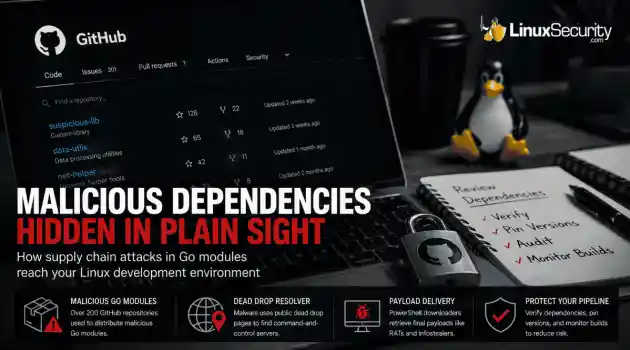
open-source dependency management Every Linux developer who works with Go has run the same workflow a thousand times. You find a library that solves your problem, you see a decent star count on GitHub, and you run go get. It is frictionless and efficient. Lately, however, it is becoming one of the most effective ways for an attacker to get code running on your build servers. The recent "Operation Muck and Load" campaign is a perfect example of why this workflow is risky. Researchers uncovered over 200 GitHub repositories...
Jul 10, 2026
 Refine news
X Clear Filters
Get the latest News and Insights
Get the latest Linux and open source security news straight to your inbox.
Community Poll
Is continuous patching actually viable?
Loading...
Explore Latest Linux Security news
We found 9,995 articles for you...
210
 security advisoryunauthorized accessLinux security
GhostApproval: Why Linux Developers Should Audit AI Coding Assistant Permissions
AI coding assistants have become a staple in many Linux developers' daily workflows. Whether you're generating boilerplate, refactoring code, or updating configuration files, it's easy to assume these tools stay safely inside your project directory. . Researchers recently pulled the curtain back on a threat they’ve dubbed " GhostApproval ." It’s a direct hit to the way we use tools like Cursor, Amazon Q, and Claude Code. They found these assistants have a dangerous blind spot: they can be tricked into modifying files outside of your project's sandbox. By hiding a simple, booby-trapped symbolic link in a code repository, an attacker can manipulate these assistants into editing sensitive system files instead of the project files you’re actually working on. Even worse, the confirmation prompts these tools show often hide the true destination of the change, making it look like you’re approving a harmless update when you’re actually handing over the keys to your system. It’s a classic trust boundary collapse, turning our favorite productivity boosters into high-speed conduits for unauthorized access. How the "Symlink Bypass" Exploit Actually Works At its core, this vulnerability is what we call a "symlink bypass." In Linux, a symbolic link—or symlink —is essentially a shortcut pointing to another spot on your hard drive. When you use an AI coding assistant, you naturally assume it’s playing by the rules and staying inside the "sandbox" of your current project folder. The security gap here is that many of these AI agents don’t bother to verify if a file is a legitimate file or just a shortcut before they start writing to it. If the tool skips that check, it will blindly follow the link wherever it goes. Quick Check: Is This File Really Inside Your Project? Before approving AI-generated file changes, verify the path: ls -l filename (Check if it points to a target) Readlink filename (See exactly where it points) Realpath filename (Confirm the fully resolvedpath is within your project) The attack itself is surprisingly straightforward: an attacker slips a seemingly harmless file, like config.json, into a repository, but turns it into a secret bridge pointing to a sensitive target, like your ~/.ssh/authorized_keys file. When you ask the AI to "update the config," it triggers a standard system call to write to that file. Because Linux is built to resolve these shortcuts automatically at the kernel level, it silently redirects the AI’s action straight to your SSH keys. Since the AI is running under your own user permissions, it has full authority to overwrite those files—and just like that, the attacker has effectively cracked open a back door to your machine without you ever suspecting a thing. Why This Matters for Linux Security At its core, this vulnerability punches a hole in the "human-in-the-loop" security model that we Linux admins have relied on for decades. We’re used to trusting our own oversight, but the breakdown here is all about trust boundaries. These AI assistants rely on us to vet every change, but when the UI shows you a harmless-looking project file while the OS is secretly hammering a sensitive system file, you aren't actually making an informed choice. You’re just rubber-stamping an action that’s hidden in plain sight. What makes this even more devious is that it’s not "malware" in the traditional sense, so your antivirus isn't going to have a heart attack. Instead, it’s a masterclass in " Living-off-the-Land ." The AI is performing perfectly normal, expected system calls—the same stuff your build tools do every day. Because it’s using your own trusted environment against you, it slips right past standard defenses. Since the system sees every move as an authorized action coming from you , it’s incredibly difficult to spot the foul play until the attacker has already gained a permanent foothold. Where Linux Users Are Most at Risk You are at a much higher risk if you frequently clone and run"AI-assisted" setups from untrusted or third-party repositories, particularly in the following environments: Cloud-based development environments: Where agents may have broad access to home directories and environment variables. Shared CI/CD build nodes: Where automated refactoring tools run without constant human oversight. Local Linux workstations: Where developers use AI agents to manage system-level configuration files or sensitive dotfiles. Sensitive Target Files: Keep a close eye on files that grant persistence or command execution, specifically ~/.ssh/authorized_keys, ~/.bashrc, ~/.profile, and core application configurations in ~/.config/. Staying Secure: Practical Defensive Steps If your team is using AI coding assistants, it’s time to stop treating them like basic text editors. You need to start viewing these tools as high-risk, privileged processes. Here is how you can lock down your environment: Audit Tool Permissions: Dig into your assistant’s documentation to see if it has access to your entire file system. If it does, do your best to restrict its scope strictly to your project folders. Don't Just "Rubber Stamp": Never blindly approve a diff from an AI. Take a second to use the command-line tools we covered to verify the actual file path before you give the agent the green light to modify anything. Tighten Path Resolution: If you’re writing scripts that handle files provided by others, always use realpath to double-check that the file is exactly where you think it is before your script touches it. Keep an Eye on System Calls: Consider setting up eBPF-based monitoring (like bpftrace ) to alert you if something tries to write to sensitive areas like your SSH keys or .bashrc. Run Agents with Low Privilege: Never run your development AI agent as a user with broad sudo access. Create a dedicated, low-privilege service account specifically for your development work—it’s the best way to minimize the "blast radius" if something goes wrong. At the end of the day, GhostApproval isn't exploiting a bug in the Linux kernel; it's exploiting the blind trust we put in the relationship between AI tools, our file systems, and our own approval processes. As AI becomes more deeply woven into our daily workflows, verifying what the AI is changing is just as important as reviewing the code it generates. As a Linux professional, how does the integration of AI-assisted tools into your current CI/CD pipeline change how you approach system-level auditing and access control? . Explore GhostApproval and how Linux developers can address AI coding assistant permission risks to enhance system security.. AI coding assistant permissions, GhostApproval vulnerability, Linux security practices, symlink dangers, unauthorized access management. . MaK Ulac
 Jul 09, 2026
•
Jul 09, 2026
• Security Vulnerabilities
74
 network securityfirewall managementapplication layer
Locking Down Linux Network Security with Private Routing Techniques
Linux runs a huge portion of today's infrastructure because it gives administrators an unusual amount of control over the system. That control extends to networking, where almost every aspect of packet flow, routing, filtering, and interface behavior can be customized. The trade-off is that very little of that hardening happens automatically. A fresh installation is usually built to communicate, not to isolate. . As environments grow, servers start exchanging data with monitoring platforms, storage systems, container hosts, cloud services, and internal applications. Some of those connections are intentional. Others remain long after the service that required them has disappeared. Private routing brings that communication back under control by defining where traffic is allowed to move instead of assuming every system should be able to reach every other system. Securing Administrative Access and Digital Identities Many network incidents don't begin with a firewall failure. They begin with an administrator losing control of the account that manages the environment. It's common for cloud consoles, DNS providers, monitoring platforms, backup services, and virtualization dashboards to share the same administrative email address. That account receives alerts, approves authentication requests, resets passwords, and often becomes the recovery path for everything else. If someone gains access to it, they may never need to attack the network directly. That's why identity should be addressed before touching routing tables or firewall policies. If there is any reason to believe those credentials have been exposed, take the time to reset your Google password or secure whichever primary administrative account your infrastructure depends on. Recovering those identities first keeps infrastructure alerts, password recovery requests, and management portals under your control while the rest of the environment is being reviewed. Once that's done, changes to routing and segmentation become much easier to trustbecause the accounts responsible for managing them haven't been left as an open question. Mitigating Application Layer Vulnerabilities Not every server deserves the same level of trust, even if they're running on the same network. Media processing systems are a good example. They often accept files from outside users, perform complex decoding operations, and rely on large third-party libraries that receive regular security updates. Recent disclosures involving ffmpeg reminded administrators how quickly a flaw in widely deployed software can become a much larger operational problem when that application sits beside more sensitive systems. Network segmentation changes the outcome. A vulnerable media server may still require patching, but it doesn't need unrestricted access to internal databases, authentication services, or file storage. Restricting communication to specific destinations keeps each workload focused on its own responsibilities. If one application behaves unexpectedly, the rest of the environment isn't automatically exposed simply because every route was left open. Patching the Core Operating System Firewall rules have one important assumption built into them. The operating system enforcing those rules is still trustworthy. Once root access is obtained, that assumption disappears. Routing tables can be rewritten, forwarding rules adjusted, firewall policies removed, and network activity hidden without changing the overall architecture. From the outside, the environment may still appear properly segmented while the host itself has already stopped enforcing those controls. That is one reason kernel updates deserve the same attention as firewall maintenance. Security researchers continue to uncover vulnerabilities that remained unnoticed for years, including a recently disclosed root-level issue that had existed for nearly a decade before administrators were advised to prioritize patching. Keeping Linux systems current isn't separate from network hardening. It's part of thesame effort because every routing decision ultimately depends on the operating system applying it correctly. Implementing Effective Private Routing Rules Open a firewall that's been running for several years, and the rule set often tells a story. Temporary exceptions become permanent. Test environments survive long after the project ends. Legacy services keep old ports open because nobody wants to remove something that might still be needed. Eventually, the firewall reflects years of operational history instead of the network that exists today. A default-deny policy forces that conversation back into the open. Using tools such as iptables, nftables , or UFW , administrators explicitly define the traffic that belongs while everything else remains blocked. That approach usually produces smaller, easier-to-audit rule sets because every allowed connection has an identifiable purpose. The same thinking applies to NAT and IP forwarding. Internal addresses should stay internal whenever possible, and administrative access is generally easier to monitor when it passes through a dedicated bastion host or jump server instead of exposing multiple management interfaces directly to the internet. Fewer entry points also make it much harder for external scanners to build an accurate picture of the network. Addressing Industry Standards and Compliance Compliance requirements tend to expose network designs that grew without much planning. During an audit, it's difficult to justify why a public web server can freely communicate with systems storing payment information or customer records if that connection serves no operational purpose. Questions like that often reveal routing decisions that were made years earlier and never revisited. Most regulatory frameworks expect sensitive workloads to be separated from internet-facing services through logical or physical segmentation. Private routing supports that separation by making communication predictable and intentional. Instead of relying on assumptionsabout how systems should behave, administrators can demonstrate exactly which connections exist and why they're allowed. That level of visibility helps during audits, but it also makes day-to-day administration much less complicated because unexpected traffic stands out instead of blending into everything else. Sustaining Network Integrity Over Time Networks rarely become less complicated on their own. New applications appear. Old servers stay online longer than expected. Teams add temporary firewall rules during deployments, migrations, or troubleshooting sessions, and many of those changes quietly survive well past their original purpose. None of that happens overnight, which is why gradual configuration drift is so easy to miss. Keeping private routing effective is mostly a matter of paying attention to those small changes before they accumulate. Reviewing firewall rules, checking routing policies, monitoring network logs, and removing access that no longer serves a purpose all contribute to a cleaner environment. The goal isn't to rebuild the network every few months. It's to make sure the documented design still matches what the infrastructure is actually doing. A well-segmented Linux network isn't defined by having the most firewall rules or the most restrictive configuration. It's defined by clarity. Administrators know which systems should communicate, which ones shouldn't, and the routing policies reflect those decisions instead of years of forgotten exceptions. That makes the environment easier to operate, easier to troubleshoot, and considerably easier to trust as it continues to grow. . Discover how to harden your Linux network by implementing private routing, managing traffic, and securing digital identities.. Linux network management, private routing, firewall best practices, application layer security, infrastructure protection. . Anthony Pell
Jul 08, 2026
•
Network Security

210
 security advisoryauthenticationopenssh
The Hidden Cost of Enterprise SSH Authentication
We often view OpenSSH security updates through the lens of standard patch management. When a new CVE hits, we scramble to update, check our versions, and return to business as usual. But recent vulnerabilities tied to distribution-added OpenSSH GSSAPI patches are a reminder that the danger doesn't always lie in the core code; it often resides in the "convenience" features we layer on top. . These recent issues shouldn't just trigger an apt upgrade or dnf update; they should trigger a configuration audit. As our infrastructure has grown more complex, we have enabled features like GSSAPI—designed to simplify enterprise management—that have quietly expanded our attack surface in ways that standard hardening guides rarely address. Why Enterprises Enable GSSAPI SSH keys work well until your environment starts growing. A handful of Linux servers is easy enough to manage, but hundreds or thousands are a different story. Keys need to be rotated, access needs to be revoked when employees leave, and every new system has to be brought into the process. That's where GSSAPI comes in. Organizations already using Kerberos can let users authenticate with their existing domain credentials instead of distributing and maintaining SSH keys on every server. For many enterprises, that's a practical decision rather than a security decision. The catch is that SSH is no longer handling a relatively simple login. It now has to work with Kerberos tickets and the software that supports them. Recent GSSAPI-related vulnerabilities are a reminder that every additional authentication feature adds more code that has to process data before a session is established. That doesn't mean GSSAPI is unsafe. It means features that make administration easier also deserve the same level of review as the rest of your SSH configuration. There's another detail that's easy to miss. Many Linux distributions ship OpenSSH with downstream patches to support enterprise environments. Those additions aren't part of the upstream OpenSSHcode maintained by the OpenBSD project, so administrators should pay attention to distribution-specific security advisories rather than assuming every OpenSSH issue affects every system the same way. Why "More Secure" Isn't "Less Risky" The core insight here is that complexity is the enemy of security. We implement GSSAPI to avoid the human-centric failure of weak passwords, but we trade that for the system-centric failure of a complex, high-privilege service boundary. If your environment doesn’t require SSO via Kerberos, you are paying a security tax for a convenience you aren't actually using. Even if you do require it, you need to treat the GSSAPI configuration with the same level of paranoia you apply to your authorized_keys files. The Audit: What Should You Be Looking For? If you are running an enterprise Linux fleet, the recent OpenSSH updates serve as a forcing function to look beyond the patch. Ask yourself the following: Is GSSAPI actually necessary? For most standalone servers or small, static clusters, the answer is usually no. If you aren't actively using Kerberos for SSH authentication, explicitly set GSSAPIAuthentication no in your sshd_config. Are your "Forwarding" features justified? Features like GSSAPIDelegateCredentials no, AllowAgentForwarding no, and AllowTcpForwarding no are often left enabled by default out of habit. These provide lateral movement pathways for attackers who compromise an initial jump host. Is your authentication boundary siloed? In a modern "Zero Trust" architecture, we aim to minimize the trust we place in the server itself. Are you relying on the server to validate complex Kerberos tokens, or are you moving toward ephemeral, centrally signed SSH certificates? The Takeaway The latest OpenSSH updates are not just another entry in your vulnerability management dashboard—they are a critique of our collective preference for "easy" enterprise configuration. When you see a GSSAPI-related vulnerability in a changelog,don't just patch. Re-evaluate. Every feature you enable in sshd_config is an intentional decision to expand the scope of what an attacker can target. Before you restart that service, ask yourself: Am I configuring this for security, or am I just configuring it for convenience? Want more Linux security news, vulnerability analysis, and software supply chain updates? Subscribe to the LinuxSecurity Newsletter and get the latest threats, advisories, and expert insights delivered directly to your inbox. Related Reading How to Harden SSH on Linux After Disabling Password Authentication How to Detect Unauthorized SSH Key Usage on Linux Systems . OpenSSH updates highlight the importance of thorough configuration audits over standard patching practices.. OpenSSH updates, enterprise SSH risk management, GSSAPI configuration issues. . MaK Ulac
Jul 06, 2026
•
Security Vulnerabilities
209
 privilege escalationLinux securityvulnerability prioritization
How Linux Security Teams Can Prioritize Real-World Attack Paths and Reduce Alert Fatigue
Linux security teams are drowning. Patches, kernel updates, new CVEs every week. SSH exposed here, an old web service there, and a forgotten cron job running as root. On top of that, SIEM dashboards blink all day with alerts that all claim to be “high priority.” . It’s no surprise that people stop paying attention. The real problem isn’t a lack of data. It’s the opposite. Too much noise, not enough signal. Security teams see huge lists of vulnerabilities and thousands of alerts, but very little context about which ones actually matter for how an attacker would move through their Linux environment. The limits of counting vulnerabilities Most Linux environments today are judged by numbers. How many critical CVEs are open? How many high alerts did the SOC see yesterday? How many hosts are unpatched? Those metrics look good on a status slide, but they don’t tell you how close you are to a real compromise. A kernel vulnerability on an isolated lab box is not the same as a weak SSH configuration on an internet-facing bastion host. A missing patch on a backup server with no network access is not equal to a sudo misconfiguration on a server where every engineer logs in daily. Traditional vulnerability management tools usually treat them the same. They assign a score, drop it on a dashboard, and call it a day. Linux administrators then stare at pages of CVEs with vague descriptions and generic “apply patch” advice. It’s not that they don’t want to fix things. It’s that they can’t do everything, and the tools rarely tell them what they can safely ignore. Alert fatigue in Linux environments Alerts add another layer of pressure. IDS, EDR, log monitoring, file integrity checks, container security tools—they all generate events. A suspicious process here. A permission change there. An unusual SSH login pattern. Each rule is well-intentioned. Together, they become exhausting. Security engineers start to recognize patterns: the same noisy rule firing over and over,the same false positives from a backup job or a deployment script. After enough of that, people click “acknowledge” without digging in. Not because they’re careless. Because they’re overloaded. It's not just anecdotal. Recent research on SOC alert overload found that the volume and complexity of alerts have grown faster than most teams' ability to triage them. Alert fatigue is what happens when the team’s attention becomes a scarce resource. The more you burn it on low-value alerts, the less you have left for the one alert that actually signals an attack in progress. Shifting the focus: attack paths, not item counts The shift that’s happening in better-run Linux security programs is simple in concept: Stop treating vulnerabilities and alerts as individual items. Start treating them as parts of attack paths. Attackers don’t care about your entire CVE list. They care about chains. A weak external entry point. A misconfiguration that allows lateral movement. A privilege escalation that gives them root. A gap in monitoring that lets them stay quiet. That’s why attack surface visibility matters so much. Teams need a clear view of: Which Linux systems are exposed to the internet Which services and ports are open, and to whom Which identities can access which hosts Where sensitive data and critical workloads actually live Once you see the environment this way, a vulnerability is no longer just “critical.” It’s “critical on a public-facing server that has direct SSH access to our production database subnet.” That’s a different level of urgency. Prioritizing vulnerabilities in context On a practical level, Linux security teams can start by asking a few questions for each issue: Is this system reachable from the internet or from less-trusted networks? If exploited, does it help an attacker escalate privileges or move laterally? Does it expose credentials, secrets, or control over important services? Is this weakness part of a chainwe’ve already seen in real-world attacks? A local privilege escalation bug on a developer workstation running Linux might be important, but not nearly as urgent as a misconfigured sudoers file on a jump host used for production access. A medium-severity bug in an exposed SSH service with weak auth can be more dangerous than a “critical” bug buried behind multiple layers of segmentation. This is where concepts like continuous threat exposure management (ctem) come in. Instead of just counting issues, organizations try to understand how those issues connect, which ones create realistic attack paths, and how those paths change over time as systems are added, removed, or reconfigured. Privilege escalation and configuration weaknesses Linux gives a lot of power to configuration files. That’s both a strength and a risk. A single line in /etc/sudoers can decide whether a compromised user account turns into full root control. A world-writable script triggered by a cron job can hand over system-level access. An NFS export with the wrong settings can quietly bypass permissions you thought were enforced. These don’t always show up as flashy CVEs. They look like small misconfigurations. But in real incidents, these are often the steps attackers rely on after initial access. These common Linux privilege escalation patterns tend to repeat across environments, which is exactly why they're so easy to overlook. Prioritization here means treating privilege escalation risks as first-class citizens. That includes: Reviewing sudo rules and removing unnecessary privileges Locking down service accounts and automation scripts Tightening file permissions on scripts, configs, and logs Watching for setuid binaries and unusual capabilities Exposed services and attack surface Linux servers tend to accumulate services over time. Old admin tools. Forgotten testing daemons. Temporary debug ports that never got closed. From an attacker’s perspective, every listening service isan opportunity. Even if the version is fully patched, it may leak information, offer brute-force access, or serve as a foothold for future misconfigurations. Regular mapping of exposed services internally and externally is crucial. Not just listing ports, but also understanding business impact: What happens if this service is compromised? Does it sit in front of sensitive data or critical operations? Who really needs access to it? Again, the goal is to see where a real-world attack would likely begin, not to chase every open port with equal urgency. Continuous validation, not one-time cleanup The Linux landscape inside most organizations is not static. New containers spin up. New VMs appear. Engineers experiment, deploy, retire, and repurpose systems. One-time cleanups help, but they don’t last. The only sustainable approach is continuous validation of your controls. This shift toward validating exposures on an ongoing basis is becoming the norm for security teams who've outgrown periodic scans: Regularly simulate attack paths or run adversary-style tests Verify that segmentation actually blocks the movement you expect Check that logging, detection, and response playbooks work in practice Confirm that newly deployed Linux systems inherit hardened baselines This is where many teams are moving beyond traditional vulnerability scanning. They want a feedback loop that says, “Here is how an attacker would move through your Linux environment today,” and, “Here is what changed since last week that opened up a new path.” From noise to clarity In the end, reducing alert fatigue and making Linux environments safer are the same goal. You don’t need fewer tools. You need better questions: Which weaknesses create a clear path from the outside world to something we care about? Where are we giving away privilege too easily? What’s exposed that doesn’t need to be? Are our controls actually working, right now, against the waysattackers operate? When teams organize their work around realistic attack paths instead of raw counts and dashboards, something important happens. The noise drops. The work feels more meaningful. And when an alert arrives that fits into a known, dangerous path, it finally gets the attention it deserves. . Discover how Linux security teams can effectively manage alerts and vulnerabilities by focusing on real-world attack paths and reducing fatigue.. Linux security, alert management, attack path prioritization, privilege escalation, continuous validation. . Anthony Pell
Jul 06, 2026
•
Security Trends
210
 security advisorycriticalUbuntu
Mak's Security Roundup: Prioritizing This Week's Critical Updates
Before you close out the week, check what still needs to be patched. . The list is not small. Ubuntu and Red Hat pushed kernel updates. OpenVPN and OpenShift both received security fixes. Several everyday Linux components were patched too, including Vim, nginx, cifs-utils, LibVNCServer, nghttp2, and Perl. That is the kind of week administrators can easily write off as routine. It should not be. These are the updates that keep small openings from turning into real access. Why This Week Looks Different One notable trend this week is the sheer volume of vendor advisories rather than a single dominant vulnerability. Ubuntu and Red Hat released updates across kernels, enterprise platforms, VPN software, and commonly deployed utilities. That pattern reflects today's Linux security landscape, where reducing risk often depends more on maintaining patch discipline than responding to one high-profile event. Linux Kernel Security Updates Kernel updates are easy to postpone because they usually mean a reboot. That's exactly why they keep showing up on patch backlogs. This week's updates include fixes for privilege escalation and container-related issues . Those aren't the vulnerabilities I'd be comfortable leaving unpatched for long. If someone already has a foothold on a server, the kernel is often where they try to go next. The less time those flaws sit in production, the better. Strengthening the Perimeter: OpenVPN The OpenVPN 2.7.5 update addresses seven security vulnerabilities, including issues with DNS handling, TLS-Crypt-v2 implementation, and proxy behavior. As the "front door" of the modern distributed enterprise, VPN gateways are inherently exposed and must be prioritized. Because VPN gateways are internet-facing, administrators should prioritize these updates to reduce the risk of unauthorized access, denial-of-service conditions, or other attacks addressed by the released fixes. Patching ensures that your remote access infrastructure remains a secure gateway ratherthan an entry point for unauthorized actors. Orchestration Integrity: OpenShift Red Hat OpenShift 4.19.36 and OpenShift 4.15.66 include security updates for the platform’s container infrastructure. As organizations shift toward microservices, OpenShift has become the operating system of the data center. Because OpenShift manages workloads across the cluster, a compromise of the orchestration layer can have broad security implications. Keeping OpenShift current helps reduce the risk of attackers exploiting vulnerabilities that could expose administrative components, workloads, or sensitive configuration data. Reducing that exposure also limits their ability to gain broader visibility or control over the production environment. Maintaining the Ubiquitous "Plumbing" Beyond the headline infrastructure components, several widely deployed utilities—including Vim , nginx , cifs-utils , LibVNCServer , nghttp2 , and Perl —received security attention this week. These utilities are the "plumbing" of Linux, used in almost every deployment and serving as dependencies for larger applications. Widely deployed utilities often become part of larger attack chains because they are present on so many systems. Delaying these seemingly minor updates can leave commonly deployed software exposed, creating opportunities for attackers to incorporate them into larger attack chains after gaining an initial foothold. Supply Chain Vigilance via Hardened Images Red Hat continues to ship updates for Hardened Images , including AI Base Images and container images. This reflects the industry shift toward "secure-by-design" infrastructure. Relying on stale base images is a common way organizations introduce known vulnerabilities into production. While automated scanners can quickly identify these vulnerabilities, your environment remains at risk until the underlying images are updated to a hardened baseline. The New Security Reality This week’s activity provides a vital snapshot ofthe current threat landscape, highlighting several key takeaways for security and infrastructure teams: Adopt a "Time-to-Exploit" Mindset: For internet-facing software, the window between public disclosure and exploitation is increasingly measured in hours or days, making timely patching more important than ever. Move Beyond Silos: You cannot secure your environment by patching in isolation. You must treat kernels, containers, and VPNs as a single, interdependent surface. Prioritize Ruthlessly: If your team is overwhelmed, follow this hierarchy: 1. Internet-facing services: (VPN gateways, web servers). 2. Kernel and privilege escalation fixes: (Reducing the risk of host compromise and container escape). 3. Ubiquitous utilities: (Vim, Perl, etc., to block lateral movement). What Matters Most This Week If this week's updates have one thing in common, it's that none of them can really be ignored. Kernel patches, VPN software, container platforms, and the tools that quietly support Linux systems all received security fixes. That's becoming a pretty normal week for Linux administrators. Nobody has an unlimited maintenance window. If you have to make choices, start with the systems that are easiest for an attacker to reach. Kernel updates shouldn't sit in the queue for long either, especially when they address privilege escalation or container-related issues. After that, work through the remaining utilities before they become next month's backlog. How is your team handling the growing volume of Linux security updates without falling behind on day-to-day operations? . Stay updated on critical patches for Linux systems from Ubuntu and Red Hat, vital to protect against threats.. Linux Kernel Security, OpenVPN Security Updates, Red Hat Patches, Ubuntu Updates, OpenShift Security. . MaK Ulac
Jul 03, 2026
•
Security Vulnerabilities
209
 malwaresecurity researchtrojan
Trojanized GitHub PoC Repositories Deliver ChocoPoC Malware to Security Researchers
GitHub has become the latest delivery mechanism for malware aimed at security researchers. . YesWeHack and Sekoia identified a campaign that hid a Python-based remote access trojan (RAT) called ChocoPoC inside repositories presented as proof-of-concept exploits for recently disclosed vulnerabilities. Someone looking for a working exploit could clone the project, execute the code, and unknowingly launch a second payload that established remote access. Nothing about the campaign specifically targets Linux. The workflow does. Linux remains a common platform for exploit development, reverse engineering, malware analysis, and penetration testing, so it's also a common place to download and test public PoCs. That makes research workstations an appealing target when attackers decide the easiest way to reach an organization is through the people analyzing its vulnerabilities. How Trojanized GitHub PoC Repositories Delivered ChocoPoC Malware The campaign centers on the deployment of trojanized repositories that mimic legitimate exploit research. When a researcher clones and executes the code to validate a vulnerability, the malicious payload executes alongside the advertised exploit. Once the malicious script is triggered, it can establish remote access, allowing attackers to execute commands remotely on the compromised system. The repositories were designed to resemble legitimate security research projects, allowing the embedded malicious code to blend into routine research workflows. The Campaign Highlights a Common Workflow Risk The campaign highlights a standard practice among vulnerability researchers: downloading public proof-of-concept code to validate newly disclosed vulnerabilities. Linux is widely used for these tasks because of its native development tools, scripting ecosystem, and established penetration-testing distributions. Because researchers frequently execute public exploit code during vulnerability validation, Linux research environments can become attractive targets forcampaigns that abuse trusted repositories. Trust Abuse in Open Source Research Workflows ChocoPoC isn't remarkable because of the malware itself. Security researchers have seen Python backdoors before. What stands out is where it was hidden. Public proof-of-concept repositories have become a routine part of vulnerability research, and attackers are now using that expectation against the people who depend on them. This incident is part of a wider pattern of trust abuse on public code-sharing platforms. Academic research presented at USENIX WOOT 2025 in the paper SecurePoC: A Helping Hand to Identify Malicious CVE Proof of Concept Exploits in GitHub demonstrates that malicious and misleading proof-of-concept repositories have become a significant enough problem to warrant dedicated detection research ( USENIX WOOT 2025, el-Yadmani et al. ; Zenodo Artifact ). The researchers identified numerous cloned and modified repositories containing malicious additions, highlighting how public code-sharing platforms have become an attractive distribution channel for malicious proof-of-concept repositories. Why Linux Users Should Pay Attention ChocoPoC is not a Linux-specific threat. The malicious repositories described by YesWeHack and Sekoia could affect researchers working on Windows, macOS, or Linux. What makes the campaign relevant to Linux users is how many security professionals perform vulnerability research. Linux is widely used for penetration testing, exploit development, reverse engineering, and malware analysis. As a result, Linux workstations, virtual machines, and lab environments are common places to clone and execute public proof-of-concept code. The campaign exploits that research workflow, not the operating system itself. For Linux users who regularly test exploits from public repositories, it serves as a reminder that the repository deserves the same level of scrutiny as the vulnerability being investigated. Reducing Risk When Testing Public Exploit Code As public exploitrepositories become a more frequent source of opportunistic attacks, the security of the researcher’s workstation must be prioritized. Researchers should begin by performing a thorough source inspection, reviewing PoC code for obfuscated commands, unexpected network calls, or hardcoded IPs before any execution. Beyond manual review, consider using disposable virtual machines or isolated container environments when validating exploit code to ensure that malicious payloads cannot reach your host filesystem or network. For those working in Windows-based environments, Microsoft has recently launched a public preview of WSL Containers (WSLC), which allows for the creation of native, isolated Linux container environments ( Microsoft Dev Blog ; Microsoft Learn ; WSL API Reference ; Phoronix ). Furthermore, researchers should perform due diligence by assessing repository reputation, commit history, and the author's track record rather than relying on the code’s presence alone. Finally, monitoring outbound network connections during the testing phase is a practical way to identify and block any unexpected traffic generated by a script. Conclusion ChocoPoC serves as a critical reminder that the security industry’s own workflows are now firmly in the crosshairs of threat actors. As public exploit repositories continue to grow in volume, the ability to validate the integrity of the code we download is becoming just as essential as the ability to validate the vulnerabilities the code aims to address. Security professionals must treat unverified PoC code with the same scrutiny as any other untrusted software. . ChocoPoC malware highlights a serious risk in GitHub PoC repositories, impacting security researchers across platforms.. malware delivery techniques, security researcher risks, public code repositories, ChocoPoC attacks. . MaK Ulac
Jul 02, 2026
•
Security Trends
212
 incident responseLinux administrationauthentication
Azure CLI Password Spraying: Why Cloud Identity Is Now Linux Security
Over the span of just 14 days, threat actors unleashed more than 81 million login attempts against Microsoft’s Azure command-line interface (CLI). The campaign , which security researchers at Huntress identified as an ongoing, automated password-spraying effort, successfully compromised at least 78 Microsoft accounts across 64 organizations between June 12 and June 26, 2026. . While the scale is massive, the underlying strategy is surprisingly surgical. Attackers aren't exploiting a flaw in Azure. Instead, they're taking advantage of the way legacy authentication flows can interact with modern cloud identity controls when organizations haven't fully retired older authentication methods. This campaign demonstrates that for cloud administrators, the traditional "MFA everywhere" mantra is only as strong as the authentication flows that support it. For Linux administrators, the campaign is particularly relevant because Azure CLI is widely used from Linux workstations, jump hosts, automation servers, and CI/CD pipelines. As cloud administration increasingly shifts to command-line tooling, protecting those identities has become just as important as hardening the underlying operating system. Administrators Saw the Pattern First What makes this campaign especially notable is that operational teams appeared to notice the activity well before it became a formal threat report. In sysadmin discussions nearly two weeks earlier, administrators described seeing strange Azure CLI login attempts, persistent account lockouts, and confusion over why Conditional Access (CA) seemed to ignore the authentication traffic. None of those early reports identified the underlying authentication flow or attributed the activity to a coordinated campaign. They did, however, demonstrate an important reality of modern incident response: administrators often recognize abnormal authentication patterns long before researchers have enough data to characterize them. Reviewing authentication telemetry instead of dismissingrepeated login failures as background noise can provide valuable early warning that something larger is unfolding. Operational takeaway Large authentication spikes, unexplained account lockouts, and unusual sign-in patterns are often dismissed as background noise. This campaign shows they may instead be the earliest indicators of an emerging attack. What Happened in the Azure CLI Password Spray Campaign The attackers used IPv6 infrastructure controlled by the internet provider LSHIY LLC to run their spray. They weren't using sophisticated zero-days; they were testing massive lists of previously stolen credentials against cloud identities, a tactic documented in the Azure Threat Research Matrix as AZT202 . Unlike traditional brute-force attacks that repeatedly target a single account, password spraying tests a small number of commonly used passwords across many accounts to avoid triggering lockout thresholds. By specifically targeting the Azure CLI, the attackers leaned into a non-interactive authentication path. Because Azure CLI can be used through legacy authentication flows such as Resource Owner Password Credentials (ROPC), authentication may occur without the interactive browser prompt where modern MFA challenges are presented. Microsoft has long discouraged ROPC because it is incompatible with modern authentication. ROPC itself is not a vulnerability. The risk comes from continuing to support a legacy authentication flow while assuming modern identity protections apply consistently across every authentication path Why Azure CLI Is an Attractive Target Azure CLI is a fixture in the modern DevOps stack. It’s the primary interface for infrastructure-as-code (IaC) workflows, Linux administration workstations, jump hosts, and CI/CD pipelines. Administrative identities increasingly represent the control plane for modern infrastructure. Compromising one account can provide access to cloud resources that would have previously required multiple lateral movement stepsinside the network. A single compromised Azure CLI identity can provide keys to the kingdom—including direct control over cloud subscriptions, storage accounts, and secret stores—bypassing the need to pivot through your internal Linux environment. The ROPC Problem: When MFA Cannot Be Completed At the center of this attack is the Resource Owner Password Credentials (ROPC) grant . In a standard interactive flow, the user is redirected to a Microsoft login page, which triggers MFA. ROPC, by design, allows an application to handle the username and password directly. Because there is no interactive browser component, there is no place to present an MFA challenge or a number-matching prompt. If your application or script is configured to use ROPC, the authentication flow happens in the background, creating authentication paths that many organizations mistakenly assume are covered by their existing MFA policies, as Microsoft notes in its CLI documentation . Why Conditional Access Alone May Not Stop Credential Testing Conditional Access (CA) policies are powerful, but they are not universal if your deployment is partial. A typical failure in this campaign occurred when organizations enforced MFA only for specific "Web Portals" or "Admin Dashboards" while leaving the Azure CLI service principal or user-login surface exposed to ROPC-based authentication. If Conditional Access policies don't cover every relevant application and client type, authentication requests may not trigger the protections administrators expect. The result isn't that Conditional Access is broken, but that identity protections are applied inconsistently across different authentication paths. Organizations should verify that MFA and Conditional Access policies apply to all cloud applications and supported client types while eliminating legacy authentication flows such as ROPC wherever possible. What Linux and Cloud Administrators Should Check Now The priority is to eliminate non-interactive authentication paths whereverthey exist. Audit CLI Usage: Identify where az login is being triggered in your environments. If scripts are passing clear-text credentials or using ROPC-compatible flows, migrate them to Managed Identities or Certificate-based authentication. Eliminate ROPC: Actively disable legacy authentication and ROPC dependencies across your Entra ID tenant. Tighten CA Policies: Ensure your Conditional Access policies apply to "All Cloud Apps," "All Users," and "All Client App types." Avoid broad exclusions based on IP address or location. Enable Smart Lockout: While not a silver bullet against "low-and-slow" spraying, Microsoft Entra Smart Lockout provides an additional layer of protection by tracking and throttling failed attempts at the tenant level. How to Investigate Password Spraying in Microsoft Entra ID If you suspect your organization was targeted, conduct a targeted review of your sign-in logs using the steps outlined in the Microsoft Password Spray Incident Response Playbook : Filter by App: Search specifically for "Microsoft Azure CLI" in your sign-in logs. Examine Failure Trends: Look for spikes in failed authentications, especially from disparate or unusual IPv6 addresses. Check for Success-After-Failure: Look for a successful login for a specific user identity that immediately follows a string of failed attempts. Review Client App Types: Investigate "Other clients" in your sign-in logs, as these are often where ROPC and legacy protocol attempts hide. Final Thoughts This Azure CLI campaign isn't notable because the attackers guessed a password; it’s notable because it exploited a misalignment in modern identity architecture. The lesson extends well beyond Azure. As Linux administrators increasingly manage infrastructure through cloud APIs instead of local consoles, identity has become part of the operating environment itself. Protecting administrative credentials, eliminating legacy authentication, and continuously reviewingauthentication paths now belong alongside patching, hardening, and system monitoring as core Linux security practices. . Explore how recent Azure CLI attacks reveal weaknesses in cloud identity authentication and the importance for Linux admins.. Azure CLI, Cloud Security, Identity Protection, Linux Admin, Multi-Factor Authentication. . MaK Ulac
Jul 01, 2026
•
Cloud Security
209
 security updatemobile securityoffensive security
What Kali Linux 2026.2 Says About Today's Linux Security Priorities
Offensive Security just dropped Kali Linux 2026.2 , and at first glance, it looks like a standard quarterly refresh. You’ve got the usual kernel bumps, desktop environment updates, and a handful of new utilities. But don't write this off as just another routine version update. If you look past the changelog, this release highlights several capabilities that continue to be important in offensive security. From AI-assisted workflows to credential testing and mobile assessments, Kali Linux 2026.2 reflects the techniques many security professionals are incorporating into modern Linux security testing. For Linux administrators and defenders, understanding what tools are being added to Kali can be just as valuable as using them; they reflect the techniques security teams—and attackers—consider most relevant for evaluating modern Linux environments. . Why Kali Releases Matter Even If You Don't Use Kali Most enterprise Linux systems will never run Kali Linux, but administrators still benefit from following its development. New tools often reflect the techniques penetration testers are actively using during real-world assessments. Reviewing each release helps defenders identify emerging testing priorities and evaluate whether their own monitoring, authentication controls, and hardening practices address those attack paths. What's New in Kali Linux 2026.2 The headline for 2026.2 is the inclusion of nine new security tools, but the platform improvements are what really move the needle for daily operations. The distribution is now running on the Linux kernel 6.19, with the desktop experience receiving a facelift through GNOME 50 and KDE Plasma 6.6. Tool Primary Purpose arsenal-ng Cybersecurity command reference and cheat sheets hydra-gtk GUI for Hydra credential testing legba Password spraying and authentication testing oletools Analyze Microsoft Office documents andmacros penelope Shell handler for post-exploitation shell-gpt AI-assisted command generation Tailscale Secure remote connectivity tookie-osint Social media reconnaissance uro URL normalization for web testing Taken together, the new tools cover credential auditing, OSINT, phishing analysis, AI-assisted workflows, remote connectivity, and shell management. They reinforce a broader reality: modern security assessments rarely focus on a single system. Today's engagements often combine identity testing, cloud infrastructure, web applications, mobile devices, and social engineering into a single assessment. Beyond the aesthetics, the team focused on friction reduction. VM deployments are significantly faster this time around, thanks to the removal of graphics firmware from pre-built images, and there’s a marked improvement in NetHunter’s stability. For those running security assessments in virtualized labs, these workflow optimizations save real time when you're spinning up or tearing down testing environments. Another notable addition is Tailscale, which gives security teams a straightforward way to create encrypted connections between testing systems. For organizations with distributed labs or remote team members, it can simplify access to assessment environments without exposing them directly to the internet. Credential Attacks Continue to Be a Priority Among the new tools are additions focused on credential testing, including legba and the re-added hydra-gtk . Their inclusion reflects how identity-based attacks—including password spraying, credential reuse, and authentication testing—continue to play a central role in modern security assessments. If an administrator uses the same password for a local Linux server and a corporate SSO account, that’s an open door. These tools act as a wake-up call: if you aren't enforcing MFA, disabling legacyauthentication, and proactively monitoring for password-spraying attempts, your infrastructure is likely the low-hanging fruit in a credential-stuffing campaign. AI Is Becoming Part of Everyday Security Operations The inclusion of shell-gpt might trigger a knee-jerk reaction about AI replacing security pros, but that’s missing the point. Tools like shell-gpt illustrate how AI is beginning to reduce repetitive command-line work. Rather than replacing expertise, they help security professionals generate commands, reference syntax, and automate routine tasks more efficiently. Offensive security is notoriously repetitive. Whether it's drafting boilerplate command syntax or normalizing log output, the friction of manual scripting slows down an assessment. These tools reduce repetitive command-line work and make common workflows easier to reproduce, allowing analysts to spend more time interpreting results than writing boilerplate commands. Mobile Devices Are Now Part of Enterprise Security Assessments The latest NetHunter improvements highlight a shift in scope. Many organizations that rely on Linux servers also manage Android devices, embedded Linux systems, and IoT endpoints. Expanding NetHunter reflects the reality that enterprise security assessments increasingly extend beyond traditional servers. Strong Linux server hardening is only one part of the equation. If attackers can gain network access through an insecure Android device or wireless infrastructure, they may still be able to pivot toward Linux systems. Kali 2026.2 provides the tools to assess these wireless "flanks" of the enterprise, ensuring that mobile and IoT devices are part of your broader security program. Security Testing Is Becoming Faster There’s a clear emphasis on speed in 2026.2, from the faster VM boot times to the smaller initrd. When you're building disposable lab environments, validating detections, or conducting repeated penetration tests, time is your most limited resource. Faster deployments meanassessments can happen more frequently, which makes security validation a natural part of daily operations rather than a painful, quarterly event. By removing unnecessary graphics firmware from pre-built virtual machine images, Kali reduces boot times for many VM-based testing environments while leaving bare-metal installations unchanged. Office Documents Still Matter in Linux Environments Kali 2026.2 also highlights the ongoing relevance of oletools . While Linux endpoints are less commonly associated with Office malware than Windows systems, Linux administrators frequently investigate phishing campaigns, analyze suspicious attachments, and protect mixed-platform environments. Tools like oletools help incident responders inspect Office documents for embedded macros and other malicious content before those files reach users or move deeper into an organization. What Linux Administrators Should Take Away From the Release One of the most useful aspects of following Kali releases isn't deciding whether to upgrade immediately. It's understanding where offensive security is investing its attention. The tools that enter Kali often mirror the techniques organizations are increasingly testing during security assessments, giving defenders an opportunity to evaluate whether their own controls keep pace. Use this table as a checklist for your own hardening efforts: Area Question to Ask Authentication Could your SSH service withstand password spraying? AI Workflows Have you established guidelines for using AI tools without exposing sensitive commands or data? Email Security Are Office documents scanned for malicious content before users open them? OSINT Is unnecessary organizational information publicly exposed? Mobile Security Are Android and IoT devices included in security assessments? Detection Can your monitoringidentify credential attacks and suspicious shell activity regardless of the specific tool used? Conclusion Kali Linux 2026.2 is more than a collection of new packages and version upgrades. Its newest tools and platform improvements reflect the techniques security professionals are using to evaluate modern Linux environments. Whether your organization performs formal penetration tests or simply wants to strengthen its defenses, the release highlights where security testing is placing increasing emphasis: identity, automation, mobile devices, and operational efficiency. Pay attention to the techniques these tools are designed to test; they reflect the attack paths that penetration testers evaluate today and the behaviors defenders should be prepared to detect. Want more Linux security news, vulnerability analysis, and software supply chain updates? Subscribe to the LinuxSecurity Newsletter and get the latest threats, advisories, and expert insights delivered directly to your inbox. . Kali Linux 2026.2 showcases new capabilities in offensive security, highlighting tools for credential testing, AI, and mobile assessments.. Linux Security Tools,Kali Linux 2026.2,Cybersecurity Tools,Credential Testing Techniques,AI in Security. . MaK Ulac
Jun 30, 2026
•
Security Trends

Get the latest News and Insights
Get the latest Linux and open source security news straight to your inbox.
Community Poll
Is continuous patching actually viable?
Search Topics
Powered By

Linux Security - Your source for Top Linux News, Advisories, HOWTOs and Feature Releases
QUICK LINKS
subscribe to newsletters!
Like staying secure? So do we.
Sign up for updates, tips, and alerts!