Explore top 10 tips to secure your open-source projects now. Read More
×


Security Vulnerabilities  security advisory authentication
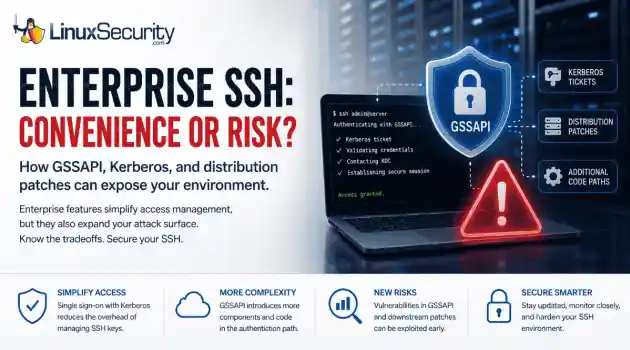
security advisory authentication We often view OpenSSH security updates through the lens of standard patch management. When a new CVE hits, we scramble to update, check our versions, and return to business as usual. But recent vulnerabilities tied to distribution-added OpenSSH GSSAPI patches are a reminder that the danger doesn't always lie in the core code; it often resides in the "convenience" features we layer on top. . These recent issues shouldn't just trigger an apt upgrade or dnf update; they should trigger a...
 Jul 06, 2026

Security Trends privilege escalation Linux security
privilege escalation Linux security Linux security teams are drowning. Patches, kernel updates, new CVEs every week. SSH exposed here, an old web service there, and a forgotten cron job running as root. On top of that, SIEM dashboards blink all day with alerts that all claim to be “high priority.” . It’s no surprise that people stop paying attention. The real problem isn’t a lack of data. It’s the opposite. Too much noise, not enough signal. Security teams see huge lists of vulnerabilities and thousands of alerts, but very...
Jul 06, 2026
Security Vulnerabilities security advisory critical
security advisory critical Before you close out the week, check what still needs to be patched. . The list is not small. Ubuntu and Red Hat pushed kernel updates. OpenVPN and OpenShift both received security fixes. Several everyday Linux components were patched too, including Vim, nginx, cifs-utils, LibVNCServer, nghttp2, and Perl. That is the kind of week administrators can easily write off as routine. It should not be. These are the updates that keep small openings from turning into real access. Why This Week Looks...
Jul 03, 2026
Security Trends malware security research
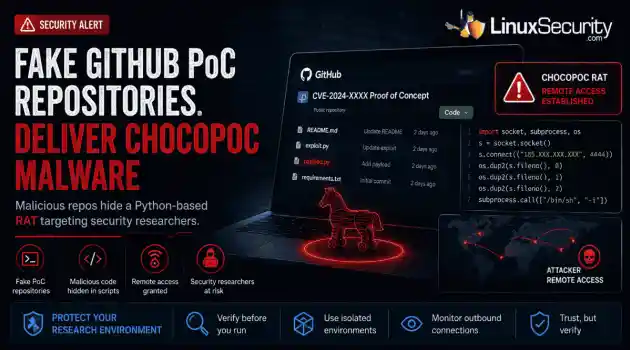
malware security research GitHub has become the latest delivery mechanism for malware aimed at security researchers. . YesWeHack and Sekoia identified a campaign that hid a Python-based remote access trojan (RAT) called ChocoPoC inside repositories presented as proof-of-concept exploits for recently disclosed vulnerabilities. Someone looking for a working exploit could clone the project, execute the code, and unknowingly launch a second payload that established remote access. Nothing about the campaign specifically...
Jul 02, 2026
Cloud Security incident response Linux administration
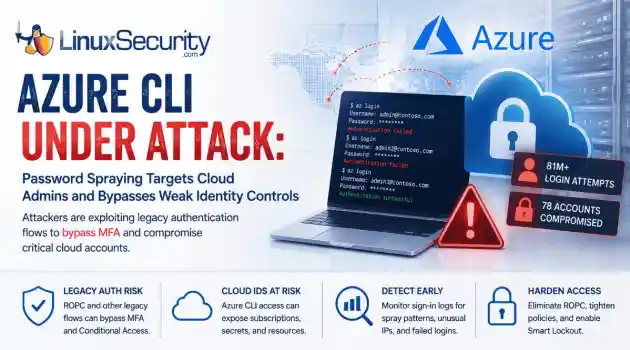
incident response Linux administration Over the span of just 14 days, threat actors unleashed more than 81 million login attempts against Microsoft’s Azure command-line interface (CLI). The campaign , which security researchers at Huntress identified as an ongoing, automated password-spraying effort, successfully compromised at least 78 Microsoft accounts across 64 organizations between June 12 and June 26, 2026. . While the scale is massive, the underlying strategy is surprisingly surgical. Attackers aren't exploiting a flaw in...
Jul 01, 2026
 Refine news
X Clear Filters
Get the latest News and Insights
Get the latest Linux and open source security news straight to your inbox.
Community Poll
Is application sandboxing truly safe?
Loading...
Explore Latest Linux Security news
We found 9,995 articles for you...
209
 security updatemobile securityoffensive security
What Kali Linux 2026.2 Says About Today's Linux Security Priorities
Offensive Security just dropped Kali Linux 2026.2 , and at first glance, it looks like a standard quarterly refresh. You’ve got the usual kernel bumps, desktop environment updates, and a handful of new utilities. But don't write this off as just another routine version update. If you look past the changelog, this release highlights several capabilities that continue to be important in offensive security. From AI-assisted workflows to credential testing and mobile assessments, Kali Linux 2026.2 reflects the techniques many security professionals are incorporating into modern Linux security testing. For Linux administrators and defenders, understanding what tools are being added to Kali can be just as valuable as using them; they reflect the techniques security teams—and attackers—consider most relevant for evaluating modern Linux environments. . Why Kali Releases Matter Even If You Don't Use Kali Most enterprise Linux systems will never run Kali Linux, but administrators still benefit from following its development. New tools often reflect the techniques penetration testers are actively using during real-world assessments. Reviewing each release helps defenders identify emerging testing priorities and evaluate whether their own monitoring, authentication controls, and hardening practices address those attack paths. What's New in Kali Linux 2026.2 The headline for 2026.2 is the inclusion of nine new security tools, but the platform improvements are what really move the needle for daily operations. The distribution is now running on the Linux kernel 6.19, with the desktop experience receiving a facelift through GNOME 50 and KDE Plasma 6.6. Tool Primary Purpose arsenal-ng Cybersecurity command reference and cheat sheets hydra-gtk GUI for Hydra credential testing legba Password spraying and authentication testing oletools Analyze Microsoft Office documents andmacros penelope Shell handler for post-exploitation shell-gpt AI-assisted command generation Tailscale Secure remote connectivity tookie-osint Social media reconnaissance uro URL normalization for web testing Taken together, the new tools cover credential auditing, OSINT, phishing analysis, AI-assisted workflows, remote connectivity, and shell management. They reinforce a broader reality: modern security assessments rarely focus on a single system. Today's engagements often combine identity testing, cloud infrastructure, web applications, mobile devices, and social engineering into a single assessment. Beyond the aesthetics, the team focused on friction reduction. VM deployments are significantly faster this time around, thanks to the removal of graphics firmware from pre-built images, and there’s a marked improvement in NetHunter’s stability. For those running security assessments in virtualized labs, these workflow optimizations save real time when you're spinning up or tearing down testing environments. Another notable addition is Tailscale, which gives security teams a straightforward way to create encrypted connections between testing systems. For organizations with distributed labs or remote team members, it can simplify access to assessment environments without exposing them directly to the internet. Credential Attacks Continue to Be a Priority Among the new tools are additions focused on credential testing, including legba and the re-added hydra-gtk . Their inclusion reflects how identity-based attacks—including password spraying, credential reuse, and authentication testing—continue to play a central role in modern security assessments. If an administrator uses the same password for a local Linux server and a corporate SSO account, that’s an open door. These tools act as a wake-up call: if you aren't enforcing MFA, disabling legacyauthentication, and proactively monitoring for password-spraying attempts, your infrastructure is likely the low-hanging fruit in a credential-stuffing campaign. AI Is Becoming Part of Everyday Security Operations The inclusion of shell-gpt might trigger a knee-jerk reaction about AI replacing security pros, but that’s missing the point. Tools like shell-gpt illustrate how AI is beginning to reduce repetitive command-line work. Rather than replacing expertise, they help security professionals generate commands, reference syntax, and automate routine tasks more efficiently. Offensive security is notoriously repetitive. Whether it's drafting boilerplate command syntax or normalizing log output, the friction of manual scripting slows down an assessment. These tools reduce repetitive command-line work and make common workflows easier to reproduce, allowing analysts to spend more time interpreting results than writing boilerplate commands. Mobile Devices Are Now Part of Enterprise Security Assessments The latest NetHunter improvements highlight a shift in scope. Many organizations that rely on Linux servers also manage Android devices, embedded Linux systems, and IoT endpoints. Expanding NetHunter reflects the reality that enterprise security assessments increasingly extend beyond traditional servers. Strong Linux server hardening is only one part of the equation. If attackers can gain network access through an insecure Android device or wireless infrastructure, they may still be able to pivot toward Linux systems. Kali 2026.2 provides the tools to assess these wireless "flanks" of the enterprise, ensuring that mobile and IoT devices are part of your broader security program. Security Testing Is Becoming Faster There’s a clear emphasis on speed in 2026.2, from the faster VM boot times to the smaller initrd. When you're building disposable lab environments, validating detections, or conducting repeated penetration tests, time is your most limited resource. Faster deployments meanassessments can happen more frequently, which makes security validation a natural part of daily operations rather than a painful, quarterly event. By removing unnecessary graphics firmware from pre-built virtual machine images, Kali reduces boot times for many VM-based testing environments while leaving bare-metal installations unchanged. Office Documents Still Matter in Linux Environments Kali 2026.2 also highlights the ongoing relevance of oletools . While Linux endpoints are less commonly associated with Office malware than Windows systems, Linux administrators frequently investigate phishing campaigns, analyze suspicious attachments, and protect mixed-platform environments. Tools like oletools help incident responders inspect Office documents for embedded macros and other malicious content before those files reach users or move deeper into an organization. What Linux Administrators Should Take Away From the Release One of the most useful aspects of following Kali releases isn't deciding whether to upgrade immediately. It's understanding where offensive security is investing its attention. The tools that enter Kali often mirror the techniques organizations are increasingly testing during security assessments, giving defenders an opportunity to evaluate whether their own controls keep pace. Use this table as a checklist for your own hardening efforts: Area Question to Ask Authentication Could your SSH service withstand password spraying? AI Workflows Have you established guidelines for using AI tools without exposing sensitive commands or data? Email Security Are Office documents scanned for malicious content before users open them? OSINT Is unnecessary organizational information publicly exposed? Mobile Security Are Android and IoT devices included in security assessments? Detection Can your monitoringidentify credential attacks and suspicious shell activity regardless of the specific tool used? Conclusion Kali Linux 2026.2 is more than a collection of new packages and version upgrades. Its newest tools and platform improvements reflect the techniques security professionals are using to evaluate modern Linux environments. Whether your organization performs formal penetration tests or simply wants to strengthen its defenses, the release highlights where security testing is placing increasing emphasis: identity, automation, mobile devices, and operational efficiency. Pay attention to the techniques these tools are designed to test; they reflect the attack paths that penetration testers evaluate today and the behaviors defenders should be prepared to detect. Want more Linux security news, vulnerability analysis, and software supply chain updates? Subscribe to the LinuxSecurity Newsletter and get the latest threats, advisories, and expert insights delivered directly to your inbox. . Kali Linux 2026.2 showcases new capabilities in offensive security, highlighting tools for credential testing, AI, and mobile assessments.. Linux Security Tools,Kali Linux 2026.2,Cybersecurity Tools,Credential Testing Techniques,AI in Security. . MaK Ulac
 Jun 30, 2026
•
Jun 30, 2026
• Security Trends
79
 security advisoryvulnerability managementopen source initiative
Linux Foundation Launches Akrites to Strengthen Software Supply Chain Security
The Linux Foundation has officially launched Akrites , a coordinated industry initiative designed to improve how critical open source vulnerabilities are validated, coordinated, and disclosed before patches reach downstream users. Backed by a diverse coalition—including AWS, Google, Microsoft/GitHub, Red Hat, NVIDIA, and OpenAI—Akrites establishes a shared Security Incident Response Team (SIRT) to streamline the validation, remediation, and disclosure of vulnerabilities in the foundational code that underpins the modern digital economy. . AI Is Changing Software Supply Chain Security One detail in the Linux Foundation announcement stands out more than the launch itself. The organization isn't suggesting that open source projects suddenly need more vulnerability reports. They already receive plenty. The problem is volume. AI-assisted analysis has made it possible to review large codebases much faster than before. Researchers can identify suspicious patterns, compare projects, and generate vulnerability reports in a fraction of the time that manual analysis once required. That is good news for open-source security, but it has also exposed a weakness in the current response model. Every report still has to be reviewed by a person. Someone has to reproduce the issue, determine whether it affects supported releases, understand its severity, decide whether a CVE is appropriate, develop a patch, and move that fix through coordinated vulnerability disclosure before technical details become public. None of those tasks has become significantly easier simply because AI can produce findings more quickly. According to Endor Labs, one of Akrites' founding members, fewer than 5% of recently validated open source vulnerabilities have been patched . Whether that percentage changes over time, it illustrates the same trend. Discovery is accelerating faster than remediation. Why Existing Open Source Security Processes Are Under Pressure The reality for many maintainers looks verydifferent from how people imagine open-source security working. A widely used library isn't necessarily maintained by a large engineering team. In many cases, it's a handful of contributors or even a single developer balancing maintenance with a full-time job. Now imagine that the project suddenly receives dozens of reports describing the same underlying issue. One submission comes from a commercial scanner. Another is generated by an AI coding assistant. A third arrives through a bug bounty program. None are identical, but all require investigation. The difficult part isn't opening the email. It's figuring out whether the report is accurate, whether the vulnerability can actually be reproduced, whether downstream users are affected, and how the issue should move through vulnerability disclosure without exposing organizations before a fix is available. Akrites is intended to reduce that burden by acting as a shared Security Incident Response Team. Instead of every organization independently contacting maintainers, the initiative provides a coordinated process for validating reports, removing duplicates, and helping projects prepare fixes before disclosure begins. Recent Incidents Showed Why Coordination Matters Recent security incidents have demonstrated that identifying a vulnerability is often only the beginning. Log4Shell became a global response effort almost overnight. The challenge wasn't limited to understanding the vulnerability itself. Linux distributions, software vendors, cloud providers, security teams, and enterprise administrators all had to coordinate patches, advisories, testing, and deployment under intense time pressure. The XZ Utils backdoor exposed a different weakness. It showed how much critical infrastructure still depends on software maintained by very small teams. When one upstream project experiences a security problem, the consequences spread through Linux distributions, enterprise products, containers, cloud platforms, and countless applications built ontop of that code. Akrites would not have prevented either incident. The Linux Foundation isn't making that claim. Instead, the initiative attempts to strengthen the coordination that happens after a vulnerability is discovered and before it reaches the wider ecosystem. What Akrites Means for Open-Source Security Akrites represents a clear realization: open source security can no longer rely solely on the efforts of individual maintainers. Every critical project eventually hits the same wall: the software becomes indispensable long before the maintenance team has the resources to manage it. One interesting aspect of this initiative isn't just the technology—it's the list of founding members. Organizations like Citi, JPMorgan Chase, Ericsson, and Cisco rarely launch joint initiatives unless they share a massive, systemic problem. In this case, they do. Modern infrastructure shares an enormous amount of upstream code, which means one overwhelmed maintainer is now a systemic risk for banks, power grids, and cloud providers alike. What This Means for Linux Administrators Linux administrators rarely work directly with upstream maintainers, yet they depend on them every day. Enterprise distributions such as Red Hat Enterprise Linux, Ubuntu, Debian, SUSE, AlmaLinux, and Rocky Linux package software only after upstream projects have investigated reports, developed patches, and coordinated disclosure. Improvements at the upstream level can ripple through the entire software supply chain, ultimately affecting how quickly organizations receive trusted updates. : Faster upstream patch coordination: Verified fixes land in your distribution’s repositories sooner because the "middle work" of validation and deduplication is handled upstream. More consistent security advisories: Standardized reports make it easier to track and prioritize updates across your fleet. Better support for widely used components: Akrites says it can serve as a "maintainer of last resort" for certain criticalprojects by helping coordinate remediation when active maintenance is no longer sufficient. How Akrites Coordinates Vulnerability Response The initiative formalizes the vulnerability disclosure lifecycle to ensure confidentiality and speed. Instead of maintainers fielding reports from hundreds of sources, they have one predictable partner. Discovery: A researcher or AI surfaces a potential flaw. Confidential Submission: The report is sent to the Akrites SIRT, not a public bug tracker. Validation & Deduplication: The SIRT verifies the issue and removes duplicates. Remediation: Maintainers and industry engineers collaborate on a fix in a secure environment. Upstream Merge: The fix is merged into the original project's repository. Synchronized Disclosure: A coordinated CVE is published to alert the ecosystem. Akrites Won't Replace Vulnerability Management It is vital to note that Akrites is an upstream coordination body, not an enterprise security product. Organizations still need robust internal programs, including vulnerability management processes, asset inventories, and monitoring tools to detect threats within their specific environments. Akrites improves the upstream coordination of security, but the responsibility for securing the downstream enterprise environment remains with the organization. Akrites complements existing vulnerability management programs rather than replacing them. Organizations will still need scanners, patch management workflows, asset inventories, and software bills of materials (SBOMs) to identify affected systems and deploy updates. Akrites focuses on the upstream coordination that happens before those updates reach enterprise environments. Conclusion For years, the industry invested heavily in tools designed to identify software vulnerabilities faster. Akrites reflects a strategic recognition that discovery is no longer the limiting factor. As AI continues to accelerate vulnerability research, the challenge hasbecome how quickly maintainers can validate reports, coordinate fixes, and deliver patches before attackers exploit them. Whether Akrites succeeds will ultimately be measured not by the number of vulnerabilities it processes, but by whether it successfully shortens the time between discovery and remediation across the open source ecosystem. By professionalizing the "messy middle" of the response process, Akrites is attempting to build the operational infrastructure needed to keep our most critical software secure in an age of AI-accelerated threats. Want more Linux security news, open source security analysis, and software supply chain insights? Subscribe to the LinuxSecurity Newsletter for the latest vulnerability disclosures, security advisories, threat analysis, and expert coverage of the technologies shaping the Linux ecosystem. Related Reading Why Linux Supply Chain Attacks Are Becoming a Nightmare for DevOps Teams Targeted Attacks on Open Source Maintainers Highlight Security Risks . The Linux Foundation's Akrites aims to improve the response and management of open source vulnerabilities through collaborative efforts.. Linux Foundation, Akrites, Open Source Security, Vulnerability Coordination, Software Supply Chain. . MaK Ulac
Jun 29, 2026
•
Security Projects

77
 denial of serviceopen-sourcememory leak
How Memory Leaks Affect System Stability and Security
A process with a stable workload shouldn't keep growing its resident memory. When it does, the first question isn't how much RAM is available. It's where the allocations stopped being released. On Linux, that answer isn't always obvious because the kernel, allocator, and application all influence what memory usage looks like from the outside. . Separating normal allocation behavior from an actual leak takes more than watching top or container metrics. Heap growth, allocator caches, mapped regions, and process lifetime all change the picture. A steadily increasing RSS may indicate a leak. It may also reflect fragmentation, caching, or memory the allocator hasn't returned to the kernel. The useful evidence comes from understanding how Linux manages process memory and from using the right profiling tools to follow allocations back to their source. That's where the investigation starts. What a memory leak is, at the OS level A memory leak happens when a program asks an allocator for memory through malloc() and never releases it through free(). The allocator keeps that block marked as allocated, and the kernel has no way to know it’s functionally dead once the application loses track of it. Understanding why requires a quick look at how Linux handles virtual memory underneath malloc(). The request goes to an allocator, usually glibc ’s implementation derived from ptmalloc, though latency-sensitive services often swap in jemalloc or tcmalloc instead, each using a different strategy for the same underlying problem. With glibc, small and medium allocations come from heap arenas backed by brk()/sbrk(), while large allocations are typically served through anonymous mmap() regions, with the cutoff tunable and, in modern glibc, dynamically adjusted rather than fixed. Either way, the kernel maps virtual addresses first and delays committing physical RAM until first touch, through a page fault. From the kernel’s point of view, the process still owns that virtual address range regardless ofwhether anything still needs it. Whether a page stays resident, gets swapped out, or gets reclaimed follows normal virtual memory rules and current pressure, not whether the application still holds a pointer to it. With a valid pointer, the program can release the allocation through free() or munmap(). Without one, the allocation is effectively unrecoverable until the process exits. That distinction explains a pattern every Linux administrator runs into in top or htop: the gap between VIRT and RES. VIRT is the total virtual address space a process has mapped, useful for spotting address-space growth or mmap() leaks, but not physical pressure. RES is the resident set size, the actual RAM backing that mapping. A process whose RES keeps climbing over hours or days, well past where its workload should have settled, is the most basic signature of a leak on Linux. Where leaks come from in Linux server software Leaks come from a handful of recurring patterns, and most Linux server software runs into at least one of them: Malloc/free mismatches in error paths : The most common source in C and C++ services: a function allocates a buffer, hits an early return on failure, and skips the cleanup that only runs on the success path. The leak only shows up under conditions that exercise that failure path, which makes it easy to miss in testing. File descriptor leaks : A socket or file opened without a matching close() eventually hits the per-process limit set by ulimit -n, but the cost starts well before that. Each open descriptor keeps kernel-side structures allocated behind it: socket buffers, dentry and inode references, epoll registrations. mmap()-based leaks : A process maps a file or shared memory segment and never calls munmap(). If the mapping is never touched again, VIRT grows without a matching jump in RES, which trips people up when they assume RES tells the whole story. JVM reference retention : Common in Kafka, Elasticsearch, or Cassandra deployments. Objects stay reachable throughreferences left in static collections, listeners that never get removed, or classloaders that accumulate across repeated redeploys. The garbage collector is doing what it’s designed to do: keeping alive everything still reachable, even when “reachable” only happens because of a bug. Leaks inside managed runtimes : Garbage collection doesn’t make a language immune. In Python, C extensions like numpy or pandas manage memory outside the reach of Python’s own collector, so a leak inside the extension is invisible to gc.collect(). In Go, a goroutine blocked forever on a channel that never receives anything holds onto every variable it captured for as long as the program runs. Connection pool exhaustion : A database connection checked out and never returned drains the pool over time, and each connection still in use holds buffers, prepared statement caches, and protocol state behind it. Detecting and diagnosing memory leaks on Linux Diagnosing a leak on Linux moves through four stages: spotting the trend, ruling out look-alikes, finding the responsible code, and confirming what happened after the fact. Spotting the trend top or htop sorted by memory is the first signal, followed by ps aux --sort=-%mem to confirm which process is climbing. /proc/[pid]/status gives quick indicators like VmRSS and VmHWM for trend-spotting. For mapping-level accuracy, especially when shared pages matter, use /proc/[pid]/smaps or smaps_rollup, which show memory by individual mapping and help separate a heap leak from one in a mapped file or shared library. On hosts running many copies of similar daemons, plain RSS double-counts shared pages, which is where smem earns its place, reporting proportional set size (PSS) for a more honest per-process picture. Ruling out look-alikes Not every upward RSS trend is a true lost-allocation leak. Allocator fragmentation, unbounded caches, per-thread arenas, and garbage-collected heaps that don’t return memory to the OS all produce leak-like graphs. The fixdiffers: a true leak needs corrected ownership and lifetime, while bloat needs cache limits, heap sizing, or allocator tuning. Finding the responsible code Once a leak is confirmed, the next step is finding it in the code. Valgrind’s memcheck , run with --leak-check=full, classifies leaks as “definitely lost” or “possibly lost,” tied to the allocating call stack, though the overhead makes it mostly a staging tool rather than something run against live traffic. AddressSanitizer and LeakSanitizer, built into gcc and clang, are lighter and more common in CI pipelines instead, though the specific behavior depends on compiler, platform, and sanitizer configuration. For a process already running in production, where attaching a heavily instrumented build isn’t an option, eBPF-based tools have become the standard: memleak.py from the BCC toolkit , or the bpftrace equivalent, hooks into malloc and free on a live process with much lower overhead than Valgrind, though overhead still depends on allocation rate, sampling settings, and workload. It reports outstanding allocations without requiring a restart. For JVM workloads, jmap pulls a heap dump that Eclipse Memory Analyzer or VisualVM can open to find which objects are holding the most memory and why they’re still reachable. Go ships its own answer in the standard library’s pprof heap profiler. Kernel-space leaks are rarer, usually inside drivers rather than core subsystems. The kernel’s built-in kmemleak detector exists because user-space tools can’t see kernel memory, and slabtop offers a lighter way to watch slab cache growth without it. Confirming it after the fact When none of this happens in time, the OOM killer’s own logs become the diagnostic tool of last resort. dmesg | grep -i oom or journalctl -k usually shows which process was holding the most memory at the moment it got killed, useful retroactively even if it would have helped more a few hours earlier. The stability impact, from RSS growth to the OOM killer The kernel’s response to memory pressure follows a general pattern, though the exact path depends on workload, kernel settings, cgroups, and available swap. Under pressure, Linux attempts to reclaim in stages: page cache, reclaimable slab, and, depending on configuration, anonymous memory through swap. As a process’s RSS grows, the kernel typically starts with page cache, the clean, easily-recreated pages backing recently read files, reclaimed through kswapd running in the background. This is why low free memory on a Linux box often isn’t a problem: page cache is supposed to fill unused RAM and gets evicted painlessly under pressure. The trouble starts once page cache has little left to give and the kernel has to consider reclaiming anonymous memory, the heap and stack pages behind running processes, including whatever a leak has accumulated. vm.swappiness shapes how aggressively the kernel prefers swapping anonymous memory over reclaiming file-backed cache, but it doesn’t guarantee heap and stack pages get swapped before anything is killed, since that depends on how much swap exists and how fast pressure builds. This is the stretch where a leaking service feels sluggish rather than broken, right up until reclaim can’t keep pace. Once reclaim and swap can’t satisfy demand, the OOM killer picks a victim based on oom_score, adjustable per process through /proc/[pid]/oom_score_adj. This matters operationally: a leak in one service can get an unrelated process killed instead, if that process has a less negative oom_score_adj when the kernel goes looking for a victim. vm.overcommit_memory controls commit accounting and affects whether large allocations fail early, but it doesn’t control this later reclaim-and-OOM sequence once real pressure exists. Containers and orchestrated environments Inside a container, the same leak plays out differently because memory is bounded by a cgroup rather than the whole host. Cgroup v1 enforces this through memory.limit_in_bytes; cgroup v2 through memory.max.A leaking process usually hits that ceiling well before it affects the rest of the node, and gets killed by the kernel’s per-cgroup OOM handling. In Kubernetes, this surfaces as a pod entering the OOMKilled state, visible in kubectl describe pod. The restart policy that makes containers resilient also makes leaks harder to notice. Kubernetes brings the container back up automatically, RSS resets to baseline, and the leak resumes from zero until it grows back to the limit, and the cycle repeats. Without memory metrics tracked over time, through Prometheus scraping cAdvisor or kube-state-metrics and graphed in something like Grafana, this pattern looks like an intermittent crash. It’s a deterministic leak on a timer set by request rate and the configured memory limit. Sidecars complicate this further. Kubernetes memory limits are usually specified per container, so a leak in a logging sidecar or service mesh proxy gets killed independently of the main application, without eating into its limit directly. Newer clusters can also define pod-level resource limits, now beta and enabled by default, giving the whole pod a shared memory ceiling instead. Either way, a sidecar with no limit set can still consume from the node’s general pool, putting unrelated pods at risk of eviction. The security implications go deeper than data exposure Leaks create three kinds of security exposure: denial of service, a more specific data-exposure risk than is often assumed, and a quieter risk to the security tooling running alongside the leak. 1. Denial of service The most direct risk is denial of service. Leak-driven DoS is a recognized attack class, formally classified as CWE-401 , “Missing Release of Memory after Effective Lifetime,” not just an unfortunate side effect of sloppy code. An attacker who finds a request pattern that reliably triggers a code path missing a free() call can repeat it to drive a service toward its memory limit on purpose. The recently disclosed HTTP/2 Bomb attack is betterframed as resource-amplification denial of service than a classic leak, but the result is similar: a small amount of attacker-controlled input forces disproportionate server-side resource consumption, and the outcome looks identical to an organic crash unless someone is watching for it. 2. Data exposure A second risk is data exposure, though the mechanism is more specific than it’s often assumed to be. A true memory leak and a failure to clear sensitive data before releasing it are related but distinct problems. The practical risk with leaks specifically is duration: a buffer holding a credential, a session token, or a request body that should have lived for milliseconds instead stays resident for hours or days, simply because nothing freed it. That extended lifetime widens the window during which an unrelated bug, an out-of-bounds read, a crash that writes a core dump, a swap file persisted to disk, can expose data that a properly managed allocation would never have stuck around long enough to leak. 3. Quieter risk to the security tooling A third, quieter risk involves the security tooling on the same host. auditd, intrusion detection agents, and log shippers compete for the same memory as everything else, and get throttled or killed under the same pressure a leak creates, unless their oom_score_adj is specifically protected. The moment a host is under the most pressure, often because something is leaking, is also the moment its own defenses are least likely to be running normally. Open source software and the kernel itself Widely deployed open source daemons, Redis, Nginx, PostgreSQL, and Apache, have all had real memory leak issues tied to specific configurations or malformed input, documented in changelogs and bug trackers. Being open source means these get found and patched quickly once flagged. It also means the affected versions are public, making patch prioritization a real operational task rather than a guessing game, since anyone, including an attacker, can read the same changelog. “Linux memory leak” sometimes refers to something happening inside the kernel itself, typically in a driver rather than a core subsystem. These leaks are harder to see because user-space diagnostic tools have no visibility into kernel memory, which is the gap kmemleak was built to fill. slabtop offers a lighter way to watch slab cache growth without its full instrumentation. Preventing leaks before they ship Preventing leaks comes down to ownership discipline paired with guardrails specific to the runtime in use: C and C++: RAII and smart pointers where possible, explicit cleanup on every error branch, and sanitizers wired into CI rather than run only when something looks wrong. Go: context. Context cancellation to bound goroutine lifetimes, avoiding unbounded goroutine creation in handlers, and routine profiling with pprof. JVM services: bounded caches, deregistered listeners, and no static registries retaining request-scoped objects. Python: context managers, explicit closes instead of relying on GC timing, and tracemalloc for Python-level allocations, with native extension memory watched separately since tracemalloc can’t see it. Watching for leaks before they become incidents The most useful signal is a trend, not a threshold. A single memory number rarely tells you anything; the slope of that number over hours and days tells you almost everything. Worth alerting on: A sustained positive RSS slope after warm-up. Climbing cgroup memory usage independent of request volume. Repeated container restarts or OOMKilled events on the same workload. A growing file descriptor count. Divergence between an app’s own heap metrics and total process or container RSS. That last one tends to catch native extensions and off-heap leaks that a runtime’s own instrumentation never sees. A practical troubleshooting flow When something looks like a leak, the order of operations matters: Confirm the trend using RSS, cgroup memory, or process metrics overtime, not a single snapshot. Separate heap growth from mapping growth using smaps or smaps_rollup. Check file descriptor counts through /proc/[pid]/fd or lsof to rule out an fd leak. Match the tool to the runtime: Valgrind or a sanitizer build for C and C++, a heap dump for JVM, pprof for Go, tracemalloc for Python. Check OOM evidence through journalctl -k, dmesg, or Kubernetes pod events to confirm which process was responsible. A quick note for desktop systems Anyone running into this on their own Mac, rather than a fleet of servers, can usually resolve the issue by identifying the application consuming memory and closing or restarting it before the system becomes unresponsive. In most cases, this can be done through Activity Monitor without using the Terminal or other profiling tools. Anyone running into this on their own Mac, rather than a fleet of servers, can follow a troubleshooting guide to identify the responsible application and recover without losing unsaved work, no profiler or terminal required. Treating memory as a first-class metric The teams that catch leaks early are usually the ones already graphing RSS over time for their long-running services, the same way they graph CPU and disk. A leak announces itself on that chart as a line that never comes back down between deploys, well before it becomes an incident. Memory tends to get treated as a fixed quantity that’s either fine or not, rather than a trend worth watching, and long-running Linux infrastructure punishes that assumption eventually, usually at the worst possible time. . Explore how memory leaks impact Linux system stability, security and performance, including detection techniques and prevention strategies.. Memory Leak Linux, System Stability, Security Implications, Open Source Applications. . MaK Ulac
Jun 26, 2026
•
Server Security
79
 Linux securitysecurity assessmentautomation
How AI Is Changing Open Source Penetration Testing
AI is beginning to reshape how penetration testing workflows are organized. For years, the penetration tester’s workflow has been a labor-intensive ritual: scan, enumerate, research, exploit, and report. But new frameworks are attempting to codify that intuition, turning the "human-in-the-loop" process into a machine-coordinated workflow. But is this a genuine evolution in how we secure Linux environments, or just a sophisticated wrapper around the same old tools? . Dark Moon is an open-source autonomous penetration testing framework that combines large language models with established offensive security tools. It supports assessments against web applications, APIs, Active Directory, Kubernetes environments, content management systems, and other common enterprise targets while orchestrating scans through Docker-based tooling. The "Conductor" Philosophy For the uninitiated, Dark Moon doesn’t aim to replace the core toolkit—tools like Nmap, sqlmap, or Nuclei—that Linux security professionals have relied on for decades. Instead, it positions itself as an "AI-powered conductor." In a traditional manual assessment, a tester has to constantly context-switch, analyzing the output of one tool to decide which flag to pass to the next. One open source implementation attempts to solve this via agentic reasoning. It doesn’t just scan; it interprets the HTTP response, determines if a CMS fingerprint is present, and proposes and executes the next stage of testing based on its reasoning model. For instance, imagine exposing a new Ubuntu web server. Traditionally, you might begin with Nmap, move to ffuf after discovering an HTTP service, fingerprint the application, then manually decide whether sqlmap or nuclei makes the most sense to run next. The Darkmoon project attempts to automate those transitions by using the output from one stage to dynamically determine what happens next. It can also consolidate findings into a structured report, sparing the operator from parsing dozens ofdisconnected tool outputs. Linux as the Working Environment for AI Security Tools One of the best things about these new security agents is that they’re built on the tools we’ve been using for years. The project leverages Docker for isolation, which is a massive win for Linux admins and DevOps folks who are already living in containers. It solves that classic "dependency hell" we’ve all dealt with—you know, trying to get some niche Python-based scanner to play nice with your system’s existing libraries. Because the framework runs everything in its own container, it keeps your host OS clean and stable while the AI manages the heavy lifting. For those of us who spend most of our day in a terminal, it’s not really about learning a whole new system. It’s more like getting an extra pair of hands to handle the repetitive, manual "grunt work" of orchestration, leaving us to actually dig into the interesting findings/ The Reality Check: Where AI Fits It is crucial to set expectations here. The AI is not a magic bullet. As noted in industry discussions on autonomous pentesting platforms , the real value lies in the reasoning layer. The AI isn’t discovering new exploits on its own; it is managing the execution of existing ones. This brings a specific set of limitations: Contextual Blindness: An AI can easily misinterpret a non-standard login portal or a specific network quirk that a human would recognize instantly. The "Hallucination" Risk: Some frameworks attempt to reduce hallucination risk by routing actions through controlled tool execution, the risk remains that the AI might prioritize the wrong path. Human Validation: The consensus among security researchers is that AI currently functions best as a "force multiplier." It handles the reconnaissance and the monotonous chaining of tools, allowing the professional to focus on the high-stakes analysis. Why It Matters for the Linux Community For sysadmins, researchers, and home-lab enthusiasts, these frameworksrepresent a shift in the security paradigm. We are moving away from "point-in-time" assessments—where you scan a network once a year—toward continuous security validation. The useful part is repeatability. The same checks can run after changes, after deployments, or against lab systems where configuration drift tends to show up first. While many people will use Dark Moon as a research or lab platform, the same orchestration model could eventually fit into CI/CD pipelines or scheduled internal assessments. It effectively turns your security posture from a static checkbox into a living component of your environment. Final Thoughts These frameworks don't replace tools like Nmap, ffuf, sqlmap, or the rest of the Linux security toolkit. Those tools remain the engines doing the work. What's changing is the orchestration layer sitting above them. As AI becomes better at interpreting results and coordinating workflows, frameworks like Dark Moon offer a glimpse of how future penetration testing may evolve while still relying on the open-source tools the Linux community has trusted for years. Whether you use it in production or just as a sandbox tool to explore the future of AI-driven red teaming, it’s a project that builds on the open-source spirit rather than trying to hide it behind a black-box paywall. Want more Linux security news, vulnerability analysis, and software supply chain updates? Subscribe to the LinuxSecurity Newsletter and get the latest threats, advisories, and expert insights delivered directly to your inbox. Related Reading Understanding Linux Privilege Escalation Patterns and Security Measures How Secure Is Linux? Exploring Security Design and User Privilege Models Optimizing Linux Security: Strategies for Modern Threats . Explore the capabilities of Dark Moon, an AI-powered framework transforming penetration testing workflows on Linux systems.. AI Penetration Testing, Automation Framework, Open Source Security, Linux Tools, Dark Moon. . MaK Ulac
Jun 26, 2026
•
Security Projects
209
 open-sourcelinux developmentcode review
The New Rules for AI-Assisted Contributions: Ownership is Not Optional
AI-assisted patches are already showing up across open source. Small GitHub projects, package updates, kernel-adjacent tools, system libraries. It’s not a future problem anymore. . Maintainers are going to see more of this code, and most of them aren’t trying to ban it outright. They’re trying to figure out what happens when a contributor submits a patch they didn’t fully write and may not fully understand. That’s where the review process gets messy. Linux development depends on trust, but that trust only works when the person submitting the code can answer for it. The Software Freedom Conservancy (SFC) just released a set of recommendations for how to handle this. They aren't trying to ban AI. They’re trying to solve a much more basic problem: who owns the mess when AI-generated code breaks in production? Why Maintainers Are Pushing Back Nobody really cares whether you used AI. They care whether you understand the patch you're asking them to merge. Linux development has always worked on the assumption that the person submitting the code knows why every change is there. If the review turns into the maintainer trying to reverse-engineer an AI-generated implementation because the contributor can't answer basic questions, the process starts breaking down pretty quickly. The Real-World Stakes for Linux Consider how kernel maintainers handle submissions. They have zero patience for "drive-by" patches that lack documentation. Imagine you submit a scheduler tweak that passes local tests but triggers a race condition under NUMA workloads six months later. If you didn't understand the original generation, you’re stuck—and so is the maintainer. You’ve moved from being a peer contributor to a black-box operator, and that makes the maintainer's job impossible. This is even more dangerous in the supply chain. If an upstream project silently accepts an unvetted AI patch that introduces an insecure fallback path in a crypto library or a PAM module, every downstream user ofFedora, Debian, or enterprise Linux inherits that vulnerability. We haven't even begun to grapple with how to track the provenance of AI-influenced commits in our SBOMs. A helper function generated by an AI might be fine for a small utility, but that same mistake inside the networking stack or a filesystem driver can create years of maintenance work. How Code Review Is Changing Blind approvals are becoming harder to justify. Reviewers are increasingly emphasizing verification over assumptions. Don't be surprised if your next PR gets hit with questions like: "Why did you choose this specific algorithm over a simpler approach?" "Can you walk me through the logic of this loop and why it’s safe?" "What specific edge cases did you manually test, and why?" This isn't to be difficult. It’s because the reviewer needs to know if they can trust you to maintain that code long-term. If you used an AI, you’d better be prepared to defend the output as if you had typed every character yourself. Enterprise Compliance If you work in a regulated environment—banking, government, or medical—this is a legal minefield. Enterprise Linux vendors already maintain extensive records around package provenance, vulnerability management, and software bills of materials. AI-assisted contributions introduce another layer of documentation that security and compliance teams will eventually need to account for. If your team starts pumping AI-generated code into your infrastructure without a clear audit trail, you’re inviting a massive licensing and liability headache. What Happens Next? Don't expect every project to handle this the same way. Some maintainers will update their contribution guidelines. Others won't bother writing anything down and will deal with AI-assisted patches the same way they deal with every other submission: by asking questions until they're satisfied. You'll probably see more projects asking contributors to disclose AI use when it makes sense. Whether that's an Assisted-Bytag, a note in the commit message, or something else depends on the project. There isn't a standard yet, and there may never be one. The bigger change is in review. Boilerplate isn't where maintainers lose sleep. Kernel code, authentication paths, memory management, networking, package managers. That's where the questions start. If a patch touches code that could introduce a regression or create a new attack surface, reviewers are going to want more than "the AI suggested it." None of this means maintainers are declaring war on AI. Most of them already use it for something, whether that's documentation, small scripts, or chasing down an unfamiliar API. The line gets crossed when generated code lands in a pull request, and nobody can explain why it works. That's the part the SFC is trying to address. The Bottom Line The guidance doesn't really change what Linux projects have expected for years. You own the patch you submit. AI doesn't change that. If anything, it makes that expectation more obvious because reviewers can no longer assume the person who wrote the commit also wrote every line of code. The tools will keep getting better. Review probably gets harder. The Software Freedom Conservancy is hosting ongoing public Q&A sessions to help navigate these practices. If you’re a maintainer or a frequent contributor, it’s worth the time to see how the landscape is shifting. Want more Linux security news, vulnerability analysis, and software supply chain updates? Subscribe to the LinuxSecurity Newsletter and get the latest threats, advisories, and expert insights delivered directly to your inbox. Related Reading AI's Quiet Move Into the Linux Kernel Raises New Linux Kernel Security Questions Fedora AI Disruption Highlights Emerging Risks in Open Source Software Strategies to Combat Social Engineering Threats to Open Source Projects . Maintainers are expected to embrace AI assistance in patches, understanding ownership and review complexities as trustdynamics shift.. AI contributions, open source patches, Linux development, code review, Software Freedom Conservancy. . MaK Ulac
Jun 25, 2026
•
Security Trends
78
 system updateLinux applicationgaming
Linux Roundup: The Biggest Linux Releases This Week
Most weeks in Linux are about new features. This one is about avoiding problems before they happen. Several projects shipped updates that quietly change how systems behave behind the scenes. None of them are particularly flashy, but if you're responsible for containers, workstations, gaming systems, or recovery media, these releases are worth paying attention to. Here's what stood out this week. . Podman 6.0 Is a Major Upgrade, Not a Routine Package Update If your infrastructure depends on Podman, this is the update that deserves your full attention. Podman 6 removes three technologies that have been living on borrowed time: cgroups v1 slirp4netns BoltDB These aren't deprecated anymore; they are gone. For anyone running modern Fedora or recent enterprise distributions, the transition may be almost invisible because most systems have already migrated to SQLite, Pasta networking, and cgroups v2 over the past couple of releases. Older deployments are a different story. Teams that built automation around slirp4netns, never completed the BoltDB migration, or still depend on legacy cgroup layouts, can discover that containers simply "disappear" after upgrading. The data isn't gone, but Podman may no longer recognize the old database format until the migration is completed. The Pro-Tip: Check your database backend before touching anything: podman info --format '{{.Host.DatabaseBackend}}' If the result isn't sqlite, stop there. Run podman system migrate before installing Podman 6, and verify your hosts are already using cgroups v2. This is one of those upgrades that's painless if you prepare for it and a headache if you don't. Read more: Podman 6 Migration Guide & Breaking Changes Fish Shell 4.8 Keeps Improving the Everyday Experience Fish continues doing something few shells manage well: making power-user workflows simpler without hiding complexity. Version 4.8 focuses on quality-of-life improvements: Tracing: Custom key bindings are now easier to debug; Fishtells you exactly which configuration file created them, removing a common source of frustration. Navigation: Improvements to logical and physical path handling make moving through symbolic-link-heavy development environments considerably less confusing. None of these are "headline" features, but they collectively remove dozens of tiny annoyances Linux users encounter every day. Learn more: Fish Shell Releases Ventoy 1.1.13 Fixes a Growing Secure Boot Problem Ventoy has become the go-to rescue USB for administrators. Unfortunately, recent UEFI firmware updates and Microsoft's newer Secure Boot certificates have caused more systems to reject healthy Ventoy drives with cryptic "Verification Failed" errors. Version 1.1.13 updates its Secure Boot shim to work with the newer certificate chain while introducing additional policy controls (VTOY_SECURE_BOOT_POLICY) for systems with unusual firmware. If your recovery media stopped booting on newer enterprise hardware, this update is likely the fix you need. Steam Makes Linux Streaming More Reliable Valve’s latest Steam client update isn't about new games—it's about making your desktop Linux/Steam Deck experience more robust. PipeWire: The session handling has been hardened to recover more gracefully from dropped streams and audio interruptions. Remote Play: You now have access to significantly higher bitrates (up to 250 Mbit/s). On wired local networks, this delivers substantially cleaner image quality, effectively minimizing compression artifacts. These are the kind of "invisible" fixes you appreciate only after realizing your gaming sessions stopped breaking. Read more: Steam Client Update for Linux & Steam Deck ProtonUp-Qt 2.15.1 Makes Life Easier for ARM Gamers ARM-based handhelds are growing in popularity, and ProtonUp-Qt now properly detects these architectures instead of force-feeding them incompatible compatibility layers. The project has also formally prioritized Proton-CachyOS, providing a more performantalternative for those using Lutris or Heroic. This update quietly cleans up the manual workarounds that many Linux gamers have been juggling. Read more: ProtonUp-Qt 2.15.1 Release Fooyin 0.11: Minimalism with More Power Fooyin is quietly becoming one of the most polished lightweight music players on Linux. Version 0.11 adds an integrated internet radio browser, improves indexing for massive libraries (50,000+ tracks), and includes a new real-time spectrum visualizer. It manages to feel "native" and responsive, where other Electron-based players feel sluggish. Learn more: Fooyin Releases Brave Origin: A Minimalist Browser for Linux Brave has launched "Brave Origin," a stripped-down, lightweight edition of their browser that removes "feature creep" like AI, crypto wallets, and VPN tools. The Linux Advantage: While this is a $59.99 premium product on Windows and macOS, it is free for Linux users. The Takeaway: It’s essentially the pure, secure Chromium engine without the extra services. If you’ve wanted the privacy protections of Brave without the baggage, this is the cleanest implementation available. Learn more: Brave Origin Software Freedom Conservancy: Formalizing AI Usage In a move that will likely influence project standards, the Software Freedom Conservancy (SFC) released new guidance for AI-assisted contributions. They are encouraging projects to use "Assisted-By" or "Generated-By" tags in commit metadata. The Goal: It’s not a ban; it’s a transparency requirement. For maintainers, this creates a clear audit trail and reinforces the expectation that human contributors must review, understand, and take responsibility for any code an LLM produces. Read more: Software Freedom Conservancy's AI Guidance Final Thoughts This week’s releases share a common theme: Maturation. Instead of chasing flashy, headline-grabbing features, developers are cleaning up technical debt, retiring legacy infrastructure, and hardening the software we rely on daily. If you're an admin, the Podman 6.0 migration is your highest priority. If you're a desktop user, Ventoy and Brave Origin are the items you'll want to check out this weekend. Sometimes the best Linux news isn't what gets added; it's what finally gets cleaned up. Want more Linux security news, vulnerability analysis, and software supply chain updates? Subscribe to the LinuxSecurity Newsletter and get the latest threats, advisories, and expert insights delivered directly to your inbox. Related Reading Continue exploring the latest Linux administration, container security, and open source trends with these articles from LinuxSecurity.com: Understanding Container Security Best Practices for Linux Admins Installing Podman on Rocky Linux for Security and Admin Efficiency How To Bind Rootless Containers To Privileged Ports In Docker And Podman Emerging Trends and Tools in Container Security Docker Security Management: Techniques and Best Practices . Explore the latest Linux releases focusing on application updates and security improvements for systems and gaming.. Linux Releases, Podman Update, Ventoy Fix, Gaming Applications, System Security. . MaK Ulac
Jun 25, 2026
•
Vendors/Products
210
 security advisorycriticalremote code execution
FFmpeg PixelSmash Vulnerability Exposes Linux Media Servers to Remote Code Execution Risk
A newly disclosed FFmpeg vulnerability, known as PixelSmash ( CVE-2026-8461 ), affects the MagicYUV decoder and can be triggered by specially crafted video files. . Researchers demonstrated remote code execution against Jellyfin under specific conditions and found multiple Linux applications that could be exposed through normal media processing workflows. Even where code execution is not practical, the vulnerability can still be used to crash affected applications. What Is FFmpeg? FFmpeg is one of the most widely deployed multimedia frameworks in the Linux ecosystem. It handles: Video decoding, encoding, and transcoding. Streaming and format conversion. Thumbnail generation and metadata extraction. Most users never interact with it directly. Applications call FFmpeg behind the scenes whenever media needs to be processed. That dependency chain becomes surprisingly large once administrators start looking for it: Media servers such as Jellyfin rely on FFmpeg for library scanning and transcoding. Photo management platforms use it to generate previews. Content management systems use it to inspect uploaded media. Desktop environments invoke it during thumbnail generation. Video production tools, streaming software, and automation workflows include FFmpeg in the processing path. The result is a shared component that exists across servers, workstations, containers, NAS appliances, and self-hosted platforms. A flaw inside FFmpeg often reaches much further than administrators initially expect. What Is PixelSmash? PixelSmash is the name given to CVE-2026-8461 , a heap out-of-bounds write vulnerability located in FFmpeg's MagicYUV decoder. MagicYUV is a lossless video codec designed for high-performance video processing. Researchers at JFrog discovered that specially crafted AVI, MKV, or MOV files can trigger memory corruption while the decoder processes video frame data. The vulnerability received a CVSS score of 8.8 and affects applications that relyon FFmpeg's vulnerable decoder implementation. The issue occurs because memory is allocated using one set of frame calculations while portions of the decoder later write data using different calculations. Under the right conditions, those writes extend beyond the intended heap boundary. Memory corruption follows. How the Vulnerability Works PixelSmash is a heap out-of-bounds write vulnerability in FFmpeg's MagicYUV decoder. A specially crafted video can cause the decoder to write beyond allocated memory, leading to application crashes or, under specific conditions, arbitrary code execution. How to Check If You're Affected ffmpeg -version ffprobe -version Debian/Ubuntu: dpkg -l | grep ffmpeg RHEL/CentOS/Rocky/Alma: rpm -qa | grep ffmpeg Arch Linux: pacman -Qs ffmpeg Containerized deployments: docker exec ffmpeg -version Why PixelSmash Changes the Linux Threat Model Most malicious file attacks depend on user interaction. Someone downloads a file, opens it, and triggers the exploit. PixelSmash breaks that pattern in common Linux deployments. Media servers such as Jellyfin monitor directories and immediately process new files using ffprobe. Desktop environments like GNOME and KDE generate thumbnails as soon as a directory is opened. Platforms such as Nextcloud and PhotoPrism automatically extract metadata and create previews for uploaded content. None of these workflows requires a user to play the video. The vulnerable decoder runs as part of routine system behavior. That matters because Linux environments often centralize media processing. A single server may ingest files from torrents, shared network mounts, automated download pipelines, or user uploads. Each of those paths feeds directly into background processing jobs that trust FFmpeg to handle untrusted input safely. PixelSmash turns those trusted workflows into an attack surface. A crafted video file does not need to trick a user. It only needs to reach a location where Linuxservices expect media to exist. Media Library Scanning Creates an Attack Surface Self-hosted media servers represent a clear example. Jellyfin continuously scans media libraries for new content. When a new video arrives, FFmpeg utilities such as ffprobe are often invoked automatically to extract metadata and catalog the file. The user does not need to click anything. The service sees a new file, starts processing, and executes the vulnerable code path as part of routine library management. Researchers demonstrated this behavior against Jellyfin by placing a crafted MagicYUV video into a monitored media directory. During the normal scan process, the malformed file triggered the overflow condition. For administrators running large media libraries, NAS appliances, or automated content ingestion pipelines, this is the scenario that deserves attention. Thumbnail Generation May Trigger Processing Automatically Desktop Linux systems introduce another exposure path. GNOME, KDE, and XFCE commonly generate previews and thumbnails when users browse directories. The goal is convenience, but behind that convenience sits media processing logic. A file manager opening a directory may trigger FFmpeg operations without the user ever launching a media player. Administrators investigating workstation exposure should consider thumbnail generation workflows when evaluating affected systems. The vulnerable file may be processed simply because someone browsed a folder. Automated Download Workflows Increase Risk Media automation environments often combine multiple services: Torrent clients download content. Scripts move files into library directories. Media servers scan new arrivals. Metadata services perform indexing. Preview generators create thumbnails. Transcoding services prepare content for playback. Each step expands the opportunities for FFmpeg to encounter untrusted input. JFrog researchers highlighted a scenario involving malicious torrent content entering a Jellyfin libraryautomatically. Once the file appears in a monitored directory, normal media processing begins, and the vulnerable decoder executes without user involvement. Administrators frequently focus on exposed web services, but media pipelines deserve similar scrutiny. Remote Code Execution Against Jellyfin The most significant finding from the research involved successful remote code execution against Jellyfin. Researchers demonstrated a chain in which a crafted MagicYUV AVI file entered a Jellyfin media library and triggered FFmpeg processing during metadata extraction. The overflow corrupted memory structures and ultimately redirected execution flow, allowing arbitrary commands to execute under the Jellyfin service account. That detail matters. The result was not root access, but the process executed with the privileges assigned to the Jellyfin service. Even so, service account access provides a foothold into the broader environment. Stored credentials, network shares, API tokens, configuration files, and weak sudo rules can all become relevant after initial compromise. Attackers rarely stop at the first process they reach. Why ASLR Still Matters The research does not suggest that PixelSmash reliably bypasses modern Linux memory protections on its own. Address Space Layout Randomization (ASLR) remains an important defensive barrier. The demonstrated remote code execution scenario required ASLR to be disabled. Researchers noted that CVE-2026-8461 by itself does not defeat that protection. This distinction is important because vulnerability headlines often compress technical limitations into a single phrase such as "RCE vulnerability." The overflow exists and the memory corruption is real, but exploitation becomes substantially more difficult when modern memory protections remain active and properly configured. Which Linux Applications May Be Affected? Jellyfin received much of the attention because researchers successfully demonstrated code execution against it, but the concern extends further.Applications that rely on FFmpeg and expose the MagicYUV decoder may be affected if they process attacker-controlled media files: Jellyfin Nextcloud configurations that generate video previews PhotoPrism Kodi OBS Studio Desktop thumbnail generation frameworks The exact level of exposure depends on implementation details. Decoder configuration, build options, security hardening, and application behavior all influence risk. Plex provides an interesting contrast: researchers found that Plex uses a more restrictive FFmpeg configuration with decoder limitations that reduce exposure to this specific attack path. Same dependency, different attack surface. What Defenders Should Do The immediate priority is identifying systems that process untrusted video content. Media servers deserve attention first, followed by content management platforms, photo management systems, preview generators, and automated upload workflows. Administrators should: Verify installed FFmpeg versions and apply available patches. Confirm containerized applications are not using outdated bundled FFmpeg builds. Review media libraries that automatically ingest content from torrents, uploads, shared folders, or external sources. Ensure services such as Jellyfin run with minimal privileges and do not have unnecessary access to sensitive files or network shares. Monitor vendor advisories for FFmpeg and dependent applications. PixelSmash is a reminder that some of the most important Linux attack surfaces are not internet-facing services but the background processes that automatically handle untrusted content. A media library scan or thumbnail generation task may seem routine, yet both can expose systems to vulnerabilities hidden deep within widely used dependencies. Want more Linux security news, vulnerability analysis, and software supply chain updates? Subscribe to the LinuxSecurity Newsletter and get the latest threats, advisories, and expert insights delivered directly to your inbox. Related Reading Debian FFmpeg Advisory (CVE-2026-8461/PixelSmash) Linux Server Hardening Guide (SSH & Backup Strategies) Linux Server Practical Hardening Guide . Researchers demonstrated remote code execution against Jellyfin under specific conditions and found . newly, disclosed, ffmpeg, vulnerability, known, pixelsmash, (cve-2026-8461), affects, magicyuv. . MaK Ulac
Jun 23, 2026
•
Security Vulnerabilities
209
 security advisorydata protectionsecurity assessment
Examining Security Weaknesses and Regulatory Shortcomings
Today, organizations rely heavily on technology for their operations, to secure important information and provide services in a digital world. Digital transformation opens up new opportunities, but also poses an increasing challenge for businesses and institutions in the field of cybersecurity. Data breaches, financial losses, reputational damage, and compliance issues are ongoing challenges for organizations in all industries due to security weaknesses and regulatory shortcomings. . With the ever-evolving nature of cyber attacks, businesses need to enhance security infrastructures and tackle regulatory weaknesses exposing vital systems to attack. Knowing about these weaknesses and shortcomings is critical to developing cybersecurity-resilient strategies and to keeping stakeholders happy. Understanding Security Weaknesses in Modern Organizations Security weaknesses are potential points of attack in systems, networks, applications, or organizational processes. Such vulnerabilities can result from old technologies, inadequate security protocols, human error, or lack of risk management. Security vulnerabilities are often not identified until after an actual security incident. Unfortunately, the hackers are out and looking for these vulnerabilities, and proactive security assessments are more critical than ever. Common Types of Security Weaknesses Multiple security flaws are frequent causes of cyber incidents, including: Weak password policies Computers and systems that are not patched. Misconfigured cloud environments Inadequate access controls Lack of cybersecurity training for employees: Insufficient network monitoring Third-party vendor vulnerabilities If these issues are not addressed by the organizations, they leave chances for unauthorized access, malware infection, ransomware attack, and data theft. Human Error Remains a Major Risk Cybersecurity risks cannot be totally removed by technology. Employees can be the biggest vulnerability in anorganization's security. Phishing, social engineering, and unintentional disclosure remain problems for all users of the internet. Regular cybersecurity awareness training is a must for organizations to ensure that their employees are well-equipped to recognize threats and follow secure practices. Creating a culture of security helps limit successful attacks. The Growing Impact of Regulatory Shortcomings Regulatory safeguards are critical to the security of data, accountability, and best cybersecurity practices. But many of the regulations have a difficult time catching up with the ever-changing technology and new cyber threats. Regulatory gaps can be caused by laws, standards, or regulatory enforcement that do not respond to today's security challenges. These gaps can make organizations vulnerable to compliance requirements and decrease cybersecurity effectiveness. Challenges Facing Current Regulatory Frameworks There are several challenges to the existing regulatory frameworks. Rapid Technological Evolution The pace of change in technology far outpaces many regulatory processes. AI, cloud technology, Internet of Things (IoT) devices, and linked health systems present novel challenges that the current regulatory framework may not adequately cover. This is why organizations can sometimes find themselves in a situation where their cybersecurity is not as good as the technology they are using. Inconsistent Global Regulations Companies with a global presence often have varying cybersecurity and data protection needs. The mismatch makes it difficult to achieve compliance and raises the complexity of operations. There are multiple legal frameworks that organizations must navigate through, and security controls can be a challenge to keep effective, creating compliance gaps. Limited Enforcement Capabilities Regulations may be present, but regulatory bodies may not have the resources or authority to ensure that these are adhered to. Ifsome organizations don't see a return on investment, then they don't invest. Weak enforcement of the rules lowers the incentive for some organizations to make cybersecurity investments. Oversight and tangible consequences promote compliance and security practices. The Relationship Between Security Weaknesses and Regulatory Gaps Vulnerabilities and shortcomings in security often compound one another in a vicious cycle. Lack of definition in regulations can lead to under-investment in security. Likewise, a high degree of susceptibility can reveal already identified weaknesses of the regulatory frameworks. As healthcare institutions handle patient information and medical apparatus, they are particularly vulnerable to cybersecurity concerns, for instance. Regulatory bodies are keeping their requirements on the rise as part of their efforts to counter these risks. An FDA cybersecurity deficiency letter may indicate that a medical device manufacturer's cybersecurity documentation, risk assessment, or cybersecurity controls need to be improved before meeting regulatory expectations. This is a prime example of the ever-increasing link between cybersecurity readiness and regulatory compliance . Finding Problems Before Someone Else Does Most organizations only stumble upon their own security holes after a painful audit or a live incident. By then, the weakness might have been an open door for years. Regular risk assessments aren't just about checking boxes; they’re about brutal honesty. You have to look at your shadow IT, your sprawling permissions, and your third-party dependencies with a skeptical eye. The real goal isn't creating another compliance report. It is figuring out where your crown jewels are, how they’re actually held together, and exactly how bad things get when the current defenses buckle. Visibility is just as vital as assessment. If you aren't monitoring your environment, you’re flying blind. Real-time logging catches the noise—the weird privilege escalation,the odd admin behavior, or the spike in traffic—long before a user reports a problem. If you can’t see the activity, you effectively don’t have a defense. Focus on the Controls That Fail Most Often Security reviews often turn up the same recurring ghosts. Access control is usually the biggest offender. Employees shift roles, contractors come and go, and "temporary" service accounts turn permanent. Because the business keeps running, nobody notices the access bloat until a breach happens. If an account with stale, excessive permissions gets hijacked, the blast radius is almost always worse than anyone anticipated. Software maintenance is equally fragile. Often, it isn't that a patch is missing; it’s that the organization has lost track of the asset. Legacy servers and "forgotten" applications often sit outside the normal update rhythm. You can’t patch what you don’t know you own. Then there is training. Annual slideshows might satisfy an auditor, but they rarely prepare a human to spot a sophisticated social engineering attempt. Effective training feels less like a corporate mandate and more like a tactical briefing—giving employees realistic scenarios and a clear, non-punitive path to report when something just doesn’t look right. Where Regulation Still Struggles Organizations aren’t the only ones playing catch-up. The reality is that regulatory frameworks move like tectonic plates, while the technology we’re building on moves like a jet engine. We’re trying to secure cloud-native architectures, fragmented supply chains, and remote-first teams using rulebooks that were written for a different era. Because of that disconnect, security teams often spend thousands of hours performing "compliance theater"—ticking boxes for an auditor—instead of actually shoring up their defenses. It’s a massive drain on resources that could be better spent on real security. What we actually need is clearer, more pragmatic guidance. Right now, when requirements are vague, it’sa guessing game. Auditors interpret things one way, security teams another, and the work devolves into busywork. Real progress happens when a regulator tells us what outcome they need, rather than forcing a checklist that was outdated three years ago. Industry collaboration is the only way out of this trap. When security practitioners, vendors, and regulators actually speak the same language—sharing what’s breaking in the trenches rather than just reciting standards—we all get smarter. It’s about learning from each other’s scars so we don’t repeat the same expensive mistakes. Accountability still matters, of course, but it’s only effective when the goalposts aren't constantly moving. When the requirements are practical and the link between good hygiene and staying in business is obvious, organizations don't just comply—they invest. Final Thoughts Most of the time, security failures aren't the result of some high-tech, movie-style "zero-day" attack. They’re usually just boring, preventable stuff: an unpatched server, an old account that should have been deleted, or a total lack of visibility into what’s happening on the network. The hardest part of this job isn't spotting the gaps; it’s finding the discipline to close them before they end up on the evening news. The teams that actually move the needle don't obsess over "perfect" security. They obsess over the fundamentals. They know exactly what assets they’re running, who has the keys to them, and they’ve set up enough monitoring to actually see when something looks off. Regulators have to hold up their end of the bargain, too. They need to ensure that compliance isn't just a hurdle but a framework that keeps pace with the tech we’re actually using today. At the end of the day, the goal isn't a flawless system—because that doesn't exist. The goal is to shrink the window of opportunity so that a small human oversight doesn't spiral into a catastrophic failure. . Organizations face ongoing cybersecuritychallenges due to security weaknesses and regulatory gaps. Discover common flaws and proactive measures.. cybersecurity risk assessment,data protection compliance,security weaknesses analysis,regulatory compliance gaps. . Anthony Pell
Jun 23, 2026
•
Security Trends

Get the latest News and Insights
Get the latest Linux and open source security news straight to your inbox.
Community Poll
Is application sandboxing truly safe?
Search Topics
Powered By

Linux Security - Your source for Top Linux News, Advisories, HOWTOs and Feature Releases
QUICK LINKS
subscribe to newsletters!
Like staying secure? So do we.
Sign up for updates, tips, and alerts!