



Network Security security advisory networking
security advisory networking For years, IPv4 was the only proxy type that really mattered for anyone running automation off a Linux box. IPv6 was the protocol everyone said they’d migrate to, but almost nobody actually did. In 2026, that’s finally starting to shift. . The problem is that most admins stick with IPv4 out of habit. They know it; it’s what their tooling defaults to, and they don’t see a reason to change. Some are overpaying for addresses they don’t need. Others would quietly break their scrapers, scripts, or...
 Jun 09, 2026
Network Securityopen-source python
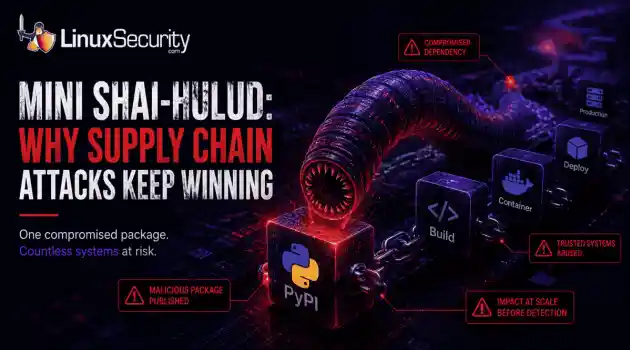
open-source python Researchers recently identified another wave of malicious packages on PyPI linked to the broader Mini Shai-Hulud campaign, a worm-like supply chain attack that spread through trusted software packages. On the surface, the packages looked no different from thousands of others published to the repository each week. . Instead of trying to break into a target network directly, the attackers hid malicious code inside software that developers were already using. A few downloads are all it takes....
Jun 09, 2026
Security Vulnerabilities malware linux
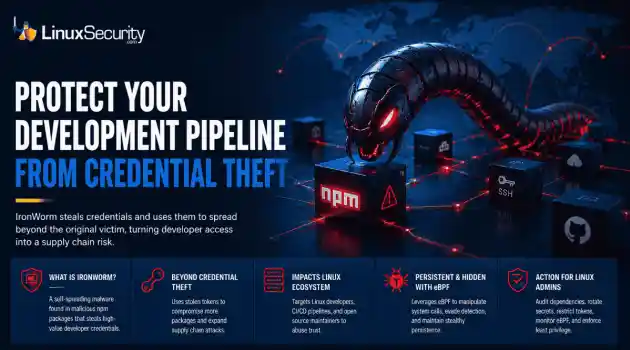
malware linux IronWorm steals credentials and uses them to spread beyond the original victim, turning developer access into a supply chain risk. . A new campaign targeting npm has evolved past simple credential theft. Researchers identified IronWorm, a self-spreading threat. It harvests high-value Linux development secrets—SSH keys, cloud tokens, package publishing credentials. One compromised workstation becomes a launchpad for downstream supply chain attacks. This is not a get-in-and-get-out operation....
Jun 08, 2026

Network Securitysystem security Linux network
system security Linux network The romanticized image of the digital nomad – a laptop on a sun-drenched balcony – rarely accounts for the actual friction of maintaining a professional development environment on the move. . The friction is amplified with Linux. We are looking for a setup that respects our kernel configurations, handles volatile network handovers, and maintains a strict security posture without the hand-holding of a consumer-grade OS – so, put simply, more than just a laptop and a sunny deck. The hardware is...
May 26, 2026

Server Securityopen-source Linux administration
open-source Linux administration Cron has existed in Unix and Linux environments for decades, handling backups, cleanup scripts, patching jobs, log rotation, monitoring tasks, and other maintenance work that administrators do not want to run manually. Most Linux servers rely on it constantly, which is exactly why attackers continue abusing it for persistence after a system has already been compromised. . Persistence through cron is not complicated. Attackers do not need a rootkit or advanced malware framework to maintain...
May 25, 2026
 Refine news
X Clear Filters
Get the latest News and Insights
Get the latest Linux and open source security news straight to your inbox.
Community Poll
What got you started with Linux?
Loading...
Explore Latest Linux Security news
We found 9,995 articles for you...
78
 security breachlinuxautomation
Risks of GitHub Repo Breach on Linux Supply Chain Security
A major internal repository breach at GitHub has exposed a critical and overlooked blind spot in Linux supply chain security. Kernel exploits, exposed SSH services, weak firewall rules, and vulnerable daemons dominated the Linux threat model for years, and in many environments, they still matter. But recent supply-chain incidents involving GitHub ecosystems, npm packages, and malicious developer tooling point somewhere else entirely: the developer workstation. . The breach matters because attackers no longer need direct access to hardened Linux servers to compromise production environments. Trusted developer tooling and CI/CD automation can now deliver poisoned code upstream long before defenders realize anything changed. Modern Linux environments increasingly depend on GitHub Actions workflows, container registries, self-hosted runners, and automated deployment pipelines tied directly to developer systems. One compromised extension or dependency may be enough to quietly move malicious code into production infrastructure. Linux environments disproportionately rely on open-source tooling, containerized CI workflows, infrastructure-as-code automation, and developer-managed deployment pipelines. That trust relationship is now becoming one of the weakest points in the modern Linux security model. Why Developer Workstations Have Become a Linux Security Blind Spot Recent supply-chain incidents involving malicious npm packages, compromised developer tooling, and poisoned CI workflows have exposed a growing problem for Linux environments: trusted developer systems now sit directly upstream from production infrastructure. VS Code extensions carry an unusual level of trust inside modern Linux workflows. Developers install them constantly for: Linting and Git integration Container and Kubernetes management Terraform support and build automation Cloud deployment workflows Most teams barely review these extensions beyond install counts and marketplace ratings. Productivityusually wins over scrutiny. Once installed, a compromised extension may gain access to: GitHub session tokens SSH keys and signing credentials npm authentication tokens Kubernetes configurations Cloud secrets and CI environment variables Linux production systems often prioritize automation, minimalism, and operational efficiency over traditional endpoint-style monitoring. That makes trusted developer environments especially valuable to attackers looking for cleaner access paths into infrastructure. Attackers no longer need to fight through hardened Linux servers directly if they can compromise the trusted tooling developers already use upstream. Why the GitHub Supply-Chain Trend Matters for Linux Security Recent supply-chain attacks highlight a dangerous reality for Linux teams: production infrastructure increasingly inherits the trust decisions made upstream inside developer tooling and CI automation. Linux systems often sit at the very end of the attack chain. The broader npm and GitHub ecosystem attacks demonstrated how malicious code can move through legitimate CI infrastructure and trusted publishing systems without immediately triggering suspicion. In several incidents, poisoned packages appeared authentic because they were distributed through otherwise trusted automation pipelines. Even cryptographic provenance becomes less meaningful if the trusted CI pipeline itself has already been compromised. Traditional Linux security still matters. Kernel hardening, SSH lockdowns, segmentation, SELinux policies, and firewall rules remain essential. But they no longer represent the full attack surface. Attackers increasingly target trust relationships because trusted automation provides cleaner and quieter access than exploiting operating systems directly. How a Single Developer Workstation Can Poison Production The attack chain starts quietly. A developer installs or updates what appears to be a legitimate VS Code extension or npm dependency. The toolingbehaves normally enough to avoid suspicion while hidden functionality begins harvesting credentials and session data. From there, attackers can move directly into trusted automation systems. A compromised developer environment may expose: GitHub access tokens SSH keys and signing credentials Kubernetes deployment configurations Cloud authentication secrets CI/CD environment variables Once attackers gain access, CI/CD systems become the amplification layer. GitHub Actions workflows may be modified to inject malicious dependencies, alter build configurations, or poison deployment artifacts. Self-hosted Linux runners create additional exposure because they often maintain persistent credentials and broad internal network access. At that point, attackers no longer need direct access to hardened Linux servers. Trusted automation delivers the malicious code for them. A compromised extension on a developer workstation may ultimately lead to poisoned containers being automatically deployed into Kubernetes clusters or production Linux environments through infrastructure already trusted by the organization. Linux CI/CD Pipelines Are Increasingly Becoming the Real Target Security researchers increasingly view CI/CD systems as the primary target for modern supply-chain attacks in Linux environments. Pipeline compromise bypasses many traditional security controls because the malicious activity occurs inside systems already approved to build and deploy software. GitHub Actions workflows deserve particular scrutiny. Risky patterns such as pull_request_target workflows may allow attacker-controlled code from external pull requests to execute inside trusted repository contexts that may still have access to repository secrets, tokens, or workflow permissions under certain conditions. Self-hosted Linux runners create even larger blast radii because they frequently maintain: Long-lived credentials Access to internal repositories Container registry permissions Terraform state files Kubernetes deployment access Infrastructure-as-code compounds the problem further. Dockerfiles, Terraform manifests, Helm charts, and deployment workflows collectively provide attackers with detailed visibility into production architecture. For Linux teams, CI/CD infrastructure must now be treated as a high-risk security boundary rather than simple deployment automation. npm Supply-Chain Attacks Continue Targeting Linux Development Environments A surge in targeted npm attacks confirms that package ecosystems remain one of the weakest links in Linux-based development environments. Attackers increasingly rely on techniques such as: Typosquatting legitimate package names Maintainer account compromise Dependency confusion attacks Poisoned transitive dependencies Transitive dependencies make the problem significantly worse. Developers may trust a direct package while having little visibility into hundreds of indirect dependencies installed alongside it. By the time defenders detect suspicious behavior, malicious packages may already exist across: CI runners Container images Production workloads Cached deployment artifacts Package trust now directly impacts the integrity of the underlying Linux environment. How Linux Admins Can Detect Exposure Security teams are increasingly adopting new response protocols for supply-chain compromises tied to developer tooling and CI automation. Admins should immediately focus on: Repository activity: Look for unauthorized workflow edits, suspicious commits, or unexpected OAuth authorizations. Runner behavior: Monitor CI runners for unusual outbound traffic, package downloads, or unexpected job execution patterns. Credential rotation: Replace GitHub tokens, SSH keys, npm credentials, cloud secrets, and Kubernetes service accounts. Artifact integrity: Rebuild containers from verified sources and validate SBOMs against known-good baselines. Extension auditing: Reviewinstalled VS Code extensions across developer systems and remove unapproved tooling. Persistence checks are equally important. Malicious workflows, poisoned caches, and hidden automation hooks may survive standard credential rotations. Supply-chain attacks rarely stop at a single layer. Best Practices for Securing Linux CI/CD Pipelines Security teams are increasingly treating developer tooling and CI infrastructure with the same level of scrutiny traditionally reserved for production servers. Endpoint Hardening Restrict VS Code extension installations through allowlists and centralized policy controls. Isolate development environments using containers or disposable workspaces. Monitor workstations for unauthorized extension activity and credential access. GitHub and CI Security Avoid risky GitHub Actions patterns such as pull_request_target unless absolutely necessary. Use MFA, short-lived tokens, and tightly scoped GitHub permissions. Deploy ephemeral CI runners instead of persistent self-hosted systems. Segment CI infrastructure from production deployment networks. Dependency and Artifact Security Verify package provenance using Sigstore or cosign. Continuously audit dependencies and monitor for suspicious package updates. Validate SBOMs before deployment. Use tooling such as OpenSSF Scorecard, Syft, Grype, and Trivy to improve visibility into software supply chains. Visibility remains the final layer. Centralized logging, behavioral monitoring, and threat intelligence integration improve detection speed when trusted tooling becomes the compromise vector. Linux Security Now Starts Before Production Linux admins spent years hardening production infrastructure against direct compromise. Attackers adapted by moving further upstream into developer environments, package ecosystems, and CI/CD automation already trusted to deploy code into production. That shift changes the security model entirely. A fully patched Linux servermay still execute poisoned code delivered through a trusted pipeline, signed package, or compromised developer workflow. In many environments, the workstation now matters just as much as the production server itself. The modern Linux attack surface no longer starts at the edge firewall or exposed SSH port. Increasingly, it starts wherever developers write, build, and ship code. Stay ahead of emerging Linux supply-chain threats, CI/CD risks, and open-source security issues by subscribing to the LinuxSecurity newsletter . Get weekly analysis, practical hardening guidance, and security insights focused on real-world Linux infrastructure. Related Reading Why CI/CD Pipelines Became Targets in Software Supply Chain Attacks GitHub Actions Linux Self-Hosted Runners Security Risks Why Linux Supply Chain Attacks Are Becoming a Nightmare for DevOps Teams The npm Supply Chain Problem: Why Installing Packages Executes Untrusted Code GitHub Actions Critical Misconfigurations Expose Open Source Risks . Explore the risks in Linux supply chain security amidst GitHub's repo breach, revealing the importance of developer tool security.. Linux Supply Chain Security, GitHub Breach, CI/CD Security, Developer Tool Threats, Security Best Practices. . Dave Wreski
 May 21, 2026
•
May 21, 2026
• Vendors/Products
209
 access controlmulti-tenantkubernetes
Addressing Multi-Tenant Risks in Linux Workloads on the Cloud
Linux administrators often face an ugly choice in the cloud: prioritize convenience and cost-efficiency by sharing infrastructure, or sacrifice those benefits for the sake of total isolation. Most modern Linux workloads don't live on their own private servers anymore. They live in shared environments like Kubernetes clusters, where multiple teams and services run side-by-side. It sounds efficient, and it usually is. . But cloud isolation isn't as ironclad as it looks on the diagram. If you don't know where the boundaries actually sit, a single misconfiguration can turn a shared server into an open door for an attacker. What “Multi-Tenant” Actually Means Most Kubernetes environments are shared whether teams realize it or not. Different workloads end up on the same worker nodes, using the same kernel underneath, separated mostly by configuration and orchestration rules. That separation holds until somebody exposes a service they forgot about, over-permissions a service account, or leaves lateral movement paths sitting open inside the cluster. Organizations love this model because it’s cheap and fast to scale. However, there is a big difference between "soft" and "hard" multi-tenancy. As explained in the official Kubernetes guidance on multi-tenancy , most setups are "soft." This means isolation depends heavily on configuration. Features like namespaces help separate workloads, but they are not always enough to contain an attacker after a system has been compromised. Why Linux Workloads Become Exposed in Shared Environments The fundamental security challenge in a shared Linux environment is that, despite the abstraction, the containers still share the same Linux kernel. When you deploy a pod, you are creating a logical boundary. But underneath that boundary, your workload is just a process—or a set of processes—running on a worker node that likely hosts dozens of other containers. Isolation here depends entirely on configuration. If the kernel is the "foundation" ofyour apartment building, the containers are just drywall partitions. They provide privacy, but they don't provide structural protection. If you are looking for more technical context on why this matters, the AWS tenant isolation guidance is an essential read. It breaks down why Kubernetes is not a hard security boundary and explores the reality of shared-node risks. In practice, this changes the threat model considerably. Attackers rarely need to "break" the cloud provider. They only need to find one weak, misconfigured workload on a shared node, and they can often use that foothold to begin enumerating the rest of your environment. Real-World Reality Check: The Tesla Breach The 2018 Tesla breach showed how quickly a weak Kubernetes configuration can turn into a larger cloud security problem. Security researchers found that one of Tesla’s Kubernetes consoles had been exposed to the public internet without password protection. Once attackers reached that management interface, they were able to view how containers were deployed and managed inside the environment. The bigger issue was what they found next. Cloud credentials were stored inside the cluster, giving the attackers a path from the Kubernetes environment into Tesla’s AWS storage. From there, they used Tesla’s compute resources to mine cryptocurrency. The lesson is blunt: configuration is part of the security boundary. The attackers did not need to break AWS isolation or exploit an advanced zero-day. They found an exposed control plane, pulled credentials from the environment, and moved laterally from there. For DevOps and platform teams, that is the real risk in multi-tenant infrastructure. If the management plane is exposed, the separation between workloads stops meaning much in practice. How Weak Isolation Leads to Real Security Problems When isolation fails, the damage usually starts small. An attacker gains access to one exposed workload, identifies overly broad permissions, and begins moving through theenvironment from there. In many cases, the first step is privilege escalation or lateral movement. A compromised container may expose access to the underlying node, shared resources, or internal services that were never meant to be reachable from that workload. Suddenly, that stolen service account token isn't just a key to one app; it’s a that token may provide access far beyond the workload it was originally created for. As discussed in Kubernetes RBAC best practices , these mistakes are almost always configuration-based. It is easy to accidentally grant "cluster-admin" or overly broad access to a service account that only needed to read a single secret. Why Cloud Security Gets Harder at Scale Security becomes harder once environments grow beyond what a single team can realistically track day to day. A cluster that started with a few workloads can eventually turn into thousands of pods spread across multiple environments, teams, and cloud accounts. At that point, consistency becomes the real problem. One team allows broad service account access for convenience. Another disables a network policy temporarily and forgets to restore it. Someone spins up a test workload that never gets cleaned up. Months later, nobody remembers which exceptions were intentional and which were accidents. This is why multi-tenant Kubernetes environments become difficult to secure at scale. The issue usually is not a single catastrophic mistake. It is the accumulation of small configuration decisions across hundreds of workloads and administrators. Google’s GKE enterprise multi-tenancy recommendations highlight that the challenge isn't just technology; it's governance. The Tradeoff Between Cost, Scalability, and Isolation If shared environments carry these risks, why do we use them? The answer is simple: business necessity. Dedicated clusters for every single team or customer are prohibitively expensive and difficult to maintain. Most organizations—especially those running SaaSplatforms—rely on tenant density to keep costs manageable. As outlined in the Azure Kubernetes multi-tenant architecture guidance , this is an operational decision. It forces a trade-off between the desire for perfect isolation and the reality of budget and operational efficiency. The goal for a modern engineering team isn't to eliminate shared infrastructure—it's to manage the risk that comes with it. Practical Ways to Reduce Multi-Tenant Linux Risks You don't need to abandon your cloud platform to stay secure, but you do need to stop relying on default isolation. Hardening a shared environment requires a layered approach: Implement Least Privilege: Audit your RBAC roles religiously. If a service account doesn't need it, don't give it. Segment Your Workloads: Use dedicated node pools for sensitive workloads. If an application handles PII or financial data, it shouldn't be sitting on the same physical host as your public-facing dev environment. Enforce Network Policies: Don't let your pods talk to everything. Use a "deny-all" default and explicitly allow only the traffic that is necessary. Monitor East-West Traffic: Most attacks happen laterally. If you aren't logging the traffic inside your cluster, you are blind to how an attacker moves once they get in. Audit Regularly: Use automated tools to scan for overly broad service accounts and risky container configurations. For those looking to build a more robust architecture, the AWS SaaS security best practices offer excellent guidance on how to build security decisions into the environment early instead of trying to retrofit them later. Conclusion Multi-tenant cloud infrastructure is the standard for modern Linux environments, but shared infrastructure inherently expands the importance of strong isolation and consistent governance. Organizations don't need to abandon shared cloud platforms, but they do need to understand where software-based isolation can fail. By moving toward a model ofleast-privilege access and layered controls, we can reduce our exposure. Shared infrastructure is not going away, which means containment matters just as much as prevention. Strong isolation and least-privilege controls help limit how far an attacker can move after gaining access to a workload. Linux threats evolve quickly, especially in shared cloud environments where a single weak configuration can expose an entire workload. Subscribe to the LinuxSecurity.com newsletter for the latest research, breach analysis, hardening guidance, and Linux-focused security updates delivered directly to your inbox. Related Reading What Is Kubernetes Security? A Linux Admin’s Practical Guide What Is a Container Escape Vulnerability? Kubernetes Security: Top Strategies for 2025 Against Emerging Threats Securing Kubernetes: DevSecOps Strategies for Cloud-Native Environments Beyond the Sandbox: Container Escape Techniques Observed in Recent Research . Explore the complexities of multi-tenant security in Linux workloads, and learn strategies to enhance your cloud environment.. Kubernetes Security, multi-tenant Linux workloads, cloud isolation strategies, container security best practices. . Dave Wreski
May 21, 2026
•
Security Trends

78
 incident responsecloud securityLinux environment
MXDR Provider Selection for Linux Environments and Security Services
Managed Extended Detection and Response (MXDR) has become one of the most sought-after security services in the enterprise market — and with good reason. It promises the holy grail: broad visibility across endpoints, network, cloud, email, and identity, combined with the 24/7 human expertise most organizations simply cannot build in-house. . However, the rapid growth of the market has produced a wide range of providers whose capabilities vary considerably beneath the surface. Choosing the right MXDR solution is not just about buying software; it’s about hiring a specialized team that understands the difference between a standard workstation and a mission-critical Linux server. If you are going to trust someone with your infrastructure, you need to look past the pitch and evaluate the actual substance. Define What You Actually Need Before You Evaluate Anyone A lot of teams start vendor calls too early. They have a rough MXDR budget, maybe a shortlist, but not a clear view of what they need the provider to cover. That creates noise quickly because the MXDR solution is not a single fixed service. Providers vary in coverage, response authority, integration depth, and how much human triage sits behind the platform. Before you speak with vendors, get your team aligned on the basics: What environments need coverage? Decide whether you only need endpoint monitoring, or whether cloud workloads, identity, email, and network traffic need to be in scope too. For Linux-heavy environments, ask whether the provider can see kernel-level events , container runtimes, and meaningful telemetry, not just raw syslogs pushed into a dashboard. What should the partnership actually do? Some teams want to approve every response action. Others need a provider that can isolate hosts, block indicators, or escalate incidents when internal staff are offline. Spell that out before procurement gets involved. What are your compliance constraints? GDPR, NIS2, HIPAA, and PCI DSS can affect datahandling, storage location, access controls, and reporting. Do not leave this for the contract review stage. By then, the wrong provider may already look like the favorite. Does the provider fit your current stack? Map what you already use for patching, identity governance, email security, endpoint control, and cloud monitoring. Then ask how the MXDR provider will extend that stack instead of duplicating alerts your team already sees. Clear answers make vendor conversations sharper. They also reduce the odds of choosing a provider because their pitch looked strong, while their actual coverage misses the systems creating most of your exposure. Not All MXDR Coverage Is Equal The defining characteristic of MXDR — the "extended" element — is coverage across multiple security domains simultaneously. In practice, however, providers differ considerably in how genuinely cross-domain their visibility is. Some platforms offer native integrations across endpoints, network, cloud, identity, and email. Others aggregate feeds from separate products, which can introduce data gaps, latency, and correlation blind spots. In a Linux-heavy environment, an attacker might use sophisticated persistence or fileless techniques that simple log aggregation will miss. When evaluating coverage, go beyond the marketing slides. Ask specifically: Which environments does the provider have native sensor coverage for? Which rely on third-party integrations? What happens to detection quality when telemetry from one domain is unavailable? A provider whose detection capability degrades significantly when a specific integration is absent is not a true MXDR partner; they are a SIEM in disguise, and they may leave dangerous gaps in the environments that matter most to your organization. Human Expertise: Who Is Actually Watching? MXDR is fundamentally a people and process service layered on top of technology. You can have the most advanced detection engine in the world, but if the analyst team isunderstaffed, junior, or drowning in a shared queue, you are just paying for fancy noise. Don’t buy the "we have a global, 24/7 SOC" line without stress-testing it. Ask the blunt questions: The Coverage Model: Is your account assigned a dedicated team, or are you in a giant shared pool? If you are in a pool, you are competing with a hundred other customers for the attention of a tired analyst who likely has no idea what a custom Linux binary looks like in your environment. The Experience Gap: Who is actually looking at your alerts at 3:00 AM? Is it a Senior Incident Responder who can interpret a suspicious kernel-level anomaly, or a monitor-tech who just follows a basic flowchart? The Communication Workflow: When a high-fidelity threat is identified, how do they talk to you? Do they just dump a generic ticket in your lap, or do they provide an executive summary that explains the why and the how ? If you are serious about a vendor, skip the sales-led reference call. Find an existing customer in your industry and ask them: "The last time a real threat hit your network, did the provider show up and help you drive the response, or did they just send you an email saying they saw something weird?" Response Authority and Speed How much authority does the provider have to act when a threat is confirmed? Some providers offer "human-in-the-loop" workflows where every action requires your sign-off. Others can isolate endpoints, block processes, and revoke sessions autonomously. There is no "correct" model, but the right answer depends on your team’s maturity. Organizations with lean security teams and limited out-of-hours coverage generally benefit from providers with broader autonomous response capability. Those in highly regulated environments, or teams running complex OT, usually need a firmer hand on every response action. That is not overcaution. It is how you avoid turning a containment play into an outage. Look for a provider that lets you tune response workflowsinstead of forcing one operating model. Heimdal’s platform supports that kind of balance, giving teams room to adjust autonomous action and human approval as trust builds. You might start with “notify only” on high-risk assets, then move toward stronger automated containment once detections, escalation paths, and false positives have been tested in real incidents. SLAs, Transparency, and Reporting Mean time to detect, or MTTD, and mean time to respond, or MTTR, are often quoted. The problem is definition drift. Some providers count time spent triaging low-confidence alerts that later prove benign, while others measure only confirmed threats with enough signal to justify a response, so the numbers can look comparable on a slide while measuring very different work. Reporting matters just as much. A useful post-incident report should be led by forensics and show what happened, how the activity was identified, what actions were taken, and what risk remains after containment. Vague summaries do not help your team patch gaps, tune controls, or hold the provider accountable. The Bottom Line Choosing an MXDR provider is not just a procurement call. It shapes how detection, escalation, containment, and reporting work inside your environment for years. Pick the team you can question under pressure, not just the one with the cleanest dashboard. The providers worth selecting are those who demonstrate their capabilities transparently, communicate clearly under pressure, and operate in a way that matches your team's capacity and risk tolerance — not just the ones who present best in a structured demonstration. Take the time to go beyond the pitch; do the legwork now, and the decision becomes significantly clearer when the next incident hits. . Explore how to choose the right MXDR provider for your Linux environment, focusing on key factors beyond the sales pitch.. MXDR provider, Linux security, incident response strategy, cloud security services. . MaK Ulac
May 19, 2026
•
Vendors/Products
77
 security advisoryremote accessLinux administration
Securing Remote Access to Linux Servers: Best Practices for 2026
Linux runs the internet. More than 96% of the world’s top one million web servers operate on Linux-based systems. That makes every linux server a target by default. Attackers do not go where defenses are strongest; they go where the infrastructure is exposed. . Attackers do not need to break everything. One weak login is enough. One open port, one forgotten service, one stale account that still works from three jobs ago. That is usually where server security starts to fail, not in some dramatic exploit chain. Remote access has always been the soft spot in Linux administration. SSH gets hit constantly. Bots hammer exposed ports, old credentials resurface, and misconfigured services sit there longer than anyone wants to admit. The work is basic, but it matters: cut the exposure, tighten authentication, read the logs, and shut down whatever should not be reachable. SSH Is Still the First Line of Defense If your server is on the internet, someone is already trying to log in. That is just the baseline now. Default SSH settings are built for convenience, and convenience is not what you want on a public-facing box. Start by moving SSH away from port 22 . It will not stop someone who is actually targeting you, and it is not a replacement for real hardening. But it does cut out a lot of low-effort scanning, which means cleaner logs, less firewall noise, and fewer false positives wasting your time when something real starts moving. SSH needs more than a port change. Limit who can log in. Disable root login. Review allowed users. The daemon should expose only what the admin workflow actually needs, because anything extra becomes something else to patch, monitor, or explain later. Ditch Password Authentication Entirely Passwords are a liability. Brute-force attacks, credential stuffing, phishing, reused creds, all of it gets easier when password-based SSH login stays enabled. Switch to SSH key pairs and treat passwords as something that should not be part of remote serveraccess anymore. Generate an Ed25519 key. It is faster and more secure than RSA at comparable key lengths. Copy the public key to the server, then open /etc/ssh/sshd_config and set: PasswordAuthentication no PubkeyAuthentication yes PermitRootLogin no Restart the SSH daemon after editing the file. Keep your existing session open and test the new connection in another terminal before you close anything. Locking yourself out of your own server is a rite of passage, but it does not need to happen today. Two-Factor Authentication Adds the Second Wall Key-based authentication is strong. Adding two-factor authentication makes remote login much harder to abuse if a private key gets stolen from a laptop, copied by malware, or pulled from a bad backup. The key should not be the whole story. Google Authenticator works cleanly with PAM on most major distros. Duo Security is better suited for teams that need centralized management and reporting. Either way, 2FA adds a pause point that attackers cannot easily automate around. This is not about making admin work annoying. It is about assuming one control may fail. That assumption is usually correct. Firewall Rules Should Be Simple and Strict A firewall should block everything by default and open only what is needed. Not what might be useful later. Not what was needed during setup and then forgotten. Needed now. On Ubuntu and Debian systems, ufw keeps the basics readable: ufw default deny incoming ufw default allow outgoing ufw allow from 203.0.113.5 to any port 2222 ufw enable Replace the IP and port with your own. If you manage servers from a fixed IP or a small trusted range, allowlisting those addresses is one of the cleaner firewall rules you can put in place. It cuts down noise before authentication even starts. Every exception should have a reason. A temporary open port has a habit of becoming permanent if nobody writes it down. VPNs and Encrypted Tunnels Keep Access Controlled VPNs sit in a usefulplace for Linux administrators. They are not magic, and they do not replace SSH hardening, but they keep management traffic inside a controlled path instead of leaving SSH exposed to the wider internet. For teams, that means fewer public login surfaces. For individual admins, it also means steadier access to documentation sites, package mirrors, security databases, and research tools that may be restricted or throttled by region. The practical value is simple enough: admin traffic moves through an encrypted tunnel before it reaches the server. For Linux administrators, understanding proper VPN setup on Linux is useful because it protects management traffic and keeps work resources reachable without opening more services than needed. A VPN should sit in front of good server-side controls, not replace them. Fail2Ban Handles the Repetitive Noise No sysadmin watches authentication logs manually all day. Fail2ban does that job quietly. It parses auth logs, spots repeated failures, and bans offending IPs through firewall rules without waiting for a human to intervene. Set the SSH jail with a reasonable maxretry value. Three to five failed attempts is enough for most systems. Use a ban time of at least an hour, and consider longer bans for repeat offenders on servers that get hit constantly. Fail2Ban will not stop every attacker. Distributed botnets can rotate IPs, and slow attempts can slip under thresholds. Still, it removes a lot of junk from the board, and that makes real triage easier. The Principle of Least Privilege Is Where Cleanup Starts The principle of least privilege sounds obvious until you audit a real server. Every user, service, daemon, and cron job should have only the permissions it needs. No more. Production systems rarely look that clean. Shared root access hangs around. Old sudoers entries survive because nobody wants to break a workflow. Service accounts get more permission than they need, then nobody revisits them for two years. That is how smallcompromises get room to spread. Start with the accounts. Then check sudo access. Then review services. A restricted account gives an attacker less room for lateral movement, fewer files to touch, and fewer commands that matter. Good places to look: /etc/sudoers and files under /etc/sudoers.d/ old user accounts that no longer need access services running as root without a clear reason shared admin credentials cron jobs and automation tokens This is not glamorous work. It is the kind of cleanup that prevents a bad login from turning into a full host compromise. Keep Systems Patched Relentlessly Patching still gets missed. Not because admins do not know better, but because maintenance windows slip, staging takes time, and production systems always have some reason to wait. Attackers like that. Old vulnerabilities are still useful because plenty of systems remain unpatched after fixes are available. The exploit does not need to be new if the target is behind. That is the uncomfortable part. Enable automatic security updates where it makes sense. On Debian and Ubuntu, unattended-upgrades handles this cleanly. On Red Hat-based systems, dnf-automatic does the same job. For critical systems, test patches in staging first, but do not let testing become a permanent excuse. Intrusion Detection Gives You Something to Work With Most attacks should be blocked by authentication controls, firewall policy, and patching. Intrusion detection is for cases that get through or start from inside. You need to know when something changed. AIDE can build a cryptographic baseline of the filesystem and alert when important files are modified. Auditd gives deeper syscall-level visibility, which helps when you need to know what ran, who ran it, and when. The output can be noisy. Tuning takes time. Still, during incident response, noisy data beats no data. Knowing which files changed and which commands executed is the difference between focused triage and weeks of forensicguessing. Logging Has to Be Active There is no such thing as useful logging if nobody reads the logs. Disk space full of ignored auth events is not security. It is storage. Track the things that show real access and real change: successful logins, failed login bursts, sudo use, new source IPs, service restarts, and edits to sensitive files. Logwatch can send daily summaries for smaller setups. Graylog or the Elastic Stack works better when multiple servers need centralized search, alerting, and dashboards. Even a rough script that emails you when someone authenticates from a new IP is better than nothing. Crude tools catch real compromises all the time because they are actually watched. SSH Certificates Help Teams Scale Access Managing individual SSH keys is fine when the team is small. Ten people, a few servers, clear ownership. Past that, key management starts to rot. SSH certificates, signed by an internal Certificate Authority, bring control back into one place. Certificates can expire automatically. Access can be scoped by user and host. Revocation does not require manually removing keys from every server. This is where remote access starts to scale without chaos. It also gives security teams a cleaner way to answer a basic question during an audit: who could log in, where, and for how long? Zero-Trust Architecture Fits Modern Infrastructure The old model was simple. Protect the perimeter, then trust what is inside. That model does not fit modern infrastructure anymore. Cloud instances, remote workers, contractors, multi-region deployments, and private admin panels all blur the perimeter. There may not be one clean “inside” to trust. Zero-trust architecture starts from the opposite assumption: every access request is untrusted until it proves otherwise. Tools like Tailscale can apply this model to SSH and internal services without a full infrastructure rebuild. Cloudflare Access can do similar work for web-based admin panels. The point is not thelabel. The point is to stop treating network location as proof of safety. Disable What You Do Not Need Every open port is an attack surface. Every running service that is not actively used is another thing to patch, monitor, and defend. Most servers accumulate small exposures over time. Run: ss -tulpn That shows listening sockets. Cross-reference the output against what the server actually needs to do. If a service should not be running, disable it: systemctl disable --now servicename Minimal cloud images are usually cleaner than old bare-metal systems, but drift still happens. A temporary service gets enabled during troubleshooting. A package opens something unexpected. A test daemon stays up because nobody circled back. Check anyway. Keep Up With a Field That Keeps Moving Security is not finished after one hardening pass. A checklist from 2022 may miss newer attack patterns, deprecated recommendations, or defaults that changed since the server was first built. That happens fast. Use official distribution security guides, vendor advisories, and reputable cybersecurity resources. You do not need to read everything. You do need a habit that keeps your assumptions from going stale. The best teams turn lessons into runbooks. They patch the process after the incident, not just the host. Backups and Recovery Still Matter Hardening remote access reduces risk. It does not remove the need for recovery. Ransomware, destructive intrusion, failed patching, admin error, and compromised automation can still take systems down. Backups should be offline, off-site, and tested. If you have never restored a backup, you do not really know if you have one. It is just a hope sitting in storage. Automate backups, verify them regularly, and keep at least one copy beyond the reach of the production server. If an attacker gets root on the box, they should not be able to delete every recovery path. Final Thoughts: Layers, Not Silver Bullets No single tool secures remote access to a Linux server . Not SSH keys alone. Not a firewall alone. Not 2FA alone. Security works better as a stack, where one layer catches what another misses. Start with the basics. Harden SSH , disable password authentication, configure firewall rules , and limit who can access the service. Add two-factor authentication, install fail2ban , patch consistently, and review access with the principle of least privilege in mind. Then go deeper. Add intrusion detection, centralize logs, use SSH certificates for teams, tighten exposed services, and move toward a zero-trust architecture where it makes sense. Review the setup every few months. Attackers are patient, systematic, and persistent, so the defensive work has to be the same. . Secure your Linux servers by tightening remote access protocols, implementing SSH keys, and utilizing 2FA for better protection.. remote access security, linux servers, ssh configuration, firewall management. . MaK Ulac
May 13, 2026
•
Server Security
77
security advisorysecurity toolslinuxLinux AI Tools Require Enhanced Observability for Security
Linux security has traditionally depended on logs, metrics, and alerts. That model works well when systems behave predictably. Inputs come in, processes run, events get logged. Security teams can usually reconstruct what happened afterward without too much trouble. . AI changes that assumption. Machine learning systems are now embedded across infrastructure and security tooling. Email filtering, threat detection, and automated response pipelines. Some systems classify suspicious activity. Others decide whether containers should be isolated or traffic should be blocked. The issue is that AI-driven decisions are not always visible through normal logging. And that creates blind spots. AI Is Becoming Part of the Security Stack Older Linux security environments were built around observability . Analysts monitored system calls, authentication events, process activity, and network traffic. The idea was simple enough. If something happened on the system, logs would eventually show it. AI systems complicate that model because their logic often lives inside the model itself rather than inside readable rules or scripts. Enterprise adoption is moving quickly, too. OpenAI reported in late 2025 that enterprise employees were saving roughly 40 to 60 minutes per day using AI tools. Organizations are now deploying AI into production workflows instead of limiting it to testing or research environments. That includes security operations. AI agents increasingly handle tasks that once required human judgment. Sorting alerts. Classifying files. Filtering phishing emails. Sometimes, even triggers automated actions without an analyst reviewing every step first. Useful, sure. But harder to audit when something goes wrong. Traditional Logs Show Events, Not Reasoning This is where traditional logging starts falling short. A firewall rule change might appear in logs, but the reasoning behind the change usually does not. An AI-powered email security system may quarantine a message, yet analystsoften cannot see the exact chain of logic that led to the decision unless the system was specifically designed to expose it. That gap becomes a problem fast. Security teams may see the outcome while missing the intermediate reasoning steps entirely. False positives become harder to debug. Auditing decisions take longer. Detecting adversarial manipulation against AI systems gets messy because the internal decision process is mostly opaque. For Linux environments built around transparency and traceability, that is a major shift. Why AI Agent Observability Matters AI agent observability is becoming important for a pretty practical reason. Teams need visibility into how AI systems behave inside production environments. Not just the final output, but also the surrounding context. What data went into the model? What tools did the AI agent use? What outputs were generated? Sometimes, even the intermediate reasoning steps or confidence scores. Without this layer of visibility, AI systems behave like black boxes sitting inside otherwise observable infrastructure. And Linux administrators generally dislike black boxes for obvious reasons. Extending Observability Beyond Infrastructure Traditional observability mostly focuses on infrastructure health. CPU usage, memory pressure, network latency, and uptime metrics. Those signals still matter, but AI systems require another layer of telemetry on top of them. Teams increasingly want visibility into: Prompt inputs Model outputs Tool interactions Workflow state changes Confidence scoring Automated response actions That information becomes especially important in regulated environments where organizations need to explain why certain actions were taken. Compliance requirements do not disappear just because an AI model made the decision instead of a human analyst. The infrastructure still needs accountability somewhere. Why This Matters Going Forward Linux security teams are slowly adapting to this shift. AIsystems are no longer treated as isolated tools running off to the side. They are becoming part of the production stack itself, which means they also need monitoring, auditing, and visibility controls like any other critical component. Logs and metrics are still necessary. Nothing changes there. But in AI-driven environments, they are no longer enough on their own. . Discover how AI influences Linux security and the need for enhanced observability to ensure effective monitoring.. Linux Security, AI Observability, Threat Detection, Security Monitoring. . MaK Ulac
May 11, 2026
•
Server Security
74
firewallnetworkingsecurity controlsLinux Firewall Rules Management Challenges Kubernetes Security
A Linux server running a few predictable services is relatively easy to secure. . You know which ports should be exposed and which processes are expected to communicate externally, and once the firewall rules are tuned properly, the environment usually remains stable for long periods. Troubleshooting is also fairly direct. If traffic fails, you inspect logs, trace connections, and work backward through the ruleset. Kubernetes changes almost all of that. The issue is not that Linux firewalling tools stopped working. nftables and iptables still process packets efficiently and remain deeply integrated into the networking stack. The problem is that modern orchestration layers introduced networking behavior that no longer maps cleanly to traditional host-level assumptions. Many Linux administrators discover this gradually. The first cluster may feel manageable, especially in a smaller environment. Then workloads begin to scale dynamically, service meshes are introduced, developers deploy additional namespaces, and suddenly the original firewall model becomes difficult to reason about operationally. The biggest challenge usually is not filtering traffic itself. It is understanding where enforcement is actually happening. Kubernetes Abstracts Networking Away From the Host One reason Kubernetes environments become harder to secure is that packet flow is no longer entirely controlled by the Linux machine. The host still matters, obviously. Traffic still traverses kernel networking layers, and tools like nftables remain relevant for local filtering and node-level hardening. But orchestration systems now make decisions above the operating system itself. A simple workload deployment can involve Kubernetes NetworkPolicies, cloud security groups, overlay networking, ingress controllers, service mesh policies, container runtime networking, and host firewall rules all at the same time. Those layers often interact in ways that are not immediately obvious during troubleshooting. For example,a Linux admin may inspect nftables rules and see no local traffic blocking, even though the actual restriction is enforced by a dynamically applied Kubernetes NetworkPolicy. The behavior itself is straightforward once understood, but troubleshooting becomes harder because enforcement is distributed across several layers rather than managed entirely from the Linux host. The official Kubernetes NetworkPolicies documentation gives a good overview of how these policies affect pod communication and namespace isolation in real-world environments. That changes the operational workflow considerably. Traditional Linux firewall troubleshooting was mostly linear. In containerized infrastructure, visibility becomes fragmented across multiple systems designed independently of one another. East-West Traffic Creates Most of the Operational Pain Perimeter filtering is usually no longer the hardest part. In many cloud environments, inbound traffic is already heavily restricted through load balancers, reverse prox ies, API gateways, or cloud-native filtering services. The more difficult problem is understanding internal communication between workloads. A compromised pod moving laterally inside the cluster often generates traffic that looks completely legitimate at the packet level. From the Linux host’s perspective, it may simply appear as normal encrypted communication between internal services. That is where traditional firewall logic begins to reach its limits. iptables and nftables understand ports, addresses, interfaces, and connection states very well. They do not understand workload identity, namespace trust boundaries, or application context without additional orchestration awareness layered on top. This becomes especially noticeable once teams start deploying microservices aggressively. Internal traffic volume is growing rapidly, and maintaining granular segmentation manually at the host layer is becoming operationally difficult to sustain. Most teams eventually respond by looseningcontrols simply because maintaining perfect granularity slows deployments down too much. nftables Is Cleaner Than iptables, but the Core Problem Remains Most administrators who have worked extensively with both systems would probably agree that nftables is easier to manage than older iptables configurations. The syntax is more consistent, IPv4 and IPv6 handling is unified, and maintaining larger rule sets is significantly less painful than dealing with sprawling legacy chains. Something like: nft add rule inet filter input tcp dport 22 ct state new accept It is much easier to reason about than older multi-table iptables structures. Performance improvements are also noticeable on busy systems. But migrating from iptables to nftables does not fundamentally solve the visibility problem introduced by Kubernetes and cloud-native infrastructure. The firewall still operates primarily at the node level. It still lacks awareness of workload orchestration, service relationships, and dynamic container behavior happening elsewhere in the stack. That distinction matters because many Linux teams initially expect nftables migration projects to improve security posture more than they actually do. In practice, the migration mainly improves maintainability. Why Linux Teams Started Layering Security Controls What most mature infrastructure teams eventually realize is that no single layer provides enough visibility anymore. Host-level filtering still matters. Kubernetes NetworkPolicies matter. Cloud-native ACLs matter. Identity-aware access controls matter. The environments that scale cleanly usually combine all of them rather than relying too heavily on a single approach. A fairly common operational pattern now looks something like this: The Linux host handles node-level hardening, SSH restrictions, local filtering, and outbound control. Kubernetes policies manage workload segmentation and namespace isolation. Cloud security groups enforce infrastructure-levelboundaries between services and environments. Centralized monitoring systems aggregate telemetry from all layers, enabling administrators to understand what is happening across the environment. That layered approach is more complicated initially, but it tends to age better operationally than directly managing every trust boundary from the Linux host. Logging Becomes More Important Than Rule Writing One thing that surprises many teams during Kubernetes adoption is how much time shifts away from writing firewall rules and toward understanding traffic visibility. Static environments are fairly predictable. Dynamic orchestration platforms are not. A service that behaved normally yesterday may suddenly exhibit entirely different traffic patterns due to autoscaling, deployment changes, or internal service discovery updates. That is why logging quality becomes critical. Linux administrators increasingly rely on: journal aggregation eBPF observability tools Kubernetes audit logs flow telemetry centralized traffic analytics Without visibility, troubleshooting becomes mostly guesswork. The challenge is no longer simply identifying blocked packets. It is understanding whether communication itself should exist in the first place. Where Cloud Firewalls Fit Into This One thing that changed significantly over the last few years is how organizations think about segmentation and visibility in hybrid infrastructure. In smaller environments, local firewalling may still be manageable directly from the host layer. In larger deployments spanning cloud providers, Kubernetes clusters, and mixed workloads, teams often need broader policy visibility than nftables alone can provide. That is part of why Cloud firewalls became more common operationally. Not necessarily as replacements for Linux-native controls, but as centralized enforcement and visibility layers sitting above fragmented infrastructure. For administrators dealing with distributed workloads, theoperational challenge is usually consistency rather than raw packet filtering performance. Maintaining comparable policies across cloud environments, container platforms, and traditional Linux systems manually becomes difficult over time. Final Thoughts Linux firewalling tools are still extremely effective at what they were designed to do. The issue is that modern infrastructure introduced orchestration layers and traffic patterns that extend far beyond the visibility of a single host. That does not make nftables or iptables obsolete. It simply changes where they fit inside the architecture. Most Linux teams are no longer trying to solve cloud segmentation entirely from the host layer. They are combining Linux-native controls with orchestration-aware policy systems, centralized visibility, and workload-level segmentation in order to keep dynamic environments manageable as they scale. . Explore why managing Linux firewall rules in Kubernetes is challenging and how to enhance visibility in dynamic environments.. Kubernetes Security, Linux Firewall, Cloud Security, Networking Policies, Network Visibility. . MaK Ulac
May 08, 2026
•
Network Security
209
 detectionsecurity monitoringarchitecture
Developing a Successful Open Source Security Information Management System
Open source SIEM gives teams flexibility, but it also shifts the burden of keeping everything running onto the architecture itself. This guide looks at how SIEM pipelines actually behave once they’re live, where they start to break down, and what small teams need to get right to keep detection usable. . Most SIEM failures don’t show up at deployment. They show up later, when ingestion starts failing, logs stop lining up cleanly, and alert noise makes the system harder to trust. The pipeline keeps running, but detection quality drops, and that’s where most teams lose visibility without realizing it. This post breaks down realistic SIEM architecture patterns, common failure points, and how to build a pipeline that stays stable under real conditions without overbuilding something your team can’t maintain. What a SIEM Pipeline Actually Needs A SIEM platform isn’t one system. It’s a chain of systems that either hold together or fall apart under load. Data ingestion from endpoints, apps, and infrastructure Transport layer moving logs reliably Log aggregation into a central point Processing and normalization for consistency (turning different log formats into a standard structure) Storage is split between hot and warm data Detection and correlation logic Visualization for analysts That’s the baseline SIEM architecture. Miss one layer and things get messy fast. Most teams focus on ingestion and dashboards. The problems usually sit in the middle, where log aggregation breaks down or normalization never really happens, which leaves the rest of the pipeline working with inconsistent data and unreliable signals. Constraints Small Teams Actually Face This is where most SIEM platform advice drifts away from reality. It assumes time and staffing that just aren’t there. Limited engineering time to maintain pipelines Budget constraints around storage and compute No dedicated detection or SOC team Operational overhead from complex SIEM tools Alert fatigue from noisy rules None of these are edge cases. They’re the default. You don’t build the same SIEM tools setup with two engineers that you would with a full security team, and trying to mirror enterprise patterns usually leads to half-built systems that generate more noise than value. Architecture Pattern 1: Lightweight Centralized Logging This is where most open source SIEM tool deployments start. It’s simple, and that’s the point. Flow looks like this. Sources send logs through agents (small programs installed on systems to collect and forward logs), agents forward to a central log aggregation layer, and that layer feeds a dashboard for basic visibility. Pros: Fast to deploy Low operational overhead Cons: Limited detection capability Doesn’t scale cleanly Log aggregation tools handle most of the heavy lifting here. You get visibility quickly, but detection is mostly manual or rule-light, which means this works best when you need coverage fast and can accept gaps while the system matures over time. Architecture Pattern 2: Queue-Based SIEM Pipeline This is where things start to resemble a proper SIEM architecture. Not cleaner, just more contro lled. Sources send logs through agents Agents push data into a queue (a buffer that temporarily holds logs so spikes don’t overwhelm the system) Processors pull from the queue and normalize logs Data moves into storage and detection layers The queue changes everything. It decouples ingestion from processing. Log aggregation still exists, but it’s no longer the choke point. You can buffer spikes, retry failed processing, and scale different parts of the pipeline independently, which makes this model more stable under load but also introduces more moving parts that need to be maintained and monitored continuously. Pros: Better scalability More resilient data flow Cons: Higher complexity More operational overhead Architecture Pattern 3: Hybrid SIEM Platform + Detection Layer At some point, centralized logging isn’t enough. Teams start layering detection on top of their existing pipeline instead of rebuilding from scratch. Detection Layer Rule-based detection sits on top of your data. Not perfect, but predictable. You define what matters and tune over time. Enrichment Logs without context don’t help much. Adding t hreat intel , asset data, or user context turns raw events into something actionable, though it also increases processing overhead and dependency on external data sources. Response Basic automation starts to creep in. Triggering alerts, isolating hosts, or flagging accounts. Not full SOAR, just enough to reduce manual triage. This is where open source SIEM starts to feel like a real SIEM platform. Still fragmented, still DIY, but capable. It also comes with the same tradeoff. More capability means more maintenance, and SIEM software doesn’t get easier to manage as you add layers. It just becomes more critical to keep it stable. Where Open Source SIEM Works (and Where It Breaks) Open-source SIEM has clear appeal. Control, cost, flexibility. It works well when you need to shape the pipeline around your environment instead of adapting to a fixed platform, and when your team can handle the operational side without relying on vendor support. Strengths: Flexible architecture design Lower upfront cost Full control over data and pipelines Limitations: Ongoing maintenance burden Complex tuning and rule management Limited support compared to commercial SIEM tools The gap shows up over time. Not at deployment. Commercial SIEM tools smooth out operations but limit customization. Open source SIEM tools give you control but expect you to handle everything that comes with it, and that tradeoff only becomes visible once the system is under real load. Common Failure Points in SIEM Pipelines Most SIEM architecture failures aren’ttechnical limitations. There are design issues that show up later. Ingesting too much data without filtering Weak log aggregation strategy leading to gaps Poor normalization across sources Alert overload from unrefined rules No retention planning for long-term storage These don’t break things immediately. They degrade the system slowly. By the time teams notice, detection quality has already dropped, and logs are either missing, inconsistent, or too noisy to trust, which turns the SIEM into a storage system instead of a detection tool. How to Choose the Right SIEM Architecture There’s no single model that fits every team. The right SIEM architecture depends on what you can actually support. Team size and available engineering time Log volume and data growth Detection requirements and risk tolerance Budget for infrastructure and storage Operational capacity to maintain the system Most mistakes happen when teams overbuild early. A SIEM platform that looks “complete” on paper but isn’t maintainable in practice ends up being ignored, and unused visibility is the same as no visibility at all. Practical Build Strategy You don’t need a full pipeline on day one. You need something that works and can evolve. Centralize log aggregation across critical systems Prioritize high-value log sources first Add basic alerting on obvious signals Introduce detection rules gradually Expand coverage as the pipeline stabilizes This approach keeps the system usable while it grows. Most open source SIEM deployments fail because they try to solve everything up front, and that usually leads to stalled builds, partial pipelines, and systems that never reach a stable operational state. Closing Insight An open source SIEM doesn’t fail because of the tools. It fails because the SIEM architecture behind it can’t hold up under real conditions. Small teams don’t need perfect pipelines. They need stable ones, and thedifference usually comes down to how much complexity they introduce early versus how much they can actually maintain once logs start flowing and the system stops being a diagram and starts behaving like infrastructure. Open Source SIEM and Log Aggregation FAQs What is an open source SIEM? An open source SIEM is a security information and event management system built using open technologies. It collects, processes, and analyzes logs from different systems, giving teams visibility without relying on commercial SIEM software, but it also requires internal effort to design, deploy, and maintain the pipeline. How does SIEM architecture work? SIEM architecture works as a pipeline. Data is ingested, transported, aggregated, processed, stored, and analyzed. Each layer depends on the others, and weaknesses in one part, especially log aggregation or normalization, tend to affect the entire system’s reliability. What are log aggregation tools? Log aggregation tools collect logs from multiple sources and centralize them. They form the foundation of most SIEM pipelines, enabling storage, search, and analysis, though on their own they don’t provide full detection or correlation capabilities. What are the best open source SIEM tools? There isn’t a single best option. Open source SIEM tools vary based on architecture and use case. Some focus on log aggregation, others on detection or visualization, and most deployments combine multiple tools rather than relying on a single platform. What is log aggregation in a SIEM pipeline? Log aggregation is the process of collecting and centralizing logs from systems, applications, and infrastructure. In a SIEM pipeline, it acts as the entry point for data processing, and if it’s unreliable or incomplete, the rest of the pipeline inherits those issues. . Explore open source SIEM architectures and learn how small teams can overcome challenges in log management and detection.. Open Source SIEM, Log Aggregation, SIEM Architecture, Detection Tools.. MaK Ulac
May 06, 2026
•
Security Trends
209
 security advisoryimportantsecure boot
Tails 7.7 Surfaces Secure Boot Risk as 2026 Certificate Expiry Approaches
Tails 7.7 doesn’t ship new features. It surfaces a trust problem that’s been sitting quietly in Secure Boot chains for years: the digital certificates that allow Linux to run on PC hardware are reaching their 15-year expiration limit . Systems relying on the Microsoft third-party UEFI CA are now on a timeline. This release makes that visible before it turns into boot failures or broken assumptions.. Secure Boot Trust Chain Warning Added in 7.7 The core update is a new warning tied to Secure Boot certificate expiration. Tails now alerts users when the Microsoft third-party UEFI CA approaches its 2026 cutoff. That matters because Secure Boot is only as strong as the keys behind it. Once the certificate expires, systems that haven’t updated firmware or rotated keys may refuse to boot Tails, or push users toward disabling Secure Boot just to regain access, which undercuts the entire trust model in a way that usually happens under time pressure and without clear recovery steps. The exposure is uneven but real. Older hardware, rarely updated firmware, and controlled environments without active key management sit closest to the edge. Package Updates: Tor Browser, Thunderbird, Debian Security Fixes Tor Browser updated to the latest ESR with upstream security patches and fingerprinting adjustments Thunderbird updated with vulnerability fixes and stability improvements Debian base packages refreshed to pull in current security patches Minor fixes affecting persistence and hardware compatibility Mostly routine work. Still necessary to keep the platform from drifting out of spec. Linux Security Context: Certificate Lifecycles and Trust Decay This release follows 7.6 closely. That pace isn’t about features; it’s dependency pressure and incremental hardening. The bigger issue sits outside Tails itself. Certificate lifecycles in Secure Boot environments are long, easy to ignore, and rarely monitored until something breaks, which creates a delayed failure condition across Linux systems that were assumed to be stable but were really just aging quietly toward a cutoff. Upgrade Guidance for Secure Boot Linux Systems Upgrade is recommended. Not because of immediate exploitation, but because visibility matters before the deadline gets close. Users running Tails with Secure Boot should start checking firmware update paths and how their systems handle key updates. Waiting until expiration means dealing with it mid-failure, often without a working boot path, which is a bad place to troubleshoot anything tied to trust chains. . Tails 7.7 highlights a risk of Secure Boot failure as digital certificates near expiration. Update practices are crucial.. Secure Boot, Tails 7.7, certificate expiration, trust chain, system update. . MaK Ulac
Apr 24, 2026
•
Security Trends

Get the latest News and Insights
Get the latest Linux and open source security news straight to your inbox.
Community Poll
What got you started with Linux?
Search Topics
Powered By

Linux Security - Your source for Top Linux News, Advisories, HOWTOs and Feature Releases
QUICK LINKS
subscribe to newsletters!
Like staying secure? So do we.
Sign up for updates, tips, and alerts!
Discover faster search, smarter navigation, and deeper Linux security insights. Read More